Shih Shyang-Rong, Chiu Wei-Yih, Chang Tien-Chun, Tseng Chin-Hsiao
Department of Internal Medicine, National Taiwan University Hospital, No. 7, Chung Shan South Road, Taipei 10002, Taiwan.
Exp Diabetes Res. 2012;2012:578285. doi: 10.1155/2012/578285. Epub 2012 Jun 12.
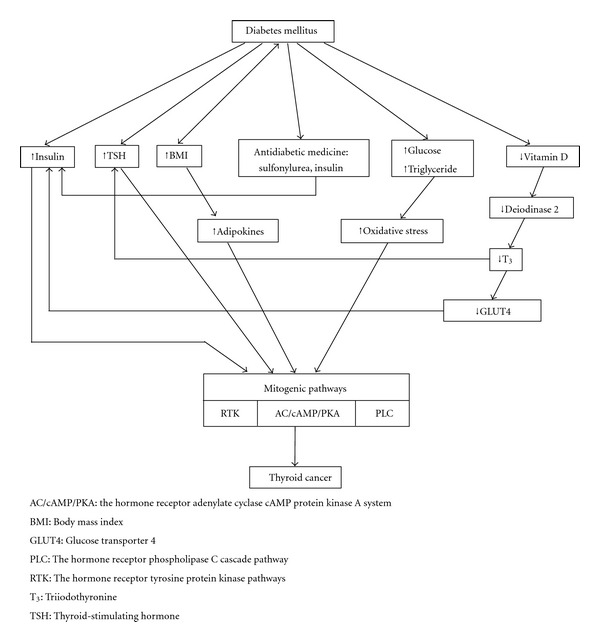
Diabetic patients have a higher risk of various types of cancer. However, whether diabetes may increase the risk of thyroid cancer has not been extensively studied. This paper reviews and summarizes the current literature studying the relationship between diabetes mellitus and thyroid cancer, and the possible mechanisms linking such an association. Epidemiologic studies showed significant or nonsignificant increases in thyroid cancer risk in diabetic women and nonsignificant increase or no change in thyroid cancer risk in diabetic men. A recent pooled analysis, including 5 prospective studies from the USA, showed that the summary hazard ratio (95% confidence interval) for women was 1.19 (0.84-1.69) and was 0.96 (0.65-1.42) for men. Therefore, the results are controversial and the association between diabetes and thyroid cancer is probably weak. Further studies are necessary to confirm their relationship. Proposed mechanisms for such a possible link between diabetes and thyroid cancer include elevated levels of thyroid-stimulating hormone, insulin, glucose and triglycerides, insulin resistance, obesity, vitamin D deficiency, and antidiabetic medications such as insulin or sulfonylureas.
糖尿病患者患各类癌症的风险更高。然而,糖尿病是否会增加甲状腺癌的风险尚未得到广泛研究。本文回顾并总结了当前研究糖尿病与甲状腺癌关系的文献,以及这种关联的可能机制。流行病学研究表明,糖尿病女性患甲状腺癌的风险显著或不显著增加,而糖尿病男性患甲状腺癌的风险不显著增加或无变化。最近一项汇总分析纳入了来自美国的5项前瞻性研究,结果显示,女性的汇总风险比(95%置信区间)为1.19(0.84 - 1.69),男性为0.96(0.65 - 1.42)。因此,结果存在争议,糖尿病与甲状腺癌之间的关联可能较弱。需要进一步研究来证实它们之间的关系。糖尿病与甲状腺癌之间这种可能联系的推测机制包括促甲状腺激素、胰岛素、葡萄糖和甘油三酯水平升高、胰岛素抵抗、肥胖、维生素D缺乏以及胰岛素或磺脲类等抗糖尿病药物。