Department of Neurology, Severance Biomedical Science Institute, Yonsei University College of Medicine, Seoul, Korea.
J Clin Neurol. 2012 Jun;8(2):116-22. doi: 10.3988/jcn.2012.8.2.116. Epub 2012 Jun 29.
The blood supply to the medulla oblongata is distinct from that of other areas of the brainstem, and thus the mechanism underlying medullary infarctions may be distinct. However, few studies have investigated this.
Of 3833 stroke patients who were on the stroke registry between February 1999 and April 2008, those with medullary infarctions demonstrated on diffusion-weighted magnetic resonance imaging were enrolled. We analyzed the topography, the involved arterial territories, and the etiologic mechanisms of the lesions.
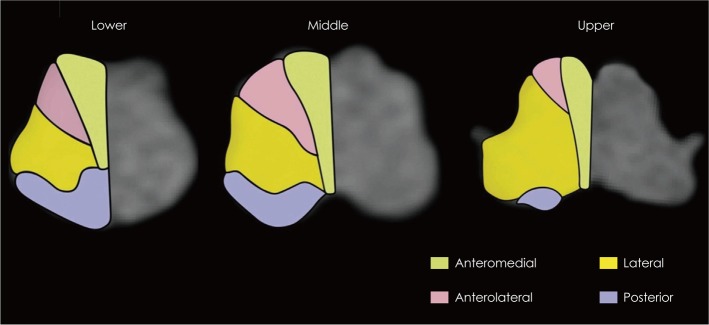
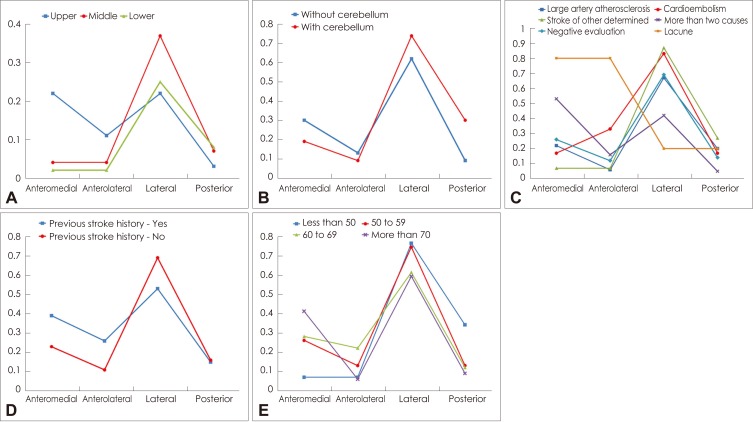
In total, 142 patients were enrolled in the study. Bilateral medullary infarctions were rare (2.2%). Lesions involving the anteromedial or lateral territories were common in the upper medulla oblongata, whereas lateral territorial involvements were common in the middle and lower regions of the medulla oblongata. Significant stenosis (>50%) or occlusion of the vertebral artery was common (52.2%). Among stroke subtypes, large-artery atherosclerosis was most common (34.5%), while lacunae and cardioembolism were rare (3.5% and 4.2%, respectively). Vertebral artery dissection was frequent. The stroke mechanisms differed with the involved vascular territories. Large-artery atherosclerosis produced lesions in the lateral, anteromedial, and posterior territories. None of the cardioembolisms or other etiologies involved anteromedial or anterolateral territories, but all involved the lateral and/or posterior territories. Lacunar infarction was found only in the anteromedial and anterolateral territories.
The topography and mechanisms of infarctions involving the medulla oblongata are different with the involved arterial territories. These findings may be associated with the distinct pattern of arterial supply to the medulla oblongata.
延髓的血液供应与脑桥等其他脑区不同,因此延髓梗死的机制可能也不同。然而,很少有研究对此进行探讨。
在 1999 年 2 月至 2008 年 4 月期间登记在脑卒中登记处的 3833 例脑卒中患者中,纳入了弥散加权磁共振成像显示有延髓梗死的患者。我们分析了病变的部位、涉及的动脉供血区和发病机制。
共纳入 142 例患者。双侧延髓梗死少见(2.2%)。延髓上部前内侧或外侧区病变常见,而中下部病变常见于外侧区。椎动脉明显狭窄(>50%)或闭塞常见(52.2%)。在脑卒中亚型中,大动脉粥样硬化最常见(34.5%),而腔隙性梗死和心源性栓塞少见(分别为 3.5%和 4.2%)。椎动脉夹层较常见。脑卒中机制与受累血管供血区不同。大动脉粥样硬化可导致外侧、前内侧和后内侧区病变。心源性栓塞或其他病因均不累及前内侧或前外侧区,但均累及外侧和/或后内侧区。腔隙性梗死仅见于前内侧和前外侧区。
延髓梗死的部位和机制与受累动脉供血区不同。这些发现可能与延髓独特的动脉供血模式有关。