Institute of Ocean Sciences, Sidney, British Columbia, Canada.
PLoS One. 2012;7(7):e40295. doi: 10.1371/journal.pone.0040295. Epub 2012 Jul 6.
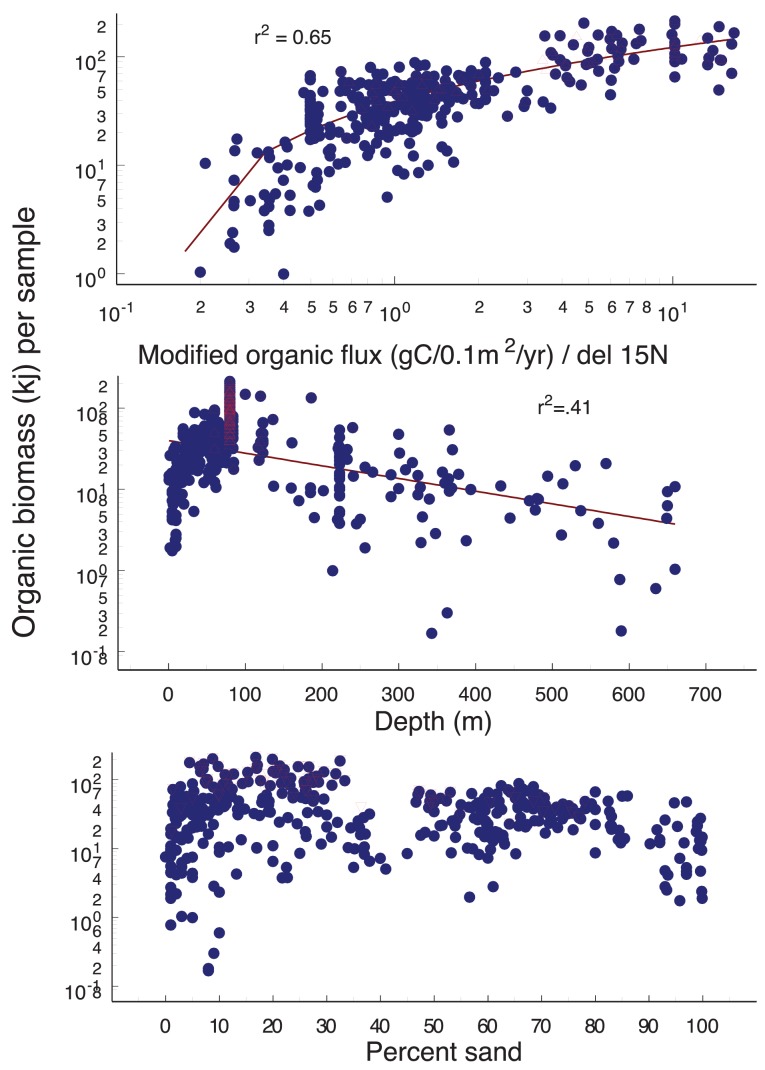
Detailed knowledge of environmental conditions is required to understand faunal production in coastal seas with topographic and hydrographic complexity. We test the hypothesis that organic biomass and production of subtidal sediment invertebrates throughout the Strait of Georgia, west coast of Canada, can be predicted by depth, substrate type and organic flux modified to reflect lability and age of material. A basin-wide database of biological, geochemical and flux data was analysed using an empirical production/biomass (P/B) model to test this hypothesis. This analysis is unique in the spatial extent and detail of P/B and concurrent environmental measurements over a temperate coastal region. Modified organic flux was the most important predictor of organic biomass and production. Depth and substrate type were secondary modifiers. Between 69-74% of variability in biomass and production could be explained by the combined environmental factors. Organisms <1 mm were important contributors to biomass and production primarily in shallow, sandy sediments, where high P/B values were found despite low organic flux. Low biomass, production, and P/B values were found in the deep, northern basin and mainland fjords, which had silty sediments, low organic flux, low biomass of organisms <1 mm, and dominance by large, slow-growing macrofauna. In the highest organic flux and biomass areas near the Fraser River discharge, production did not increase beyond moderate flux levels. Although highly productive, this area had low P/B. Clearly, food input is insufficient to explain the complex patterns in faunal production revealed here. Additional environmental factors (depth, substrate type and unmeasured factors) are important modifiers of these patterns. Potential reasons for the above patterns are explored, along with a discussion of unmeasured factors possibly responsible for unexplained (30%) variance in biomass and production. We now have the tools for basin-wide first-order estimates of sediment invertebrate production.
详细了解环境条件对于理解地形和水文复杂的沿海海域的动物区系生产力至关重要。我们检验了一个假设,即通过深度、底物类型和反映物质的可变性和年龄的有机通量来修正,可以预测加拿大西海岸乔治亚海峡整个海峡的潮间带沉积物无脊椎动物的有机生物量和生产力。利用生物、地球化学和通量数据的盆地范围数据库,使用经验生产/生物量(P/B)模型来测试这一假设。这种分析在空间范围和对温带沿海地区的 P/B 和并发环境测量的细节方面是独一无二的。修正后的有机通量是有机生物量和生产力的最重要预测因子。深度和底物类型是次要修正因子。在生物量和生产力方面,有 69-74%的可变性可以用综合环境因素来解释。<1 毫米的生物体是生物量和生产力的重要贡献者,主要存在于浅沙沉积物中,尽管有机通量低,但仍发现高 P/B 值。在深而北部的盆地和大陆峡湾中,生物量、生产力和 P/B 值较低,那里有淤泥沉积物、低有机通量、<1 毫米的生物体生物量低,以及大型、生长缓慢的大型动物占主导地位。在弗雷泽河排放口附近有机通量和生物量最高的地区,生产力并没有在中等通量水平之上增加。尽管生产力很高,但该地区的 P/B 较低。显然,食物输入不足以解释这里揭示的动物区系生产力的复杂模式。其他环境因素(深度、底物类型和未测量的因素)是这些模式的重要修正因子。本文探讨了这些模式的潜在原因,并讨论了可能导致生物量和生产力无法解释(30%)方差的未测量因素。我们现在有了用于盆地范围的第一级沉积物无脊椎动物生产力估计的工具。