Jamal Al-Bishri, Salma Al-Harthi, Wafa Al-Sofiani, Ghadah Almutairi, Roaa Alosaimi
Department of internal Medicine, Taif University, Taif, PO BOx 11153, Saudi Arabia.
Clin Med Insights Arthritis Musculoskelet Disord. 2012;5:53-7. doi: 10.4137/CMAMD.S9803. Epub 2012 May 31.
To determine the appropriateness (both indications and adequate dosage regimen via creatinine clearance estimation) of allopurinol by physicians of different specialties in a tertiary care centre.
In this cross sectional study computerized clinical records of 156 adult patients who were prescribed allopurinol from 12th November to 11th December, 2011 were retrieved from Al Hada Hospital Taif Saudi Arabia. Main outcome variables were approprsiate indications of allopurinol, prescribing physician's specialty, and dosage of allopurinol. The prescribed dosages were categorized into correct and incorrect dose adjustments based on creatinine clearance estimation. The SPSS version 16 was utilized for data analyses.
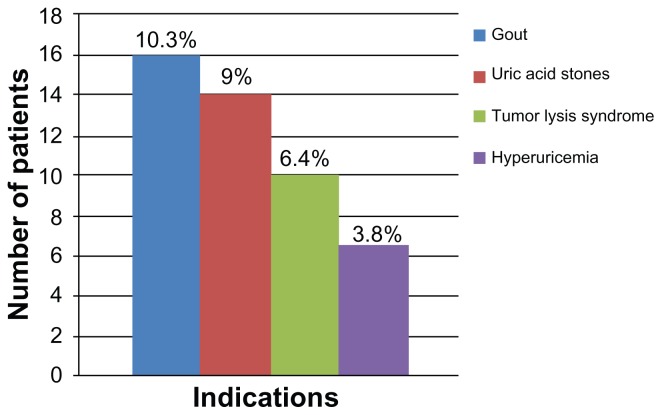
The mean (±SD) age was 58.15 (±14.99) years. There were 105 (67.3%) males and 51 (32.7%) females with male to female ratio being 2:1. Allopurinol was frequently prescribed by nephrologists and family physicians in this study. Out of 156 patients, 46 (29.5%) patients received allopurinol with appropriate indications. Eighty-five (54.5%) patients were received allopurinol without dose adjustment based on their creatinine clearance estimation; among them, 21 (13.5%) received allopurinol with appropriate indications.
The inappropriate use of allopurinol (both the indication and prescribed dosage) is still a major problem in a large tertiary care centre. Furthermore, the specialty of physicians is also a contributory factor in this inappropriateness.
确定三级医疗中心不同专科医生使用别嘌醇的合理性(包括适应证以及通过肌酐清除率估算确定合适的给药方案)。
在这项横断面研究中,从沙特阿拉伯塔伊夫市哈达医院检索了2011年11月12日至12月11日期间开具别嘌醇处方的156例成年患者的计算机化临床记录。主要观察变量为别嘌醇的适当适应证、开处方医生的专科以及别嘌醇的剂量。根据肌酐清除率估算,将规定剂量分为正确和错误的剂量调整。使用SPSS 16版进行数据分析。
平均(±标准差)年龄为58.15(±14.99)岁。有105例(67.3%)男性和51例(32.7%)女性,男女比例为2:1。在本研究中,肾病科医生和家庭医生经常开具别嘌醇。在156例患者中,46例(29.5%)患者使用别嘌醇的适应证适当。85例(54.5%)患者在未根据肌酐清除率估算进行剂量调整的情况下接受了别嘌醇治疗;其中,21例(13.5%)患者使用别嘌醇的适应证适当。
在大型三级医疗中心,别嘌醇的不恰当使用(包括适应证和规定剂量)仍然是一个主要问题。此外,医生的专科也是导致这种不恰当使用的一个因素。