Ebner Natalie C, Johnson Marcia K, Fischer Håkan
Department of Psychology, University of Florida Gainesville, FL, USA.
Front Psychol. 2012 Jul 11;3:223. doi: 10.3389/fpsyg.2012.00223. eCollection 2012.
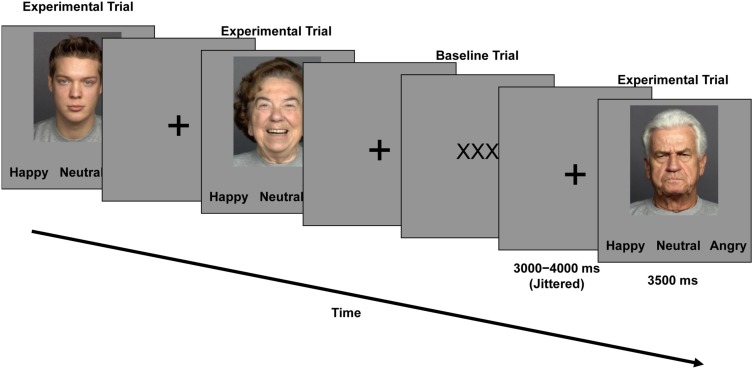
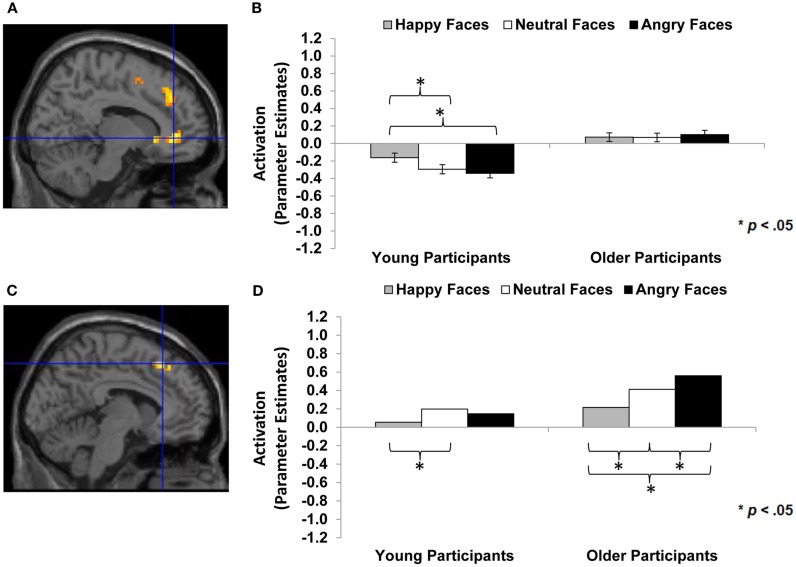
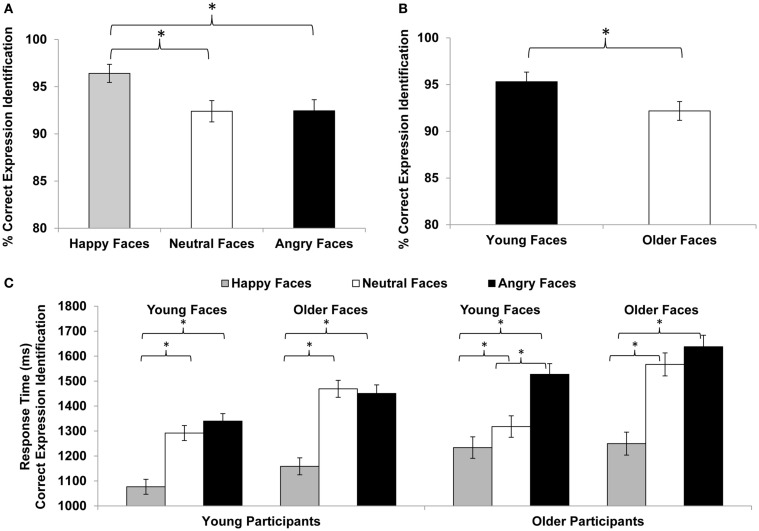
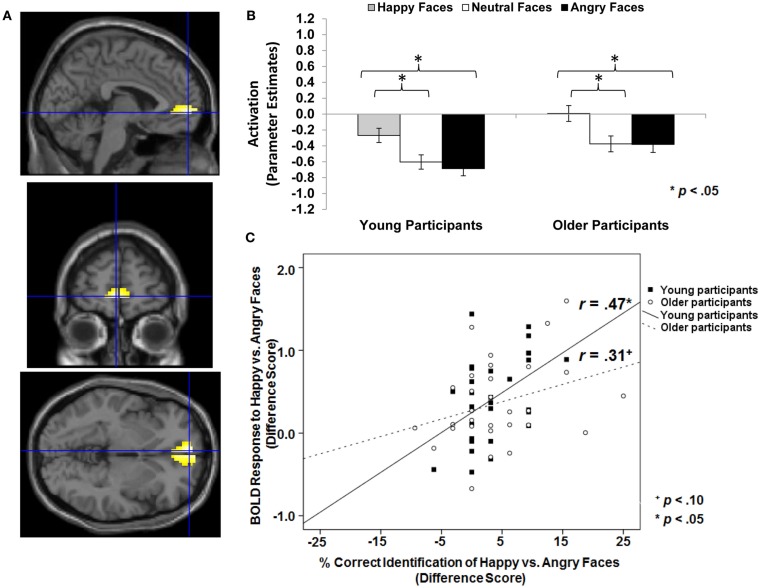
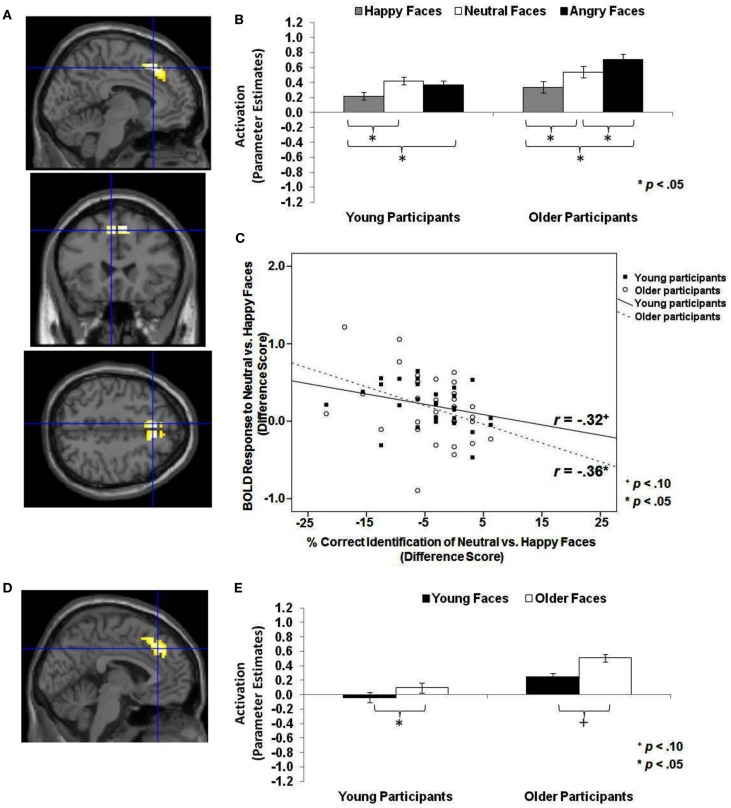
The ability to read and appropriately respond to emotions in others is central for successful social interaction. Young and older adults are better at identifying positive than negative facial expressions and also expressions of young than older faces. Little, however, is known about the neural processes associated with reading different emotions, particularly in faces of different ages, in samples of young and older adults. During fMRI, young and older participants identified expressions in happy, neutral, and angry young and older faces. The results suggest a functional dissociation of ventromedial prefrontal cortex (vmPFC) and dorsomedial prefrontal cortex (dmPFC) in reading facial emotions that is largely comparable in young and older adults: Both age groups showed greater vmPFC activity to happy compared to angry or neutral faces, which was positively correlated with expression identification for happy compared to angry faces. In contrast, both age groups showed greater activity in dmPFC to neutral or angry than happy faces which was negatively correlated with expression identification for neutral compared to happy faces. A similar region of dmPFC showed greater activity for older than young faces, but no brain-behavior correlations. Greater vmPFC activity in the present study may reflect greater affective processing involved in reading happy compared to neutral or angry faces. Greater dmPFC activity may reflect more cognitive control involved in decoding and/or regulating negative emotions associated with neutral or angry than happy, and older than young, faces.
读懂他人情绪并做出恰当反应的能力是成功社交互动的核心。年轻人和老年人在识别积极面部表情方面比消极面部表情更擅长,并且在识别年轻人的面部表情方面比老年人的面部表情更擅长。然而,对于年轻人和老年人样本中与解读不同情绪相关的神经过程,尤其是不同年龄面部的神经过程,人们了解甚少。在功能磁共振成像(fMRI)过程中,年轻和年长的参与者识别年轻和年长的快乐、中性和愤怒面部的表情。结果表明,腹内侧前额叶皮层(vmPFC)和背内侧前额叶皮层(dmPFC)在解读面部情绪方面存在功能分离,这在年轻人和老年人中大致相当:与愤怒或中性面孔相比,两个年龄组在看到快乐面孔时vmPFC的活动都更强,这与快乐面孔相对于愤怒面孔的表情识别呈正相关。相比之下,与快乐面孔相比,两个年龄组在看到中性或愤怒面孔时dmPFC的活动比看到快乐面孔时更强,这与中性面孔相对于快乐面孔的表情识别呈负相关。dmPFC的一个类似区域在看到年长面孔时比看到年轻面孔时活动更强,但不存在脑-行为相关性。本研究中vmPFC更强的活动可能反映出与解读快乐面孔相比,解读中性或愤怒面孔时涉及更多的情感加工。dmPFC更强的活动可能反映出在解码和/或调节与中性或愤怒(而非快乐)以及年长(而非年轻)面孔相关的负面情绪时涉及更多的认知控制。