Centre for Computational Systems Biology and School of Mathematical Sciences, Fudan University, Shanghai, China.
Neuroimage. 2012 Nov 1;63(2):858-73. doi: 10.1016/j.neuroimage.2012.07.012. Epub 2012 Jul 16.
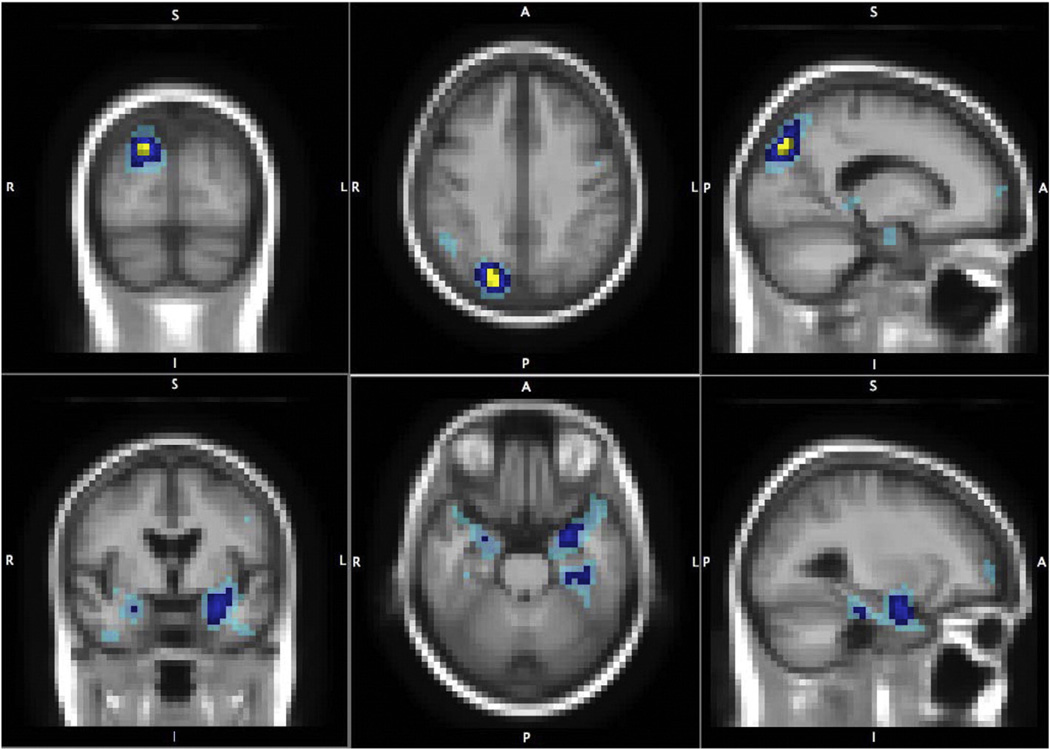
Imaging traits are thought to have more direct links to genetic variation than diagnostic measures based on cognitive or clinical assessments and provide a powerful substrate to examine the influence of genetics on human brains. Although imaging genetics has attracted growing attention and interest, most brain-wide genome-wide association studies focus on voxel-wise single-locus approaches, without taking advantage of the spatial information in images or combining the effect of multiple genetic variants. In this paper we present a fast implementation of voxel- and cluster-wise inferences based on the random field theory to fully use the spatial information in images. The approach is combined with a multi-locus model based on least square kernel machines to associate the joint effect of several single nucleotide polymorphisms (SNP) with imaging traits. A fast permutation procedure is also proposed which significantly reduces the number of permutations needed relative to the standard empirical method and provides accurate small p-value estimates based on parametric tail approximation. We explored the relation between 448,294 single nucleotide polymorphisms and 18,043 genes in 31,662 voxels of the entire brain across 740 elderly subjects from the Alzheimer's disease neuroimaging initiative (ADNI). Structural MRI scans were analyzed using tensor-based morphometry (TBM) to compute 3D maps of regional brain volume differences compared to an average template image based on healthy elderly subjects. We find method to be more sensitive compared with voxel-wise single-locus approaches. A number of genes were identified as having significant associations with volumetric changes. The most associated gene was GRIN2B, which encodes the N-methyl-d-aspartate (NMDA) glutamate receptor NR2B subunit and affects both the parietal and temporal lobes in human brains. Its role in Alzheimer's disease has been widely acknowledged and studied, suggesting the validity of the approach. The various advantages over existing approaches indicate a great potential offered by this novel framework to detect genetic influences on human brains.
影像学特征与遗传变异的联系比基于认知或临床评估的诊断措施更为直接,并为研究遗传对人类大脑的影响提供了有力的基础。尽管影像遗传学引起了越来越多的关注和兴趣,但大多数全脑基因组范围的关联研究都集中在体素单基因方法上,没有利用图像中的空间信息或结合多个遗传变异的效应。在本文中,我们提出了一种快速实现基于随机场理论的体素和聚类推断的方法,以充分利用图像中的空间信息。该方法与基于最小二乘核机器的多基因模型相结合,将几个单核苷酸多态性(SNP)的联合效应与影像学特征相关联。还提出了一种快速置换程序,与标准经验方法相比,大大减少了置换次数,并基于参数尾逼近提供了准确的小 p 值估计。我们探索了在来自阿尔茨海默病神经影像学倡议(ADNI)的 740 名老年受试者的整个大脑的 31662 个体素中,448294 个单核苷酸多态性和 18043 个基因之间的关系。使用基于张量的形态测量学(TBM)分析结构磁共振成像扫描,以基于健康老年受试者的平均模板图像计算区域脑容量差异的 3D 图谱。与体素单基因方法相比,我们发现该方法更敏感。确定了一些与体积变化有显著关联的基因。最相关的基因是 GRIN2B,它编码 N-甲基-D-天冬氨酸(NMDA)谷氨酸受体 NR2B 亚基,并且影响人类大脑的顶叶和颞叶。其在阿尔茨海默病中的作用已得到广泛认可和研究,表明该方法的有效性。与现有方法相比,该方法具有多种优势,这表明该新框架在检测遗传对人类大脑的影响方面具有很大的潜力。