Department of Medicine, University of Chicago, Chicago, IL, USA.
Sex Transm Dis. 2012 Aug;39(8):598-604. doi: 10.1097/OLQ.0b013e3182515cee.
In the United States, black men who have sex with men (BMSM) are at highest risk for HIV infection and are at high risk for limited health service utilization. We describe HIV health center (HHC) affiliation network patterns and their potential determinants among urban BMSM.
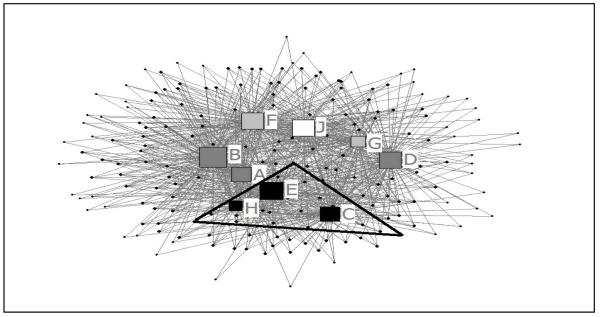
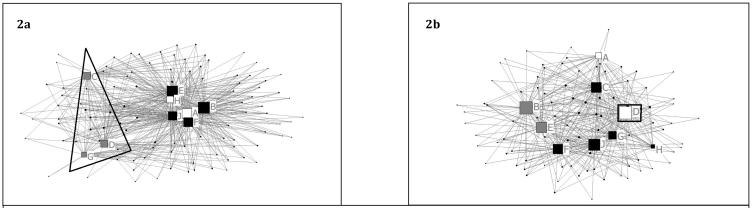
The Men's Assessment of Social and Risk Network instrument was used to elicit HHC utilization, as reported by study respondents recruited through respondent-driven sampling. In 2010, 204 BMSM were systematically recruited from diverse venues in Chicago, IL. A 2-mode data set was constructed that included study participants and 9 diverse HHCs. Associations between individual-level characteristics and HHC utilization were analyzed using Multiple Regression Quadratic Assignment Procedure. Visualization analyses included computation of HHC centrality and faction membership.
High utilization of HHCs (45.9%-70.3%) was evident among BMSM, 44.4% who were HIV infected. Multiple Regression Quadratic Assignment Procedure revealed that age, social network size, and HIV status were associated with HHC affiliation patterns (coeff., 0.13-0.27; all P < 0.05). With the exception of one HHC, HHCs offering HIV prevention services to HIV-infected participants occupied peripheral positions within the network of health centers. High-risk HIV-uninfected participants affiliated most with an HHC that offers only treatment services.
Subcategories of BMSM in this sample affiliated with HHCs that may not provide appropriate HIV prevention services. Using 2-mode data, public health authorities may be better able to match prevention services to BMSM need; in particular, HIV prevention services for high-risk HIV-uninfected men and HIV "prevention for positives" services for HIV-infected men.
在美国,与男性发生性关系的黑人男性(BMSM)感染艾滋病毒的风险最高,而且他们利用卫生服务的机会也很有限。我们描述了城市 BMSM 中与艾滋病毒保健中心(HHC)有关的网络模式及其潜在决定因素。
使用男性评估社会和风险网络工具来获取研究参与者通过应答者驱动抽样招募时报告的 HHC 利用情况。2010 年,在伊利诺伊州芝加哥的各种场所系统地招募了 204 名 BMSM。构建了一个 2 模式数据集,其中包括研究参与者和 9 个不同的 HHC。使用多元回归二次分配程序分析个体特征与 HHC 利用之间的关联。可视化分析包括计算 HHC 中心性和派别成员。
在 BMSM 中,明显有较高的 HHC 利用率(45.9%-70.3%),其中 44.4%的人感染了艾滋病毒。多元回归二次分配程序显示,年龄、社交网络规模和 HIV 状况与 HHC 隶属关系模式有关(系数为 0.13-0.27;所有 P<0.05)。除了一个 HHC 外,为感染 HIV 的参与者提供艾滋病毒预防服务的 HHC 在卫生中心网络中处于边缘位置。高风险、未感染 HIV 的参与者与仅提供治疗服务的 HHC 关系最密切。
在这个样本中,BMSM 的亚类与 HHC 联系在一起,这些 HHC 可能无法提供适当的艾滋病毒预防服务。使用 2 模式数据,公共卫生当局可能能够更好地将预防服务与 BMSM 的需求相匹配;特别是为高风险、未感染 HIV 的男性提供艾滋病毒预防服务,以及为感染 HIV 的男性提供艾滋病毒“预防即治疗”服务。