Department of Genetics, Harvard Medical School, Boston, Massachusetts 02115, USA.
Nature. 2012 Aug 16;488(7411):370-4. doi: 10.1038/nature11258.
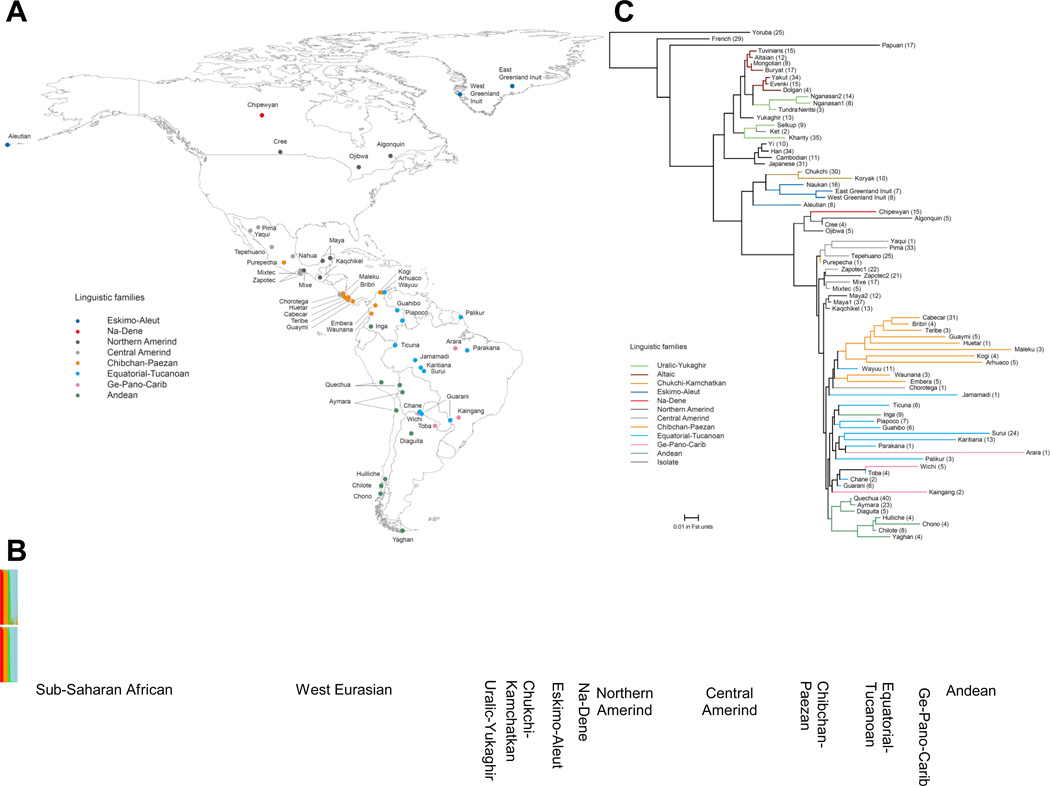
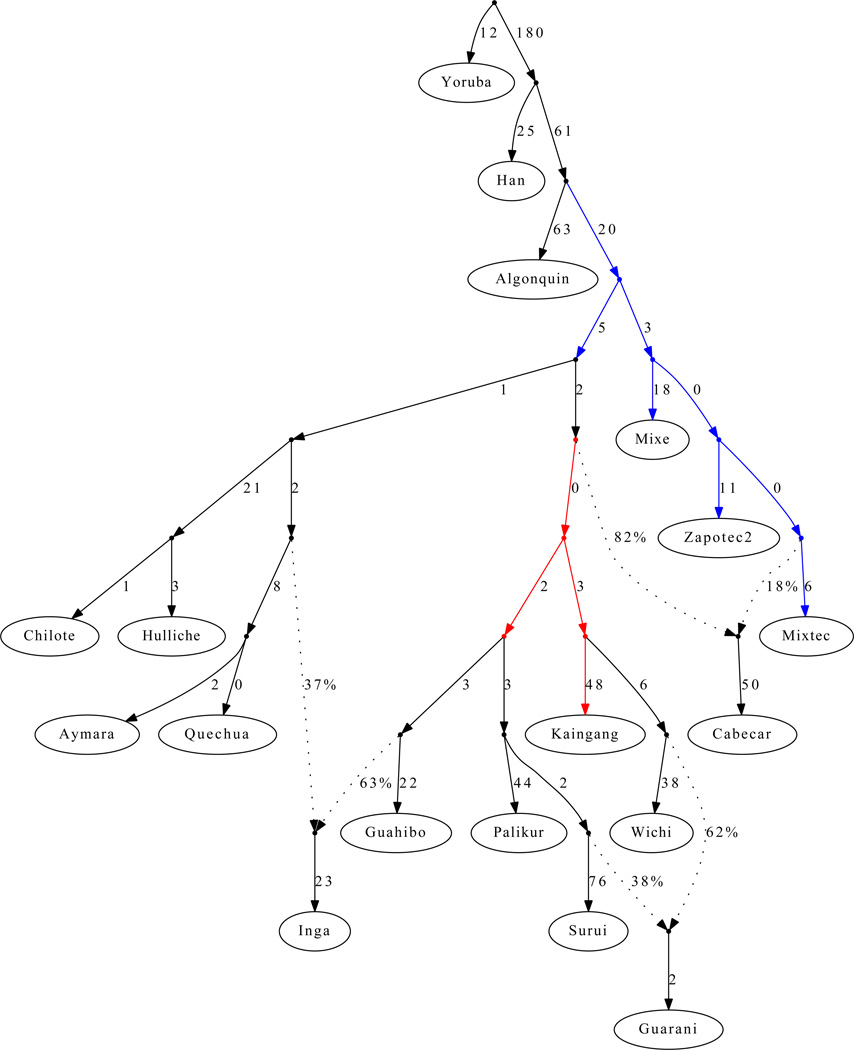
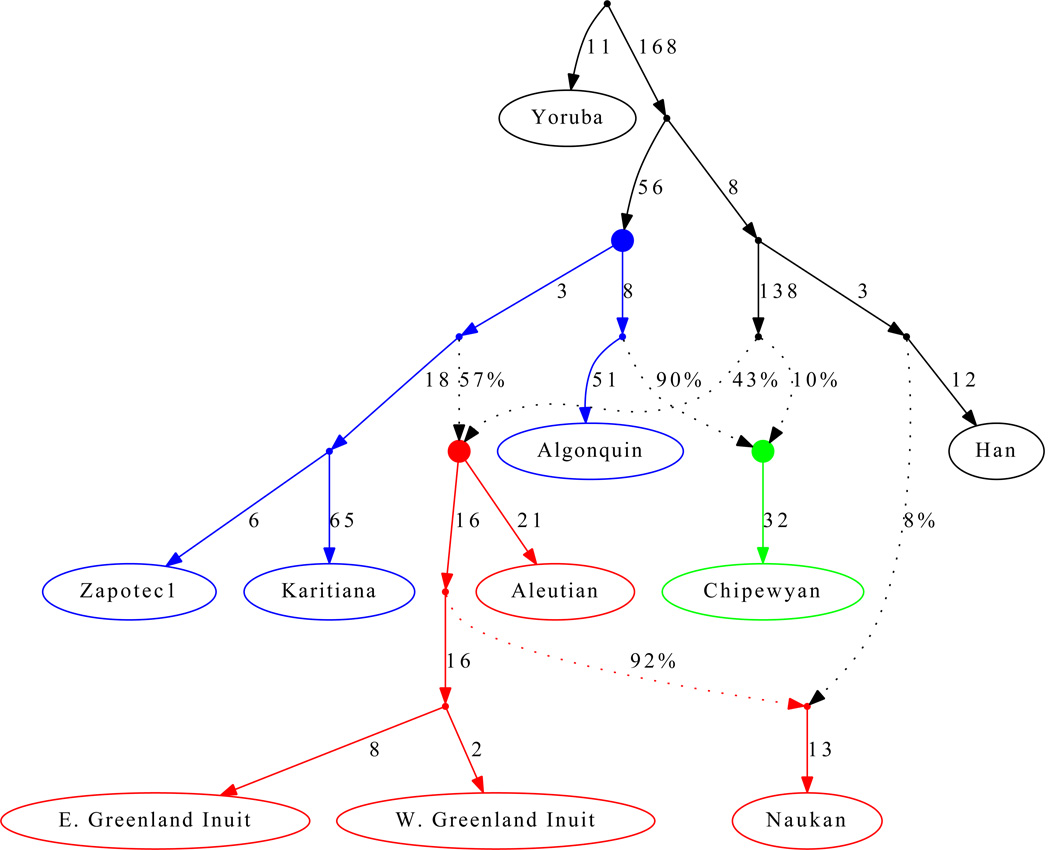
The peopling of the Americas has been the subject of extensive genetic, archaeological and linguistic research; however, central questions remain unresolved. One contentious issue is whether the settlement occurred by means of a single migration or multiple streams of migration from Siberia. The pattern of dispersals within the Americas is also poorly understood. To address these questions at a higher resolution than was previously possible, we assembled data from 52 Native American and 17 Siberian groups genotyped at 364,470 single nucleotide polymorphisms. Here we show that Native Americans descend from at least three streams of Asian gene flow. Most descend entirely from a single ancestral population that we call 'First American'. However, speakers of Eskimo-Aleut languages from the Arctic inherit almost half their ancestry from a second stream of Asian gene flow, and the Na-Dene-speaking Chipewyan from Canada inherit roughly one-tenth of their ancestry from a third stream. We show that the initial peopling followed a southward expansion facilitated by the coast, with sequential population splits and little gene flow after divergence, especially in South America. A major exception is in Chibchan speakers on both sides of the Panama isthmus, who have ancestry from both North and South America.
美洲的人类迁徙一直是遗传学、考古学和语言学研究的主题;然而,一些核心问题仍未得到解决。一个有争议的问题是,定居是通过一次单一的迁徙还是多次从西伯利亚迁徙而来的。美洲内部的迁徙模式也知之甚少。为了以比以往更高的分辨率来解决这些问题,我们从 52 个美洲原住民和 17 个西伯利亚群体中收集了数据,这些群体在 364470 个单核苷酸多态性上进行了基因分型。在这里,我们表明美洲原住民至少有三波亚洲基因流的后裔。大多数人完全来自我们称之为“第一美洲人”的单一祖先群体。然而,来自北极的爱斯基摩-阿留申语族的人继承了近一半的亚洲基因流的血统,而来自加拿大的纳-德内语族的奇佩瓦因人则继承了大约十分之一的亚洲基因流的血统。我们表明,最初的移民是沿着海岸向南扩张的,在分裂后几乎没有基因流,尤其是在南美洲。一个主要的例外是在巴拿马地峡两侧的奇布查语族,他们既有来自北美的血统,也有来自南美的血统。