Department of Surgical Oncology, University Medical Centre Groningen, University of Groningen, PO Box 30.001, 9700 RB, Groningen, The Netherlands.
Eur J Nucl Med Mol Imaging. 2012 Oct;39(10):1592-8. doi: 10.1007/s00259-012-2182-0. Epub 2012 Jul 17.
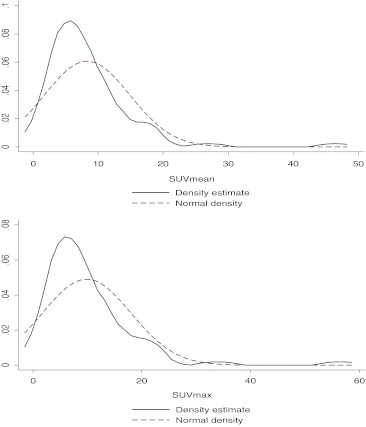
FDG PET/CT is an excellent tool to detect melanoma metastases and also allows quantification of FDG uptake using standardized uptake value (SUV). The aim of this study was to prospectively investigate the potential prognostic value of SUV for disease-free survival (DFS) and disease-specific survival (DSS) for patients with stage IIIB melanoma.
From November 2003 to March 2008, all consecutive patients were included in the present study. Inclusion criteria were: palpable, histology- or cytology-proven lymph node metastases of melanoma, and referred to the University Medical Centre Groningen for FDG PET and CT examination. Patients without distant metastases were evaluated. Multivariable survival analysis was performed to determine whether SUV was associated with DFS and DSS (Cox proportional hazard analysis).
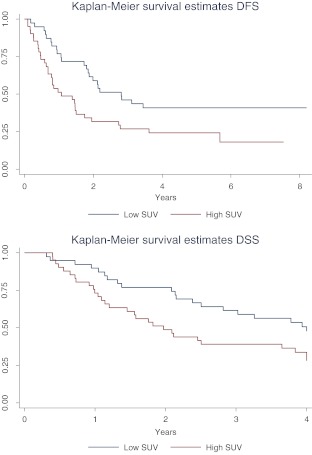
In 80 patients (without distant metastases, 65 %) SUV could be measured. Overall 5-year DFS was 41 % (95% CI 26-56 %) and 24 % (95% CI 12-38 %) in patients with a low and high SUVmean (p = 0.02), respectively. Overall 5-year DSS was 48 % (95% CI 31-62 %) and 30 % (95% CI 17-45 %) in patients with a low and high SUVmean (p = 0.04), respectively. In the multivariable analysis, SUVmean was associated with DFS (hazard ratio 1.7; p = 0.048), but was not associated with DSS (hazard ratio 1.6; p = 0.1). The number of positive nodes, extranodal growth and gender were also associated with survival.
FDG uptake in clinically overt nodal melanoma metastases is inversely associated with DFS. Univariate analysis showed an association with DSS. However, after adjustment for potential confounders this association was no longer significant. If these findings are confirmed in larger studies, SUVmean could potentially be used (in addition to the number of positive nodes, tumour size and extranodal growth) as a factor in deciding on adjuvant systemic treatment.
FDG PET/CT 是一种极好的工具,可用于检测黑色素瘤转移,并且还可以使用标准化摄取值(SUV)来定量 FDG 摄取。本研究的目的是前瞻性研究 SUV 对 IIIB 期黑色素瘤患者无病生存(DFS)和疾病特异性生存(DSS)的潜在预后价值。
从 2003 年 11 月至 2008 年 3 月,所有连续患者均被纳入本研究。纳入标准为:可触及、组织学或细胞学证实的黑色素瘤淋巴结转移,并转至格罗宁根大学医学中心进行 FDG PET 和 CT 检查。评估无远处转移的患者。进行多变量生存分析以确定 SUV 是否与 DFS 和 DSS 相关(Cox 比例风险分析)。
在 80 例(无远处转移,65%)患者中可以测量 SUV。总体而言,5 年 DFS 分别为 41%(95%CI 26-56%)和 24%(95%CI 12-38%),SUVmean 低值和高值患者分别为(p=0.02)。总体而言,5 年 DSS 分别为 48%(95%CI 31-62%)和 30%(95%CI 17-45%),SUVmean 低值和高值患者分别为(p=0.04)。多变量分析显示,SUVmean 与 DFS 相关(危险比 1.7;p=0.048),但与 DSS 无关(危险比 1.6;p=0.1)。阳性淋巴结数量、淋巴结外生长和性别也与生存相关。
临床上明显的淋巴结黑色素瘤转移的 FDG 摄取与 DFS 呈负相关。单变量分析显示与 DSS 相关。然而,在调整潜在混杂因素后,这种相关性不再显著。如果这些发现在更大的研究中得到证实,SUVmean 可能(除了阳性淋巴结数量、肿瘤大小和淋巴结外生长)可作为决定辅助全身治疗的因素之一。