Laboratoire Analyse et Probabilités EA 2172, Université d'Évry-Val-d'Essonne, Evry, France.
PLoS One. 2012;7(7):e39001. doi: 10.1371/journal.pone.0039001. Epub 2012 Jul 3.
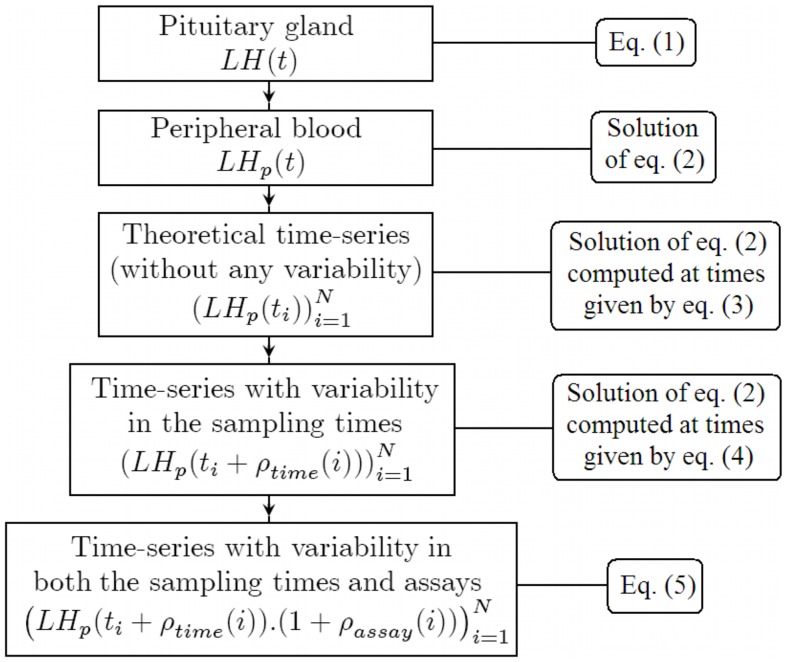
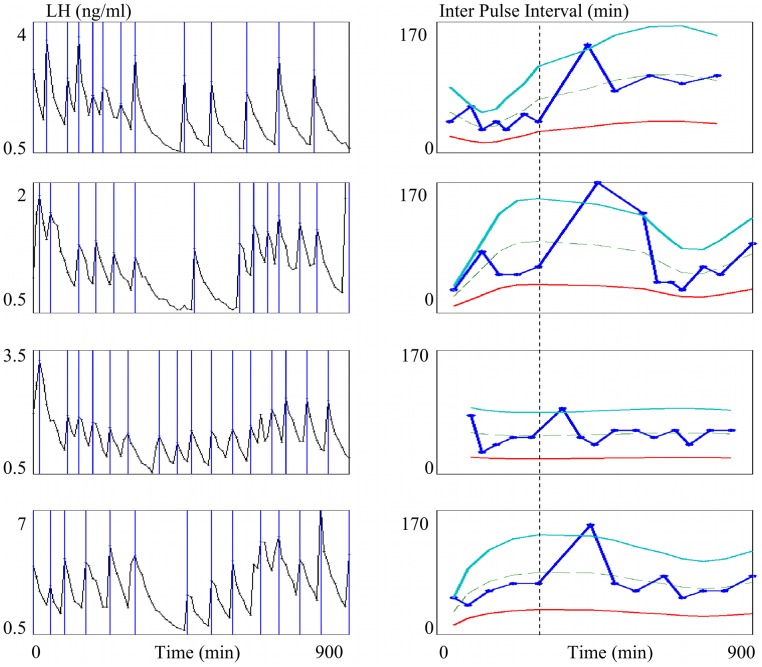
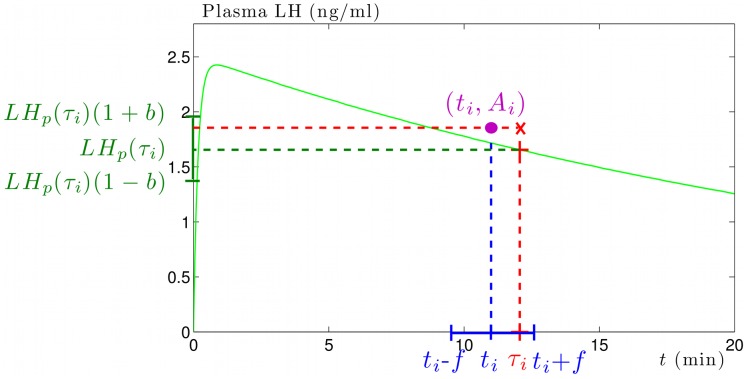
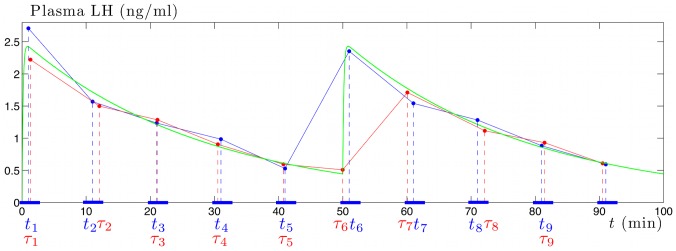
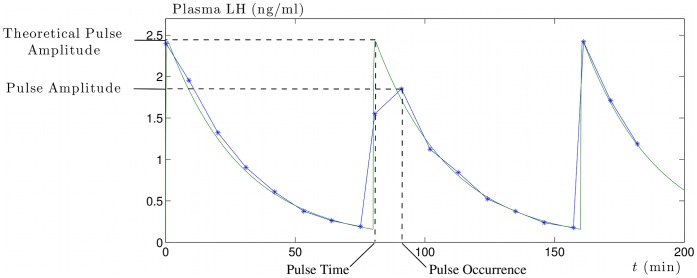
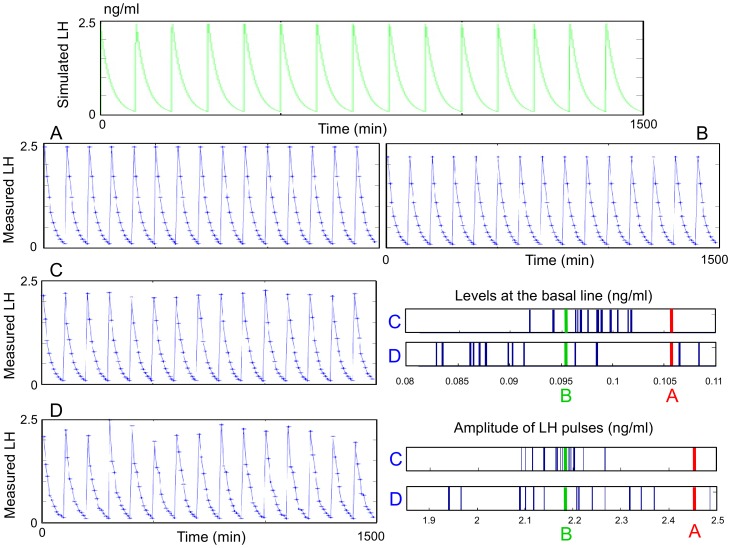
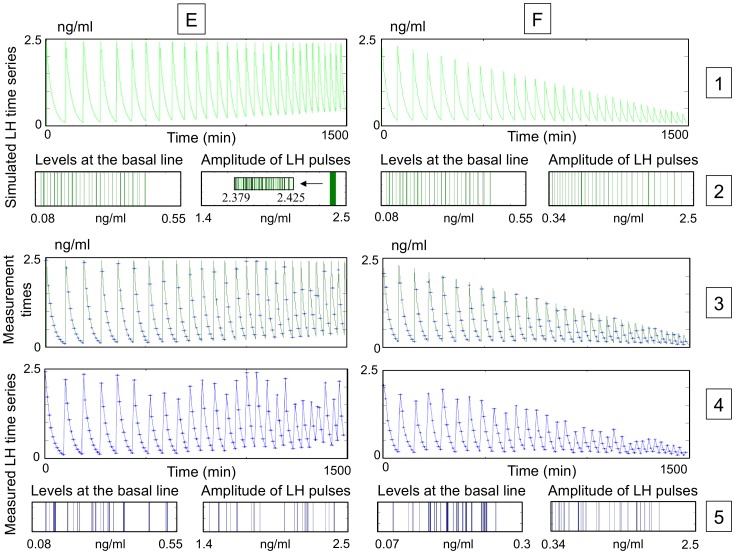
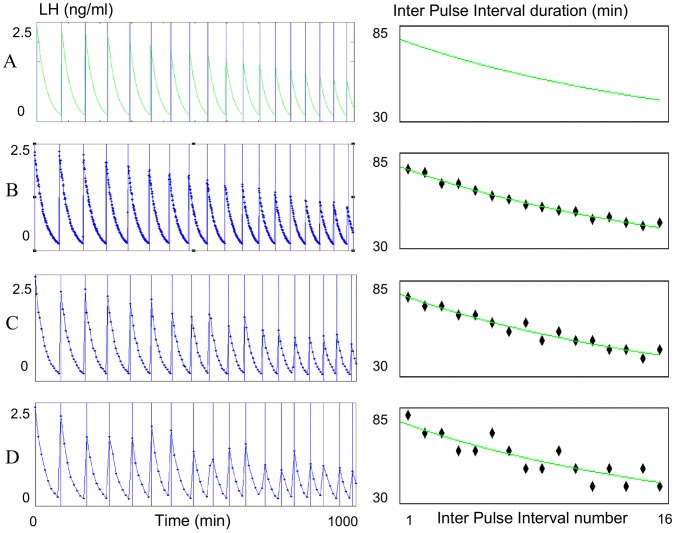
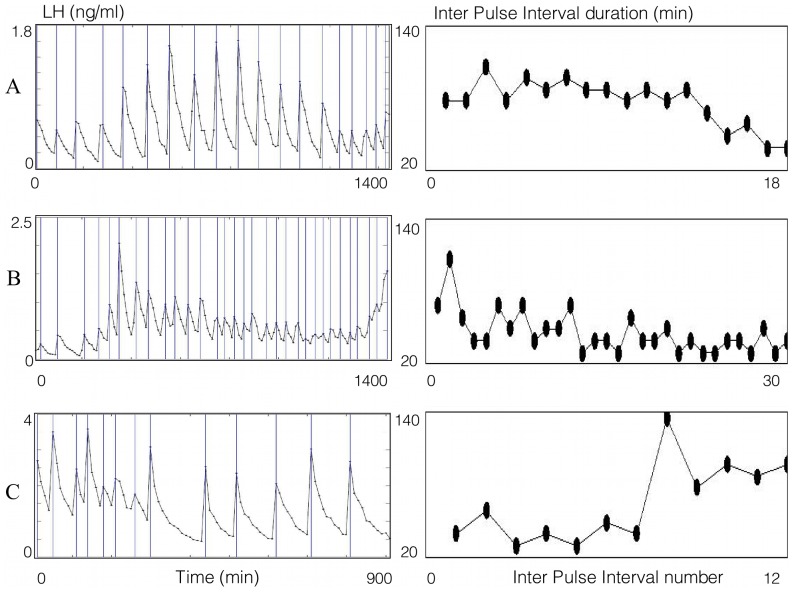
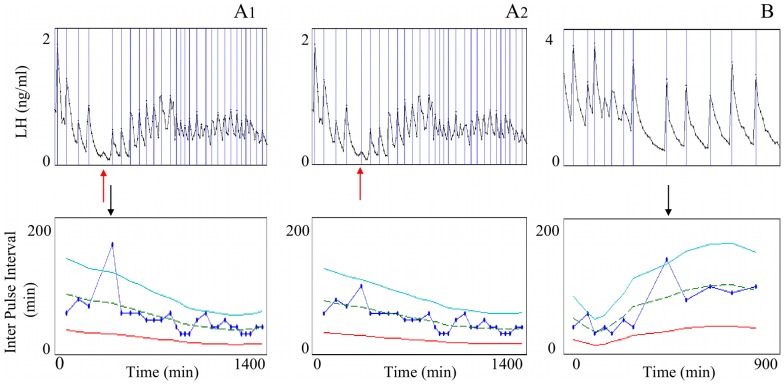
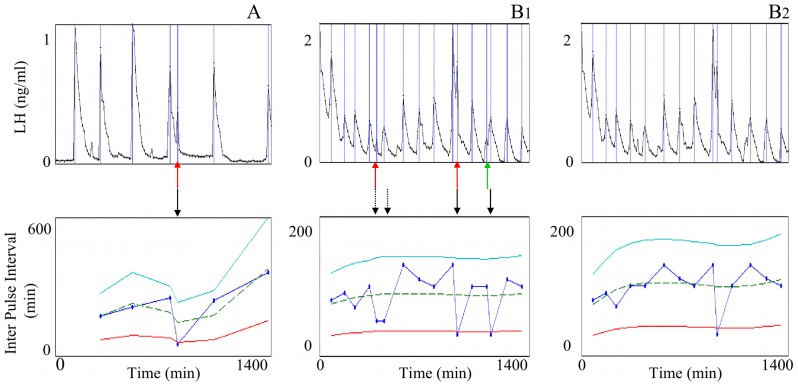
The endocrine control of the reproductive function is often studied from the analysis of luteinizing hormone (LH) pulsatile secretion by the pituitary gland. Whereas measurements in the cavernous sinus cumulate anatomical and technical difficulties, LH levels can be easily assessed from jugular blood. However, plasma levels result from a convolution process due to clearance effects when LH enters the general circulation. Simultaneous measurements comparing LH levels in the cavernous sinus and jugular blood have revealed clear differences in the pulse shape, the amplitude and the baseline. Besides, experimental sampling occurs at a relatively low frequency (typically every 10 min) with respect to LH highest frequency release (one pulse per hour) and the resulting LH measurements are noised by both experimental and assay errors. As a result, the pattern of plasma LH may be not so clearly pulsatile. Yet, reliable information on the InterPulse Intervals (IPI) is a prerequisite to study precisely the steroid feedback exerted on the pituitary level. Hence, there is a real need for robust IPI detection algorithms. In this article, we present an algorithm for the monitoring of LH pulse frequency, basing ourselves both on the available endocrinological knowledge on LH pulse (shape and duration with respect to the frequency regime) and synthetic LH data generated by a simple model. We make use of synthetic data to make clear some basic notions underlying our algorithmic choices. We focus on explaining how the process of sampling affects drastically the original pattern of secretion, and especially the amplitude of the detectable pulses. We then describe the algorithm in details and perform it on different sets of both synthetic and experimental LH time series. We further comment on how to diagnose possible outliers from the series of IPIs which is the main output of the algorithm.
生殖功能的内分泌控制通常通过分析垂体分泌的促黄体生成素(LH)脉冲分泌来研究。虽然海绵窦内的测量存在解剖和技术上的困难,但可以从颈静脉血液中轻松评估 LH 水平。然而,由于 LH 进入体循环时的清除效应,血浆水平的结果是一个卷积过程。同时测量海绵窦和颈静脉血液中的 LH 水平,揭示了脉冲形状、幅度和基线的明显差异。此外,实验采样的频率相对较低(通常每 10 分钟一次),而 LH 释放的最高频率为(每小时一个脉冲),因此 LH 测量值受到实验和测定误差的噪声干扰。因此,血浆 LH 的模式可能不是那么明显的脉冲式。然而,关于 InterPulse Intervals(IPI)的可靠信息是精确研究对垂体水平施加的类固醇反馈的前提。因此,确实需要强大的 IPI 检测算法。在本文中,我们提出了一种用于监测 LH 脉冲频率的算法,该算法基于可用的内分泌学知识,包括 LH 脉冲的形状和持续时间(相对于频率范围)以及简单模型生成的合成 LH 数据。我们使用合成数据来阐明我们算法选择的一些基本概念。我们重点解释采样过程如何严重影响原始分泌模式,特别是可检测脉冲的幅度。然后,我们详细描述了该算法,并将其应用于不同的合成和实验 LH 时间序列。我们进一步评论了如何从算法的主要输出即 IPI 系列中诊断可能的异常值。