EMBL-EBI, Wellcome Trust Genome Campus, Hinxton, Cambridge, United Kingdom.
PLoS Comput Biol. 2012;8(7):e1002554. doi: 10.1371/journal.pcbi.1002554. Epub 2012 Jul 12.
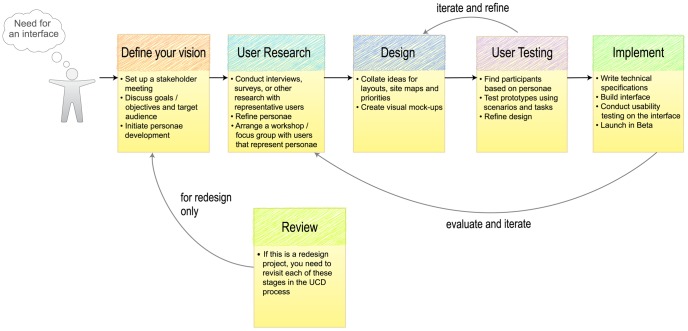
Designers have a saying that "the joy of an early release lasts but a short time. The bitterness of an unusable system lasts for years." It is indeed disappointing to discover that your data resources are not being used to their full potential. Not only have you invested your time, effort, and research grant on the project, but you may face costly redesigns if you want to improve the system later. This scenario would be less likely if the product was designed to provide users with exactly what they need, so that it is fit for purpose before its launch. We work at EMBL-European Bioinformatics Institute (EMBL-EBI), and we consult extensively with life science researchers to find out what they need from biological data resources. We have found that although users believe that the bioinformatics community is providing accurate and valuable data, they often find the interfaces to these resources tricky to use and navigate. We believe that if you can find out what your users want even before you create the first mock-up of a system, the final product will provide a better user experience. This would encourage more people to use the resource and they would have greater access to the data, which could ultimately lead to more scientific discoveries. In this paper, we explore the need for a user-centred design (UCD) strategy when designing bioinformatics resources and illustrate this with examples from our work at EMBL-EBI. Our aim is to introduce the reader to how selected UCD techniques may be successfully applied to software design for bioinformatics.
“提前发布的喜悦转瞬即逝,而无法使用的系统的痛苦却会持续多年。”发现您的数据资源没有充分发挥其潜力确实令人失望。您不仅在项目上投入了时间、精力和研究经费,如果以后想要改进系统,还可能面临昂贵的重新设计。如果产品的设计目的是为用户提供他们真正需要的东西,那么在发布之前使其完全满足需求,这种情况就不太可能发生。我们在欧洲生物信息学研究所(EMBL-EBI)工作,我们广泛咨询生命科学研究人员,以了解他们从生物数据资源中需要什么。我们发现,尽管用户认为生物信息学社区提供的是准确且有价值的数据,但他们经常发现这些资源的界面难以使用和导航。我们相信,如果您甚至在创建系统的第一个原型之前就能够了解用户的需求,那么最终产品将提供更好的用户体验。这将鼓励更多的人使用该资源,他们将更轻松地访问数据,最终可能会带来更多的科学发现。在本文中,我们探讨了在设计生物信息学资源时采用以用户为中心的设计(UCD)策略的必要性,并通过我们在 EMBL-EBI 的工作示例来说明这一点。我们的目标是向读者介绍如何成功地将选定的 UCD 技术应用于生物信息学软件设计。