Clinical and Experimental Therapeutics, College of Pharmacy, University of Georgia, Augusta, Georgia, United States of America.
PLoS One. 2012;7(7):e40594. doi: 10.1371/journal.pone.0040594. Epub 2012 Jul 13.
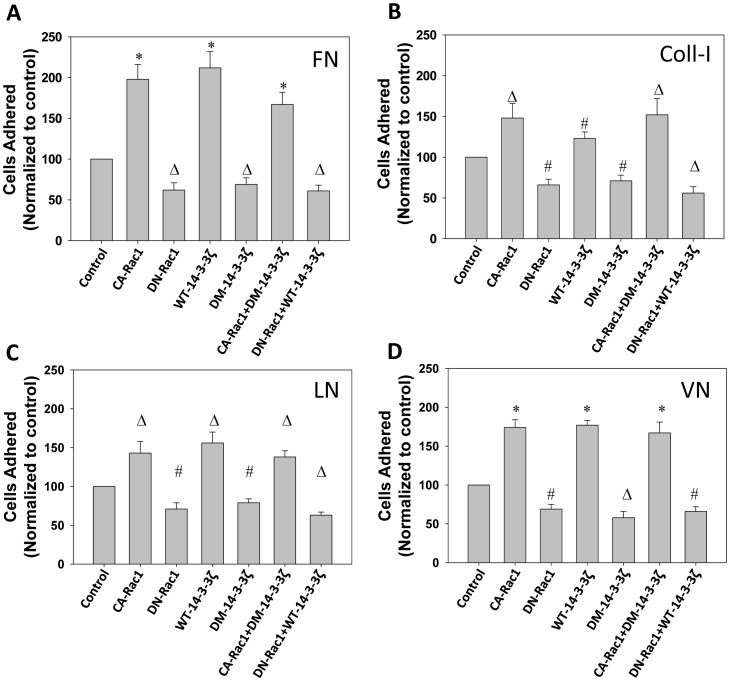
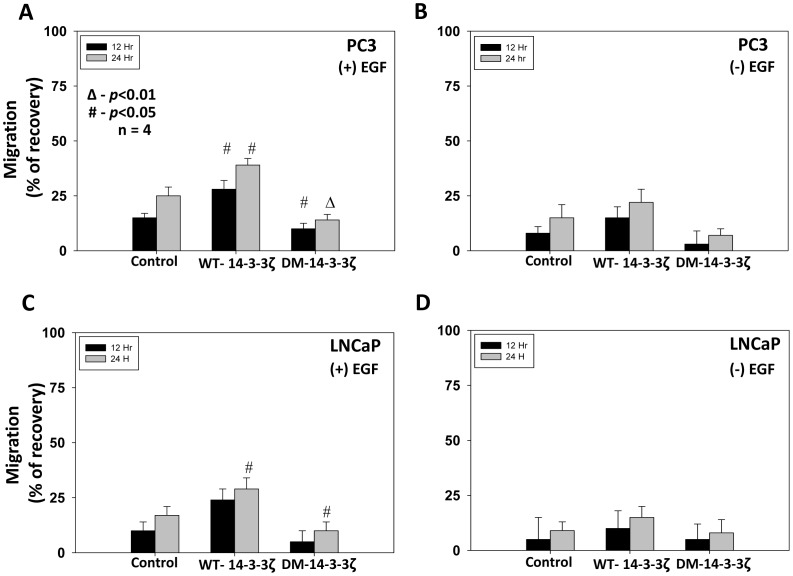
14-3-3 proteins are ubiquitously expressed dimeric adaptor proteins that have emerged as key mediators of many cell signaling pathways in multiple cell types. Its effects are mainly mediated by binding to selective phosphoserine/threonine proteins. The importance of 14-3-3 proteins in cancer have only started to become apparent and its exact role in cancer progression as well as the mechanisms by which 14-3-3 proteins mediate cancer cell function remain unknown. While protein 14-3-3σ is widely accepted as a tumor suppressor, 14-3-3ζ, β and γ isoforms have been shown to have tumor promoting effects. Despite the importance of 14-3-3 family in mediating various cell processes, the exact role and mechanism of 14-3-3ζ remain unexplored. In the current study, we investigated the role of protein 14-3-3ζ in prostate cancer cell motility and transendothelial migration using biochemical, molecular biology and electric cell-substrate impedance sensing approaches as well as cell based functional assays. Our study indicated that expression with wild-type protein 14-3-3ζ significantly enhanced Rac activity in PC3 cells. In contrast, expression of dimer-resistant mutant of protein 14-3-3ζ (DM-14-3-3) inhibited Rac activity and associated phosphorylation of p21 activated kinase-1 and 2. Expression with wild-type 14-3-3ζ or constitutively active Rac1 enhanced extracellular matrix recognition, lamellipodia formation, cell migration and trans-endothelial migration by PC3 cells. In contrast, expression with DM 14-3-3ζ or DN-Rac1 in PC3 cells significantly inhibited these cell functions. Our results demonstrate for the first time that 14-3-3ζ enhances prostate cancer cell-matrix interactions, motility and transendothelial migration in vitro via activation of Rac1-GTPase and is an important target for therapeutic interventions for prostate cancer.
14-3-3 蛋白是普遍表达的二聚体衔接蛋白,作为多种细胞类型中许多细胞信号通路的关键介质而出现。其作用主要通过与选择性磷酸丝氨酸/苏氨酸蛋白结合来介导。14-3-3 蛋白在癌症中的重要性才刚刚开始显现,其在癌症进展中的确切作用以及 14-3-3 蛋白介导癌细胞功能的机制尚不清楚。虽然蛋白 14-3-3σ 被广泛认为是一种肿瘤抑制因子,但 14-3-3ζ、β 和 γ 同工型已被证明具有促进肿瘤的作用。尽管 14-3-3 家族在介导各种细胞过程中具有重要作用,但 14-3-3ζ 的确切作用和机制仍未被探索。在本研究中,我们使用生化、分子生物学和电细胞-底物阻抗传感方法以及基于细胞的功能测定,研究了蛋白 14-3-3ζ 在前列腺癌细胞迁移和跨内皮迁移中的作用。我们的研究表明,野生型蛋白 14-3-3ζ 的表达显著增强了 PC3 细胞中的 Rac 活性。相比之下,二聚体抗性突变蛋白 14-3-3ζ(DM-14-3-3)的表达抑制了 Rac 活性以及 p21 激活激酶-1 和 2 的磷酸化。野生型 14-3-3ζ 或组成型激活 Rac1 的表达增强了 PC3 细胞对细胞外基质的识别、片状伪足的形成、细胞迁移和跨内皮迁移。相比之下,PC3 细胞中 DM 14-3-3ζ 或 DN-Rac1 的表达显著抑制了这些细胞功能。我们的研究结果首次表明,14-3-3ζ 通过激活 Rac1-GTPase 增强了前列腺癌细胞与基质的相互作用、迁移和体外跨内皮迁移,是前列腺癌治疗干预的重要靶点。