Pharmaceutical Outcomes and Policy, College of Pharmacy, Epidemiology, Colleges of Medicine and Public Health and Health Professions, University of Florida, Gainesville, Florida 32611, USA.
BMJ. 2012 Jul 18;345:e4627. doi: 10.1136/bmj.e4627.
To evaluate the cardiac safety of central nervous system stimulants in children and adolescents.
Population based retrospective cohort study.
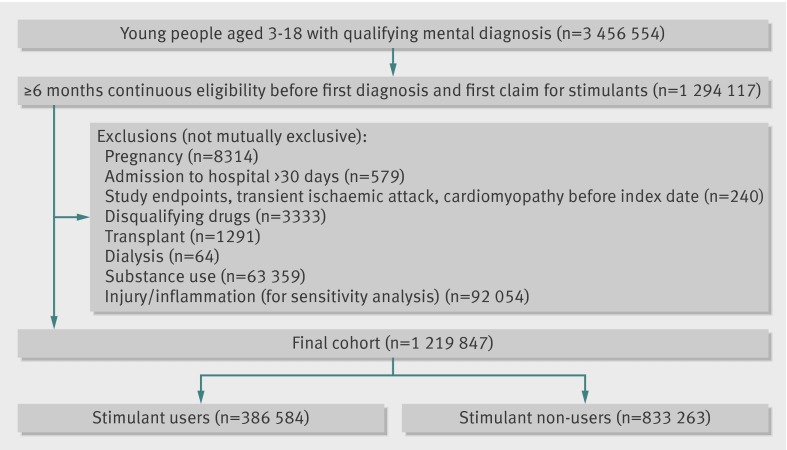
Automated healthcare claims data from 1,219,847 children and young people eligible for 28 state Medicaid programmes from 1999 to 2006 linked to the Social Security Death Master File and the National Death Index.
Children and young people age 3-18 entered the cohort at the first diagnosis of a mental health condition commonly treated with stimulants (such as attention-deficit/hyperactivity disorder) after a minimum period of six months' eligibility and were followed until loss of eligibility, their 19th birthday, admission to hospital for longer than 30 days, or death. Exclusion criteria included transplant recipients, receipt of dialysis, or claims indicating substance misuse. We retained high risk groups with similar use of stimulants as low risk children (such as children with congenital heart disease). Sociodemographic characteristics, cardiac risk factors, and psychiatric diagnoses obtained from before the index period were summarised with a propensity score. We used discrete survival analysis to estimate the relative risk for periods of stimulant use and non-use, adjusted for propensity score and antipsychotic use for the full cohort and the high risk and low risk groups.
Composite endpoint of stroke, acute myocardial infarction, or sudden cardiac death; a secondary composite endpoint added ventricular arrhythmia
A total of 66 (95 including ventricular arrhythmia) events occurred during 2,321,311 years of follow-up. The odds ratio adjusted for propensity score and antipsychotic use for current versus no stimulant use was 0.62 (95% confidence interval 0.27 to 1.44), with a corresponding adjusted incidence rate of 2.2 and 3.5 per 100,000 patient years for current stimulant and non-use, respectively. Twenty six events occurred in high risk patients (incidence rate 63 per 100,000 patient years) with an odds ratio of 1.02 (0.28 to 3.69). Odds ratios for the secondary endpoint were similar to those for the primary endpoint (0.74, 0.38 to 1.46).
Treatment of children with central nervous stimulants is not significantly associated with an increase in the short term risk of severe cardiac events. Analyses cannot be generalised to children with long term use of stimulants. Furthermore, long term effects of slight increases in heart rate or blood pressure are unknown.
评估中枢神经系统兴奋剂在儿童和青少年中的心脏安全性。
基于人群的回顾性队列研究。
来自 1999 年至 2006 年 28 个州医疗补助计划的 1219847 名儿童和年轻人的自动医疗保健索赔数据,与社会保障死亡主文件和国家死亡索引相关联。
3-18 岁的儿童和年轻人在经过至少 6 个月的合格期后,首次被诊断出患有精神健康状况(如注意力缺陷/多动障碍)后进入队列,并接受治疗,直至丧失合格性、19 岁生日、住院超过 30 天或死亡。排除标准包括移植受者、接受透析或表明药物滥用的索赔。我们保留了与低风险儿童(如先天性心脏病儿童)相似的高风险组使用兴奋剂。从索引期之前获得的社会人口统计学特征、心脏危险因素和精神科诊断情况,通过倾向评分进行了总结。我们使用离散生存分析估计了全队列和高风险组和低风险组的兴奋剂使用期和非使用期的相对风险,调整了倾向评分和抗精神病药物的使用。
中风、急性心肌梗死或心源性猝死的综合终点;添加室性心律失常的次要综合终点。
在 2321311 年的随访期间,共发生 66 例(包括室性心律失常 95 例)事件。当前使用与不使用兴奋剂相比,调整倾向评分和抗精神病药物使用后的比值比为 0.62(95%置信区间 0.27 至 1.44),相应的调整发病率分别为当前使用和不使用兴奋剂的患者每年每 10 万人中分别为 2.2 和 3.5 例。26 例事件发生在高危患者(发病率为每 10 万人每年 63 例),比值比为 1.02(0.28 至 3.69)。次要终点的比值比与主要终点相似(0.74,0.38 至 1.46)。
中枢神经系统兴奋剂治疗儿童与短期严重心脏事件风险增加无显著相关性。分析不能推广到长期使用兴奋剂的儿童。此外,心率或血压轻微升高的长期影响尚不清楚。