Laboratorio de Nutrición y Regulación Metabólica, Instituto de Nutrición y Tecnología de los Alimentos (INTA), Universidad de Chile, Casilla 138-11, El Líbano, 5524 Santiago, Chile.
Diabetol Metab Syndr. 2012 Jul 23;4(1):35. doi: 10.1186/1758-5996-4-35.
Environmental conditions in early life can induce permanent physiological changes, sometimes increasing the risk of chronic diseases during adulthood. Neural and peripheral circuits controlling energy balance may be modulated during such a critical period. Since type 1 cannabinoid receptors (CB1R) have recently emerged as targets for modulating energy balance, their premature chronic activation during early life may result in long-term metabolic consequences associated to overweight/obesity. Endogenous activation of CB1R mainly occurs after binding to the endocannabinoid Anandamide (AEA).
To evaluate long-term effects of AEA treatment during lactation on body weight, epididymal fat accumulation and related metabolic parameters during adulthood.
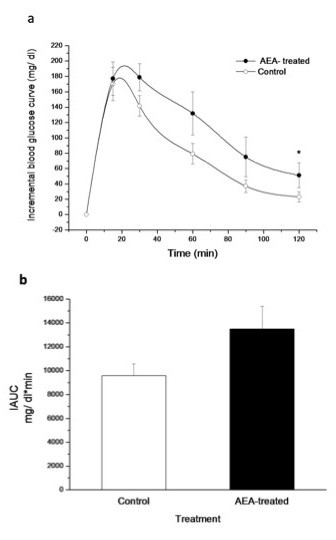
Male mice pups were orally treated with a solution of AEA (20 μg/g body weight in soy oil) or vehicle during the whole lactation period. After weaning, food intake and body weight were recorded every 10 days. Adult animals were subjected to glucose and insulin tolerance tests. Subsequently, animals were sacrificed and epididymal fat pads were extracted. Circulating levels of plasma insulin, leptin, non-sterified fatty acids (NEFA), triglyceride and cholesterol were also evaluated.
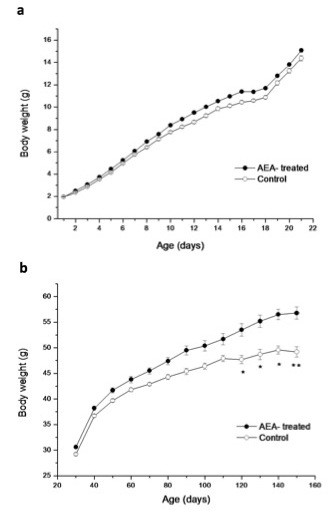
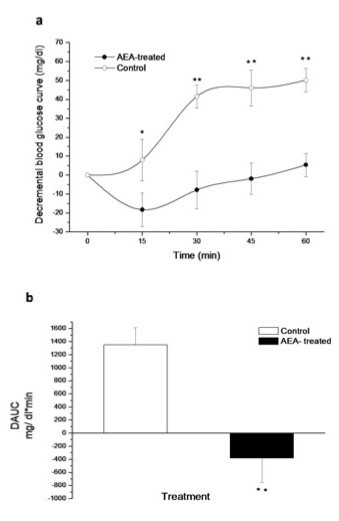
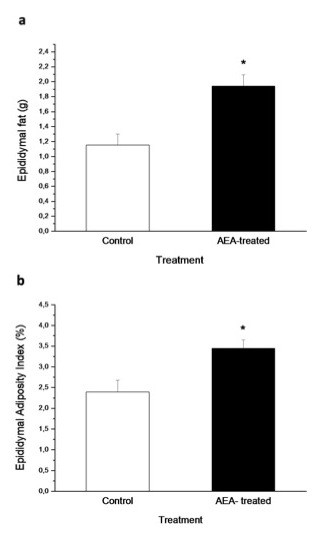
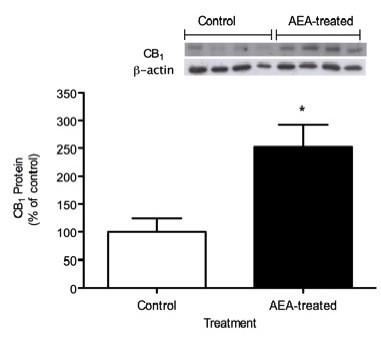
AEA-treated mice during lactation showed a significant increase in accumulated food intake, body weight and epididymal fat during adulthood when compared to control mice. When evaluating CB1R protein expression in epididymal fat, the AEA-treated group showed a 150 % increase in expression compared to the control mice. This group also displayed significantly higher levels of circulating glucose, insulin, leptin, triglycerides, cholesterol and NEFA. Moreover, a marked state of insulin resistance was an important finding in the AEA-treated group.
This study showed that overweight, accumulation of visceral fat and associated metabolic disturbances, such as a higher lipid profile and insulin resistance, can be programmed by a treatment with the endocannabinoid AEA during lactation in adult mice.
生命早期的环境条件会导致永久性的生理变化,有时会增加成年后患慢性疾病的风险。控制能量平衡的神经和外周回路可能会在这样一个关键时期被调节。由于 1 型大麻素受体 (CB1R) 最近被认为是调节能量平衡的靶点,它们在生命早期过早的慢性激活可能会导致与超重/肥胖相关的长期代谢后果。CB1R 的内源性激活主要发生在与内源性大麻素 Anandamide (AEA) 结合之后。
评估哺乳期 AEA 处理对成年后体重、附睾脂肪积累和相关代谢参数的长期影响。
雄性幼鼠在哺乳期通过口服给予 AEA(20μg/g 体重溶于大豆油)或载体溶液。断奶后,每 10 天记录一次食物摄入量和体重。成年动物进行葡萄糖和胰岛素耐量试验。随后,处死动物并提取附睾脂肪垫。还评估了循环血浆胰岛素、瘦素、非酯化脂肪酸 (NEFA)、甘油三酯和胆固醇水平。
与对照组相比,哺乳期接受 AEA 处理的小鼠在成年后表现出明显增加的累积食物摄入量、体重和附睾脂肪。在评估附睾脂肪中的 CB1R 蛋白表达时,AEA 处理组的表达增加了 150%。与对照组相比,该组的循环葡萄糖、胰岛素、瘦素、甘油三酯、胆固醇和 NEFA 水平也明显升高。此外,AEA 处理组还表现出明显的胰岛素抵抗状态。
这项研究表明,超重、内脏脂肪积累以及相关代谢紊乱,如血脂谱升高和胰岛素抵抗,可通过哺乳期给予内源性大麻素 AEA 处理来编程。