Department of Biological Sciences, Simon Fraser University, Burnaby, BC, Canada.
BMC Genomics. 2012 Jul 23;13:333. doi: 10.1186/1471-2164-13-333.
Almost half of the Caenorhabditis elegans genome encodes proteins with either a signal peptide or a transmembrane domain. Therefore a substantial fraction of the proteins are localized to membranes, reside in the secretory pathway or are secreted. While these proteins are of interest to a variety of different researchers ranging from developmental biologists to immunologists, most of secreted proteins have not been functionally characterized so far.
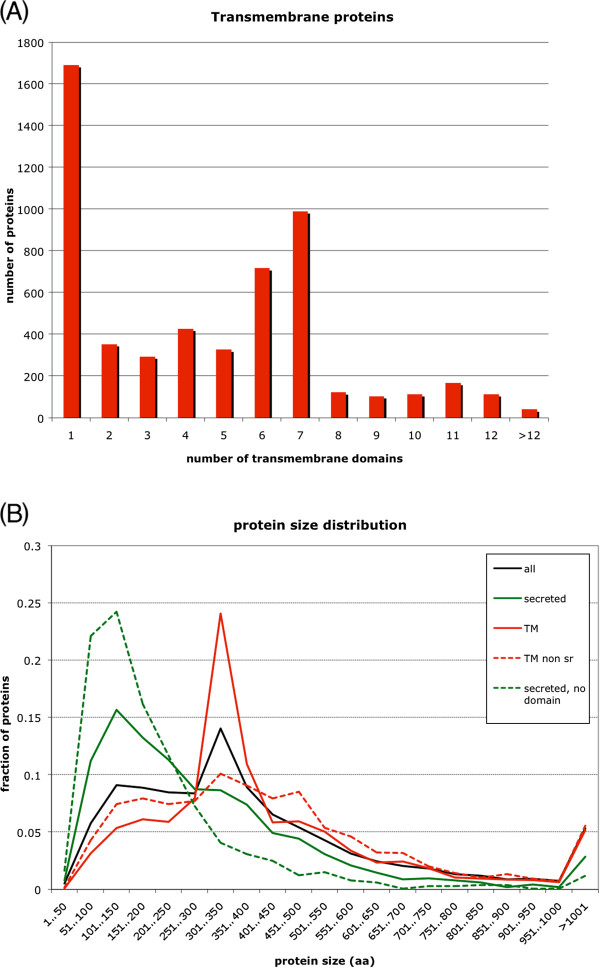
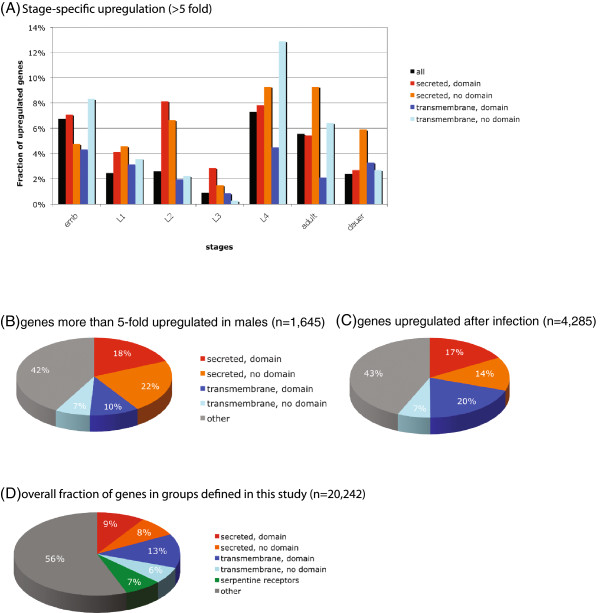
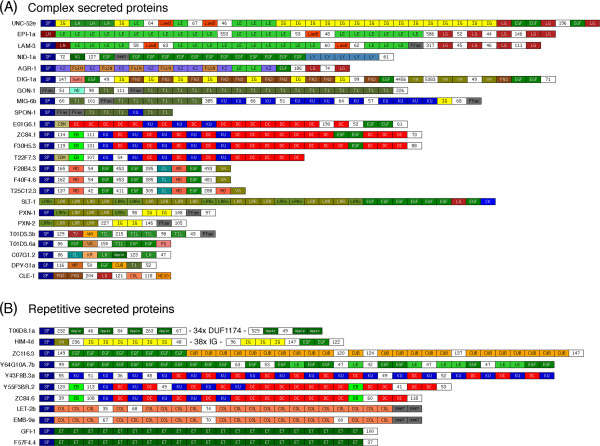
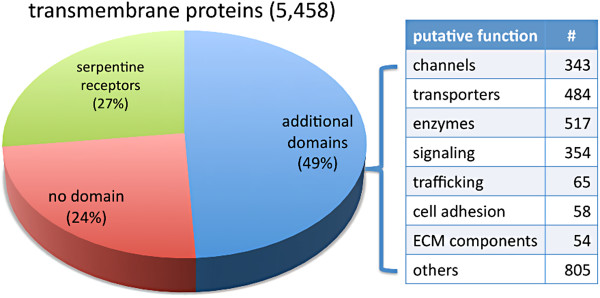
We grouped proteins containing a signal peptide or a transmembrane domain using various criteria including evolutionary origin, common domain organization and functional categories. We found that putative secreted proteins are enriched for small proteins and nematode-specific proteins. Many secreted proteins are predominantly expressed in specific life stages or in one of the two sexes suggesting stage- or sex-specific functions. More than a third of the putative secreted proteins are upregulated upon exposure to pathogens, indicating that a substantial fraction may have a role in immune response. Slightly more than half of the transmembrane proteins can be grouped into broad functional categories based on sequence similarity to proteins with known function. By far the largest groups are channels and transporters, various classes of enzymes and putative receptors with signaling function.
Our analysis provides an overview of all putative secreted and transmembrane proteins in C. elegans. This can serve as a basis for selecting groups of proteins for large-scale functional analysis using reverse genetic approaches.
秀丽隐杆线虫基因组的近一半编码带有信号肽或跨膜结构域的蛋白质。因此,相当一部分蛋白质定位于膜上,存在于分泌途径中或被分泌。虽然这些蛋白质对从发育生物学家到免疫学家等各种不同的研究人员都很感兴趣,但到目前为止,大多数分泌蛋白还没有进行功能表征。
我们使用各种标准(包括进化起源、常见结构域组织和功能类别)对含有信号肽或跨膜结构域的蛋白质进行了分组。我们发现,假定的分泌蛋白富含小蛋白和线虫特异性蛋白。许多分泌蛋白主要在特定的生命阶段或两性中的一性中表达,表明具有阶段特异性或性别特异性的功能。超过三分之一的假定分泌蛋白在暴露于病原体时上调,表明其中相当一部分可能在免疫反应中起作用。略多于一半的跨膜蛋白可以根据与具有已知功能的蛋白质的序列相似性分为广泛的功能类别。到目前为止,最大的组是通道和转运蛋白、各种酶类和具有信号功能的假定受体。
我们的分析提供了秀丽隐杆线虫中所有假定分泌蛋白和跨膜蛋白的概述。这可以作为使用反向遗传方法对大规模功能分析进行蛋白质分组的基础。