Institute for Biomedical Research, Xiamen University, 422 SiMingNanLu, Xiamen 361005, Fujian, PR China.
Mol Brain. 2011 Jan 7;4:3. doi: 10.1186/1756-6606-4-3.
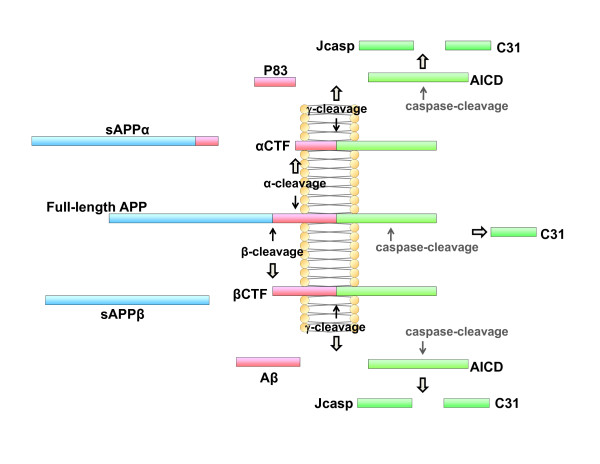
An important pathological feature of Alzheimer's disease (AD) is the presence of extracellular senile plaques in the brain. Senile plaques are composed of aggregations of small peptides called β-amyloid (Aβ). Multiple lines of evidence demonstrate that overproduction/aggregation of Aβ in the brain is a primary cause of AD and inhibition of Aβ generation has become a hot topic in AD research. Aβ is generated from β-amyloid precursor protein (APP) through sequential cleavages first by β-secretase and then by γ-secretase complex. Alternatively, APP can be cleaved by α-secretase within the Aβ domain to release soluble APPα and preclude Aβ generation. Cleavage of APP by caspases may also contribute to AD pathologies. Therefore, understanding the metabolism/processing of APP is crucial for AD therapeutics. Here we review current knowledge of APP processing regulation as well as the patho/physiological functions of APP and its metabolites.
阿尔茨海默病(AD)的一个重要病理特征是脑内存在细胞外老年斑。老年斑由称为β-淀粉样蛋白(Aβ)的小肽聚集物组成。多条证据表明,脑内 Aβ的过度产生/聚集是 AD 的主要原因,抑制 Aβ的产生已成为 AD 研究的热门话题。Aβ是通过β-分泌酶和γ-分泌酶复合物的顺序切割首先从β-淀粉样前体蛋白(APP)产生的。另外,APP 可以被 Aβ 结构域内的α-分泌酶切割,释放可溶性 APPα并阻止 Aβ的产生。半胱天冬酶对 APP 的切割也可能导致 AD 病理学。因此,了解 APP 的代谢/加工对 AD 治疗至关重要。在这里,我们回顾了 APP 加工调节的最新知识,以及 APP 及其代谢物的病理/生理功能。