Navrongo Health Research Centre, Post Office Box 114, Navrongo, Upper East Region, Ghana.
Health Econ Rev. 2012 Jul 23;2(1):13. doi: 10.1186/2191-1991-2-13.
Prepayments and risk pooling through social health insurance has been advocated by international development organizations. Social health insurance is seen as a mechanism that helps mobilize resources for health, pool risk, and provide more access to health care services for the poor. Hence Ghana implemented the National Health Insurance Scheme (NHIS) to help promote access to health care services for Ghanaians. The study examined the influence of the NHIS on the behavior of health care providers in their treatment of insured and uninsured clients.
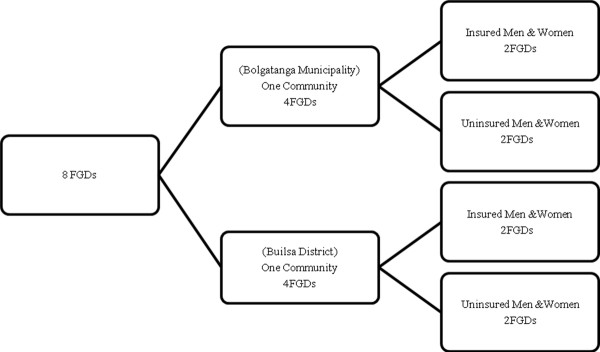
The study took place in Bolgatanga (urban) and Builsa (rural) districts in Ghana. Data was collected through exit survey with 200 insured and uninsured clients, 15 in-depth interviews with health care providers and health insurance managers, and 8 focus group discussions with insured and uninsured community members.
The NHIS promoted access for insured and mobilized revenue for health care providers. Both insured and uninsured were satisfied with care (survey finding). However, increased utilization of health care services by the insured leading to increased workloads for providers influenced their behavior towards the insured. Most of the insured perceived and experienced long waiting times, verbal abuse, not being physically examined and discrimination in favor of the affluent and uninsured. The insured attributed their experience to the fact that they were not making immediate payments for services. A core challenge of the NHIS was a delay in reimbursement which affected the operations of health facilities and hence influenced providers' behavior as well. Providers preferred clients who would make instant payments for health care services. Few of the uninsured were utilizing health facilities and visit only in critical conditions. This is due to the increased cost of health care services under the NHIS.
The perceived opportunistic behavior of the insured by providers was responsible for the difference in the behavior of providers favoring the uninsured. Besides, the delay in reimbursement also accounted for providers' negative attitude towards the insured. There is urgent need to address these issues in order to promote confidence in the NHIS, as well as its sustainability for the achievement of universal coverage.
国际发展组织提倡通过社会健康保险进行预付款和风险分担。社会健康保险被视为一种帮助为卫生筹集资源、分担风险并为穷人提供更多医疗服务的机制。因此,加纳实施了国家健康保险计划(NHIS),以帮助促进加纳人获得医疗服务。本研究考察了 NHIS 对医疗服务提供者在为参保和未参保客户治疗方面的行为的影响。
该研究在加纳的博尔加坦加(城市)和布利萨(农村)地区进行。通过对 200 名参保和未参保的客户进行出口调查,对 15 名医疗服务提供者和健康保险管理人员进行深入访谈,对 8 组参保和未参保的社区成员进行焦点小组讨论,收集了数据。
NHIS 促进了参保人的获得,并为医疗服务提供者筹集了资金。参保人和未参保人都对护理感到满意(调查结果)。然而,参保人对医疗服务的利用增加导致提供者的工作量增加,这影响了他们对参保人的行为。大多数参保人认为并经历了长时间的等待、言语虐待、未进行身体检查以及对富裕和未参保人的歧视。参保人将他们的经历归因于他们没有立即支付服务费用。NHIS 的一个核心挑战是报销延迟,这影响了卫生设施的运营,从而也影响了提供者的行为。提供者更喜欢那些会立即支付医疗服务费用的客户。很少有未参保人利用卫生设施,只有在危急情况下才去就诊。这是由于 NHIS 下医疗服务费用的增加。
提供者认为参保人机会主义行为是提供者对未参保人有利行为的差异的原因。此外,报销延迟也导致提供者对参保人持负面态度。为了促进对 NHIS 的信心,以及为实现全民覆盖的可持续性,迫切需要解决这些问题。