Blood Cancer J. 2011 May;1(5):e17. doi: 10.1038/bcj.2011.16. Epub 2011 May 13.
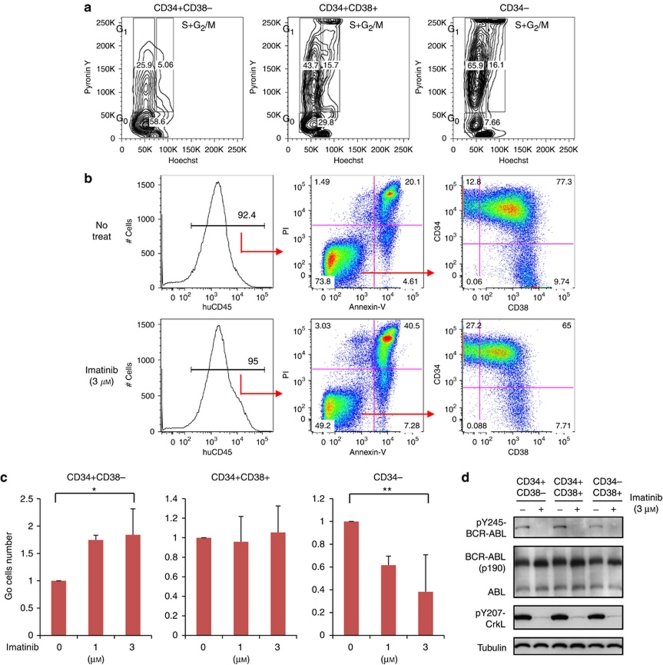
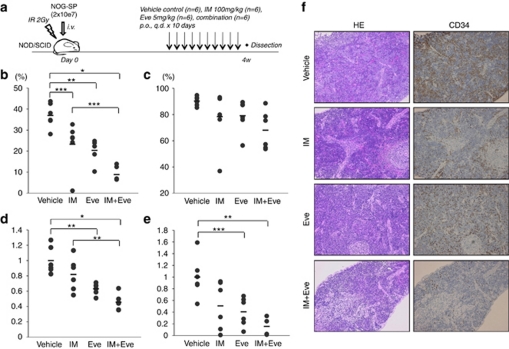
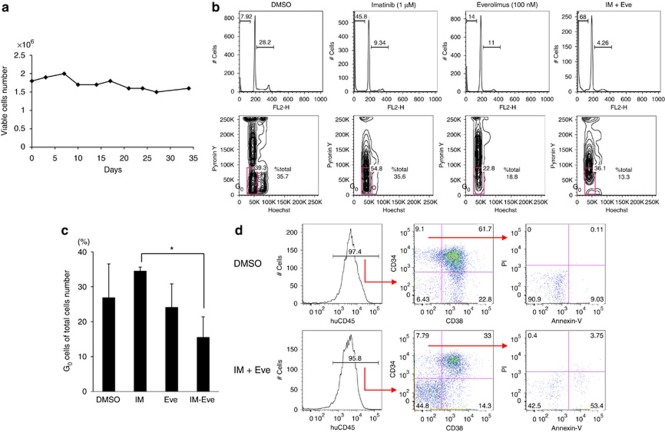
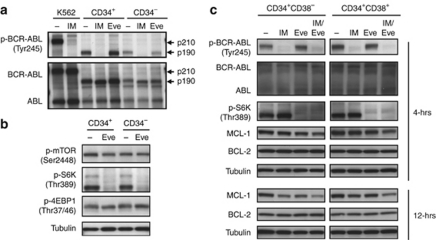
In Ph-positive (Ph(+)) leukemia, the quiescent cell state is one of the reasons for resistance to the BCR-ABL-kinase inhibitor, imatinib. In order to examine the mechanisms of resistance due to quiescence and the effect of the mammalian target of rapamycin inhibitor, everolimus, for such a resistant population, we used Ph(+) acute lymphoblastic leukemia patient cells serially xenotransplanted into NOD/SCID/IL2rγ(null) (NOG) mice. Spleen cells from leukemic mice showed a higher percentage of slow-cycling G(0) cells in the CD34(+)CD38(-) population compared with the CD34(+)CD38(+) and CD34(-) populations. After ex vivo imatinib treatment, more residual cells were observed in the CD34(+)CD38(-) population than in the other populations. Although slow-cycling G(0) cells were insensitive to imatinib in spite of BCR-ABL and CrkL dephosphorylation, combination treatment with everolimus induced substantial cell death, including that of the CD34(+)CD38(-) population, with p70-S6 K dephosphorylation and decrease of MCL-1 expression. The leukemic non-obese diabetic/severe combined immunodeficiency (NOD/SCID) mouse system with the in vivo combination treatment with imatinib and everolimus showed a decrease of tumor burden including CD34(+) cells. These results imply that treatment with everolimus can overcome resistance to imatinib in Ph(+) leukemia due to quiescence.
在 Ph 阳性(Ph(+))白血病中,静止细胞状态是对 BCR-ABL 激酶抑制剂伊马替尼产生耐药性的原因之一。为了研究由于静止导致耐药的机制以及雷帕霉素靶蛋白(mammalian target of rapamycin,mTOR)抑制剂依维莫司对这种耐药人群的作用,我们使用 Ph(+)急性淋巴细胞白血病患者细胞连续异种移植到 NOD/SCID/IL2rγ 缺陷(NOD/SCID/IL2rγ(null),NOG)小鼠中。与 CD34(+)CD38(+)和 CD34(-)群体相比,白血病小鼠的脾细胞中 CD34(+)CD38(-)群体中具有更高比例的缓慢循环 G0 细胞。与其他群体相比,经体外伊马替尼处理后,在 CD34(+)CD38(-)群体中观察到更多的残留细胞。尽管缓慢循环 G0 细胞尽管存在 BCR-ABL 和 CrkL 去磷酸化,但对伊马替尼不敏感,但与依维莫司联合治疗可诱导大量细胞死亡,包括 CD34(+)CD38(-)群体,同时伴随着 p70-S6K 去磷酸化和 MCL-1 表达减少。在体内联合应用伊马替尼和依维莫司的非肥胖型糖尿病/严重联合免疫缺陷(non-obese diabetic/severe combined immunodeficiency,NOD/SCID)小鼠白血病系统中,肿瘤负荷包括 CD34(+)细胞减少。这些结果表明,依维莫司治疗可克服 Ph(+)白血病因静止导致的伊马替尼耐药性。