Department of Ophthalmology, Shanghai Changzheng Hospital, Second Military Medical University, Shanghai, China.
PLoS One. 2012;7(7):e41325. doi: 10.1371/journal.pone.0041325. Epub 2012 Jul 19.
Intravitreal anti-vascular endothelial growth factor (VEGF) monoclonal antibodies are used in ocular neovascular diseases. A consensus has emerged that intravenous anti-VEGF can increase the risk of arterial thromboembolic events. However, the role of intravitreal anti-VEGF in arterial thromboembolism is controversial. Therefore, we did a systematic review and meta-analysis to investigate the effects of intravitreal anti-VEGF on the risk of arterial thromboembolic events.
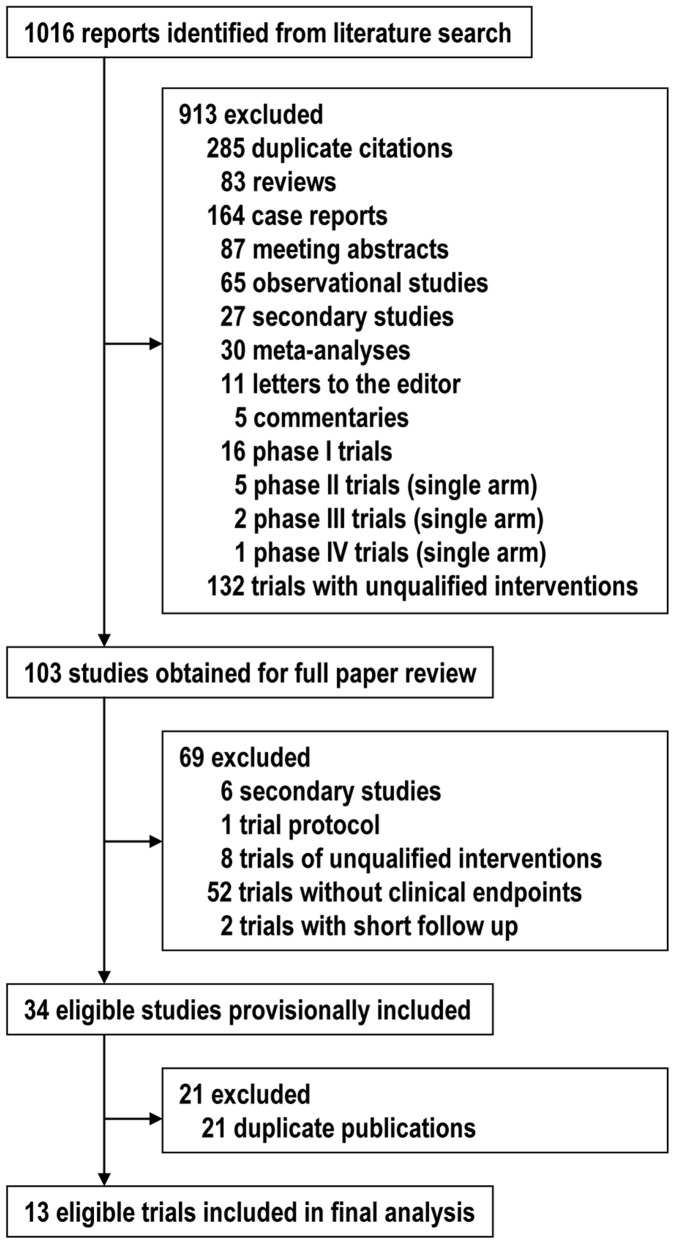
Electronic databases were searched to identify relevant randomized clinical trials comparing intravitreal anti-VEGF with controls. Criteria for inclusion in our meta-analysis included a study duration of no less than 12 months, the use of a randomized control group not receiving any intravitreal active agent, and the availability of outcome data for arterial thromboembolic events, myocardial infarction, cerebrovascular accidents, and vascular death. The risk ratios and 95% CIs were calculated using a fixed-effects or random-effects model, depending on the heterogeneity of the included studies.
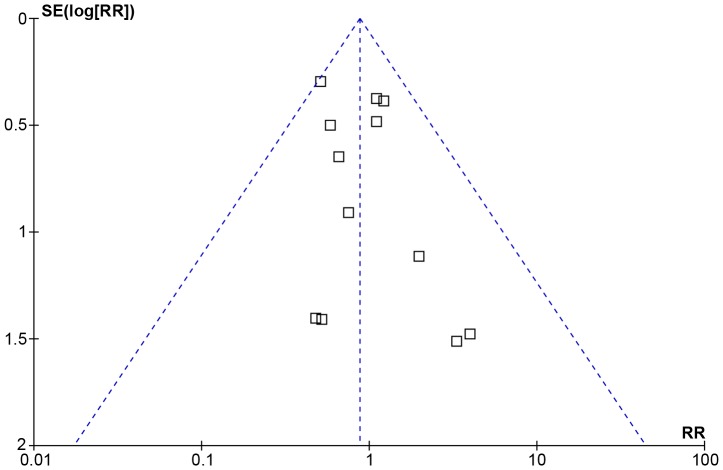
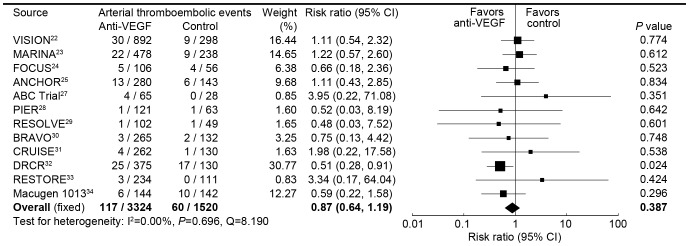
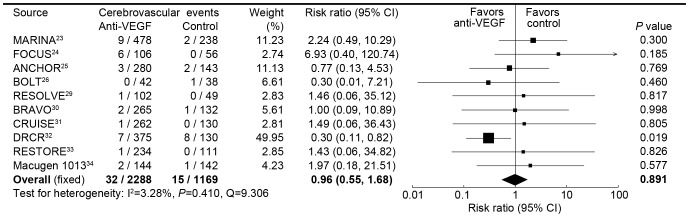
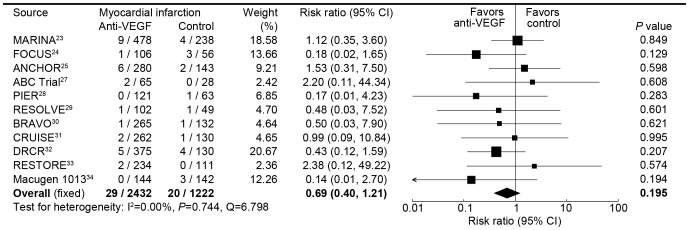
A total of 4942 patients with a variety of ocular neovascular diseases from 13 randomized controlled trials were identified and included for analysis. There was no significant difference between intravitreal anti-VEGF and control in the risk of all events, with risk ratios of 0.87 (95% CI, 0.64 to 1.19) for arterial thromboembolic events, 0.96 (95% CI, 0.55-1.68) for cerebrovascular accidents, 0.69 (95% CI 0.40-1.21) for myocardial infarctions, and 0.68 (95% CI, 0.37-1.27) for vascular death.
The strength evidence suggests that the intravitreal use of anti-VEGF antibodies is not associated with an increased risk of arterial thromboembolic events.
玻璃体内抗血管内皮生长因子(VEGF)单克隆抗体用于眼部新生血管疾病。目前已经达成共识,即静脉内使用抗 VEGF 会增加动脉血栓栓塞事件的风险。然而,玻璃体内使用抗 VEGF 与动脉血栓栓塞之间的关系仍存在争议。因此,我们进行了系统评价和荟萃分析,以调查玻璃体内抗 VEGF 对动脉血栓栓塞事件风险的影响。
电子数据库检索比较玻璃体内抗 VEGF 与对照组的随机临床试验。纳入我们荟萃分析的标准包括研究持续时间不少于 12 个月、使用未接受任何玻璃体内活性药物的随机对照组,以及具有动脉血栓栓塞事件、心肌梗死、脑血管意外和血管性死亡的结局数据。使用固定效应或随机效应模型计算风险比和 95%置信区间,具体取决于纳入研究的异质性。
共纳入 13 项随机对照试验的 4942 例患有各种眼部新生血管疾病的患者进行分析。玻璃体内抗 VEGF 与对照组在所有事件的风险方面无显著差异,动脉血栓栓塞事件的风险比为 0.87(95%CI,0.64 至 1.19),脑血管意外为 0.96(95%CI,0.55 至 1.68),心肌梗死为 0.69(95%CI,0.40 至 1.21),血管性死亡为 0.68(95%CI,0.37 至 1.27)。
有力证据表明,玻璃体内使用抗 VEGF 抗体不会增加动脉血栓栓塞事件的风险。