Alimentary Pharmabiotic Centre, University College Cork, Cork, Ireland.
Transl Psychiatry. 2011 Aug 30;1(8):e36. doi: 10.1038/tp.2011.37.
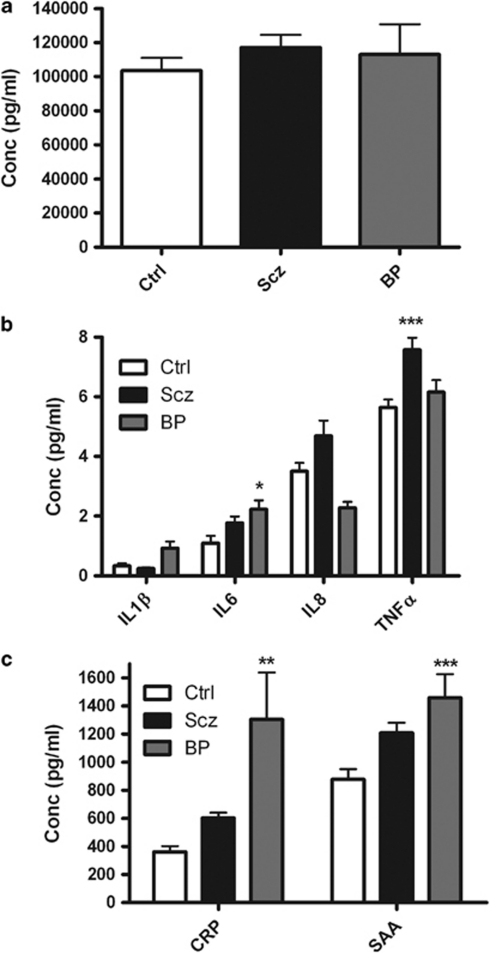
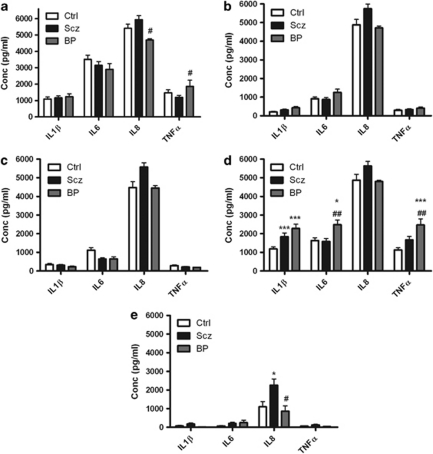
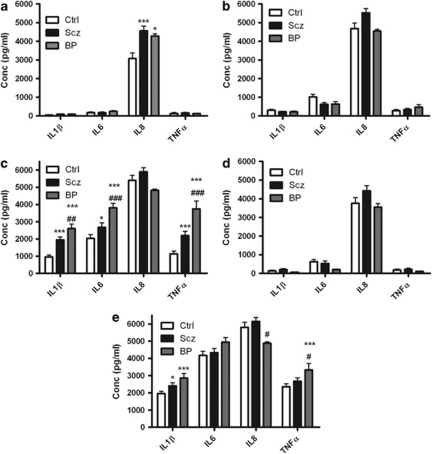
Low-grade peripheral inflammation is often present in psychotic patients. Toll-like receptors (TLRs) are pattern-recognition molecules that initiate inflammation. Our objective was to investigate the peripheral TLR activity in psychosis. Forty schizophrenia patients, twenty bipolar patients and forty healthy controls (HC) were recruited. Donated whole blood was cultured with TLR agonists for 24 h. Cell supernatants were analysed using a multiplex enzyme-linked immunosorbent assay approach to measure IL-1β, IL-6, IL-8 and tumour necrosis factor-α (TNFα). Plasma was analysed for cytokines, cortisol and acute phase proteins. Here, we show that selective TLR agonist-induced cytokine (IL-1β, IL-6, IL-8 and TNFα) release is enhanced in stimulated whole blood from schizophrenia and bipolar patients compared with HC. An exaggerated release of IL-1β, IL-6 and TNFα following treatment with the TLR2 agonist HKLM was detected in both disorders compared with controls. Enhanced TLR4-induced increases in IL-1β for both disorders coupled with TNFα increases for bipolar patients were observed. TLR8-induced increases in IL-1β for both disorders as well as IL-6 and TNFα increases for bipolar patients were detected. TLR9-induced increases in IL-8 for schizophrenia patients were also observed. No differences in TLR1, TLR3, TLR5, TLR6 or TLR7 activity were detected. Plasma levels of IL-6 were significantly elevated in bipolar patients while TNFα levels were significantly elevated in schizophrenia patients compared with controls. Plasma acute phase proteins were significantly elevated in bipolar patients. These data demonstrate that specific alterations in TLR agonist-mediated cytokine release contribute to the evidence of immune dysfunction in psychotic disorders.
低度外周炎症在精神病患者中常存在。 Toll 样受体(TLR)是启动炎症的模式识别分子。我们的目的是研究精神病外周 TLR 活性。招募了 40 名精神分裂症患者、20 名双相情感障碍患者和 40 名健康对照者(HC)。用 TLR 激动剂培养捐献的全血 24 小时。使用多重酶联免疫吸附测定法分析细胞上清液,以测量白细胞介素 1β(IL-1β)、白细胞介素 6(IL-6)、白细胞介素 8(IL-8)和肿瘤坏死因子-α(TNFα)。分析血浆中的细胞因子、皮质醇和急性期蛋白。在这里,我们显示与 HC 相比,精神分裂症和双相情感障碍患者刺激的全血中选择性 TLR 激动剂诱导的细胞因子(IL-1β、IL-6、IL-8 和 TNFα)释放增强。与对照组相比,在两种疾病中均检测到 TLR2 激动剂 HKLM 治疗后 IL-1β、IL-6 和 TNFα 的过度释放。观察到两种疾病中 TLR4 诱导的 IL-1β增加,双相情感障碍患者的 TNFα 增加。检测到两种疾病中 TLR8 诱导的 IL-1β增加以及双相情感障碍患者的 IL-6 和 TNFα 增加。还观察到精神分裂症患者 TLR9 诱导的 IL-8 增加。未检测到 TLR1、TLR3、TLR5、TLR6 或 TLR7 活性的差异。与对照组相比,双相情感障碍患者的血浆 IL-6 水平显著升高,而精神分裂症患者的 TNFα 水平显著升高。与对照组相比,双相情感障碍患者的血浆急性期蛋白显著升高。这些数据表明,特定的 TLR 激动剂介导的细胞因子释放改变导致精神障碍中免疫功能障碍的证据。