Mental Health Research Institute, Tomsk, Russia.
Transl Psychiatry. 2012 Jan 10;2(1):e67. doi: 10.1038/tp.2011.66.
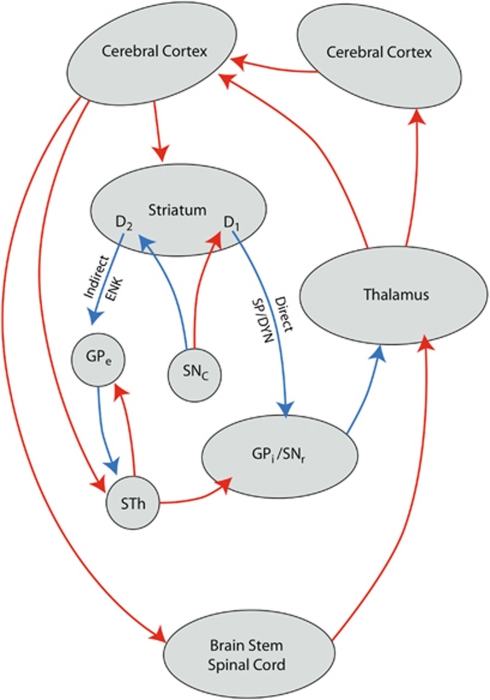
Dyskinesias are involuntary muscle movements that occur spontaneously in Huntington's disease (HD) and after long-term treatments for Parkinson's disease (levodopa-induced dyskinesia; LID) or for schizophrenia (tardive dyskinesia, TD). Previous studies suggested that dyskinesias in these three conditions originate from different neuronal pathways that converge on overstimulation of the motor cortex. We hypothesized that the same variants of the N-methyl-D-aspartate receptor gene that were previously associated with the age of dyskinesia onset in HD were also associated with the vulnerability for TD and not LID. Genotyping patients with LID and TD revealed, however, that these two variants were dose-dependently associated with susceptibility to LID, but not TD. This suggested that LID, TD and HD might arise from the same neuronal pathways, but TD results from a different mechanism.
运动障碍是亨廷顿病(HD)中自发性出现的不随意肌肉运动,也是长期治疗帕金森病(左旋多巴诱导的运动障碍;LID)或精神分裂症(迟发性运动障碍,TD)后的结果。先前的研究表明,这三种病症中的运动障碍源于不同的神经元通路,这些通路汇聚在对运动皮层的过度刺激上。我们假设,先前与 HD 中运动障碍发病年龄相关的相同 N-甲基-D-天冬氨酸受体基因变异也与 TD 易感性相关,而与 LID 无关。然而,对 LID 和 TD 患者进行基因分型的结果表明,这两种变异与 LID 的易感性呈剂量依赖性相关,但与 TD 无关。这表明 LID、TD 和 HD 可能源于相同的神经元通路,但 TD 是由不同的机制引起的。