AP-HP Service de Biochimie, Fondation FondaMental, Hôpital Lariboisière, Paris, France.
Transl Psychiatry. 2011 Nov 22;1(11):e56. doi: 10.1038/tp.2011.54.
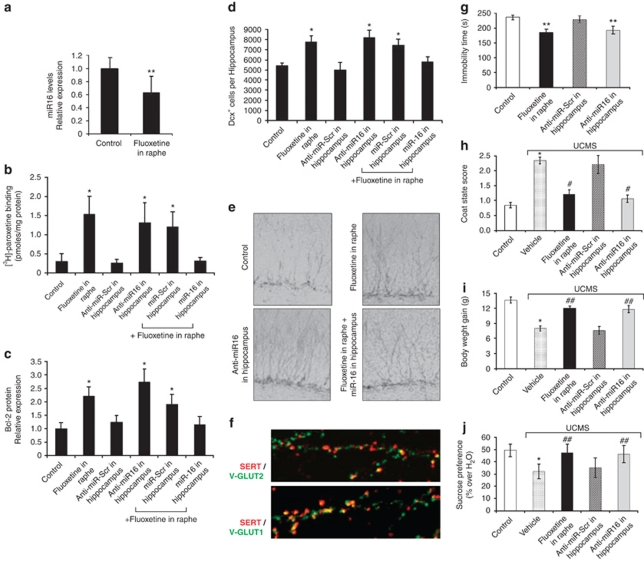
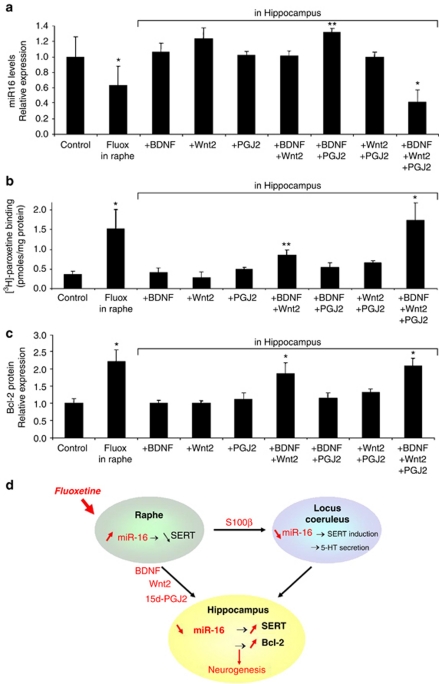
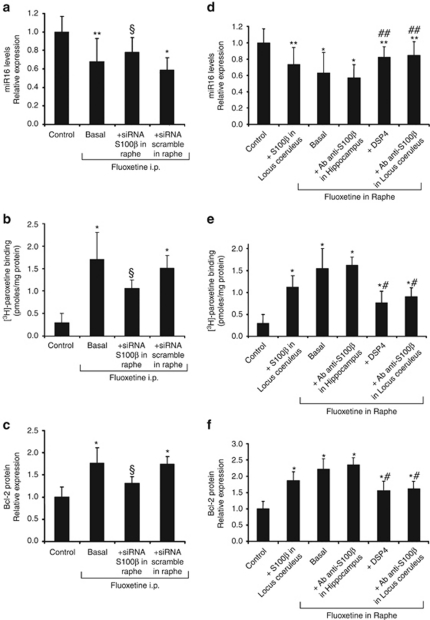
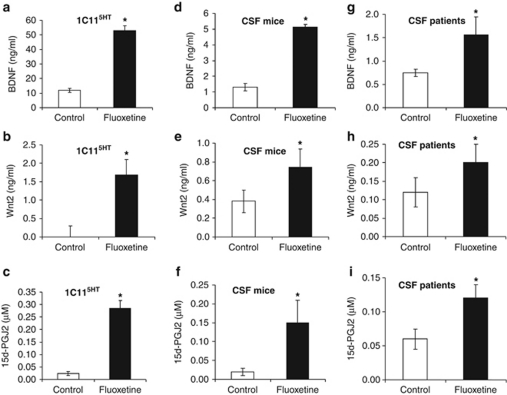
Serotonin reuptake inhibitor (SRI) antidepressants such as fluoxetine (Prozac), promote hippocampal neurogenesis. They also increase the levels of the bcl-2 protein, whose overexpression in transgenic mice enhances adult hippocampal neurogenesis. However, the mechanisms underlying SRI-mediated neurogenesis are unclear. Recently, we identified the microRNA miR-16 as an important effector of SRI antidepressant action in serotonergic raphe and noradrenergic locus coeruleus (LC). We show here that miR-16 mediates adult neurogenesis in the mouse hippocampus. Fluoxetine, acting on serotonergic raphe neurons, decreases the amount of miR-16 in the hippocampus, which in turn increases the levels of the serotonin transporter (SERT), the target of SRI, and that of bcl-2 and the number of cells positive for Doublecortin, a marker of neuronal maturation. Neutralization of miR-16 in the hippocampus further exerts an antidepressant-like effect in behavioral tests. The fluoxetine-induced hippocampal response is relayed, in part, by the neurotrophic factor S100β, secreted by raphe and acting via the LC. Fluoxetine-exposed serotonergic neurons also secrete brain-derived neurotrophic factor, Wnt2 and 15-Deoxy-delta12,14-prostaglandin J2. These molecules are unable to mimic on their own the action of fluoxetine and we show that they act synergistically to regulate miR-16 at the hippocampus. Of note, these signaling molecules are increased in the cerebrospinal fluid of depressed patients upon fluoxetine treatment. Thus, our results demonstrate that miR-16 mediates the action of fluoxetine by acting as a micromanager of hippocampal neurogenesis. They further clarify the signals and the pathways involved in the hippocampal response to fluoxetine, which may help refine therapeutic strategies to alleviate depressive disorders.
选择性 5-羟色胺再摄取抑制剂(SSRIs)类抗抑郁药,如氟西汀(百忧解),可促进海马神经发生。它们还会增加 bcl-2 蛋白的水平,而转基因小鼠中该蛋白的过度表达可增强成年海马神经发生。然而,SSRIs 介导的神经发生的机制尚不清楚。最近,我们发现 microRNA miR-16 是 SSRIs 抗抑郁作用在 5-羟色胺能中缝核和去甲肾上腺素能蓝斑核中的一个重要效应因子。我们在此表明,miR-16 介导了小鼠海马体中的成年神经发生。氟西汀作用于 5-羟色胺能中缝核神经元,会减少海马体中的 miR-16 含量,从而增加 5-羟色胺转运蛋白(SERT)的水平,SERT 是 SSRIs 的作用靶点,以及 bcl-2 的水平和双皮质蛋白阳性细胞的数量,双皮质蛋白是神经元成熟的标志物。海马体中 miR-16 的中和作用进一步在行为测试中发挥了抗抑郁样作用。氟西汀诱导的海马体反应部分通过神经递质 S100β 传递,S100β 由中缝核分泌,并通过蓝斑核起作用。暴露于氟西汀的 5-羟色胺能神经元还会分泌脑源性神经营养因子、Wnt2 和 15-脱氧-δ12,14-前列腺素 J2。这些分子本身无法模拟氟西汀的作用,我们表明它们协同作用以调节海马体中的 miR-16。值得注意的是,这些信号分子在接受氟西汀治疗的抑郁症患者的脑脊液中增加。因此,我们的研究结果表明,miR-16 通过作为海马神经发生的微观管理者来介导氟西汀的作用。它们进一步阐明了参与氟西汀对海马体反应的信号和途径,这可能有助于完善治疗策略以缓解抑郁障碍。