Coelho Arthur A, Lima-Bastos Sávio, Gobira Pedro H, Lisboa Sabrina F
Department of Pharmacology, Ribeirão Preto Medical School, University of São Paulo, Brazil.
Department of BioMolecular Sciences, School of Pharmaceutical Sciences of Ribeirão Preto, University of São Paulo, Brazil.
Neuronal Signal. 2023 Jul 25;7(2):NS20220034. doi: 10.1042/NS20220034. eCollection 2023 Jul.
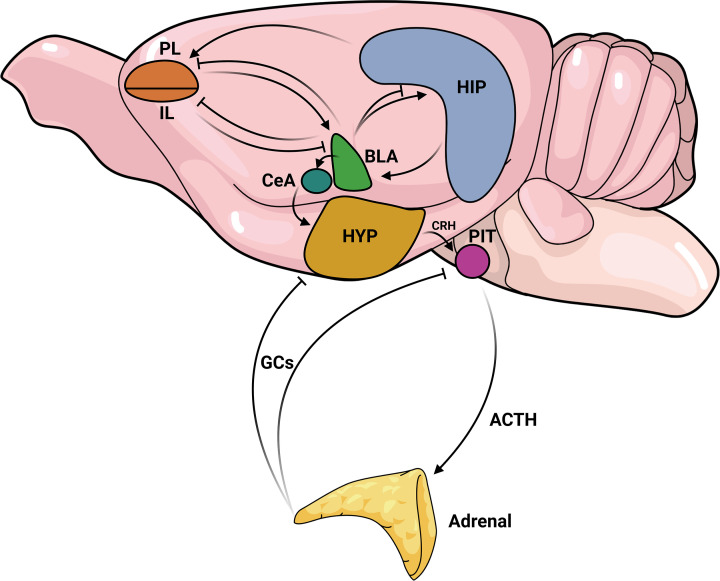
Stress exposure is associated with psychiatric conditions, such as depression, anxiety, and post-traumatic stress disorder (PTSD). It is also a vulnerability factor to developing or reinstating substance use disorder. Stress causes several changes in the neuro-immune-endocrine axis, potentially resulting in prolonged dysfunction and diseases. Changes in several transmitters, including serotonin, dopamine, glutamate, gamma-aminobutyric acid (GABA), glucocorticoids, and cytokines, are associated with psychiatric disorders or behavioral alterations in preclinical studies. Complex and interacting mechanisms make it very difficult to understand the physiopathology of psychiatry conditions; therefore, studying regulatory mechanisms that impact these alterations is a good approach. In the last decades, the impact of stress on biology through epigenetic markers, which directly impact gene expression, is under intense investigation; these mechanisms are associated with behavioral alterations in animal models after stress or drug exposure, for example. The endocannabinoid (eCB) system modulates stress response, reward circuits, and other physiological functions, including hypothalamus-pituitary-adrenal axis activation and immune response. eCBs, for example, act retrogradely at presynaptic neurons, limiting the release of neurotransmitters, a mechanism implicated in the antidepressant and anxiolytic effects after stress. Epigenetic mechanisms can impact the expression of eCB system molecules, which in turn can regulate epigenetic mechanisms. This review will present evidence of how the eCB system and epigenetic mechanisms interact and the consequences of this interaction in modulating behavioral changes after stress exposure in preclinical studies or psychiatric conditions. Moreover, evidence that correlates the involvement of the eCB system and epigenetic mechanisms in drug abuse contexts will be discussed.
应激暴露与精神疾病有关,如抑郁症、焦虑症和创伤后应激障碍(PTSD)。它也是发展或复发物质使用障碍的一个易患因素。应激会导致神经-免疫-内分泌轴发生多种变化,可能导致功能长期失调和疾病。在临床前研究中,包括血清素、多巴胺、谷氨酸、γ-氨基丁酸(GABA)、糖皮质激素和细胞因子在内的几种递质的变化与精神疾病或行为改变有关。复杂且相互作用的机制使得理解精神疾病的病理生理学非常困难;因此,研究影响这些改变的调节机制是一种很好的方法。在过去几十年里,应激通过表观遗传标记对生物学的影响受到了深入研究,表观遗传标记直接影响基因表达;例如,这些机制与应激或药物暴露后动物模型中的行为改变有关。内源性大麻素(eCB)系统调节应激反应、奖赏回路和其他生理功能,包括下丘脑-垂体-肾上腺轴激活和免疫反应。例如,eCB在突触前神经元处逆向起作用,限制神经递质的释放,这一机制与应激后的抗抑郁和抗焦虑作用有关。表观遗传机制可以影响eCB系统分子的表达,而eCB系统分子反过来又可以调节表观遗传机制。本综述将展示eCB系统与表观遗传机制如何相互作用的证据,以及这种相互作用在临床前研究或精神疾病中调节应激暴露后行为变化的后果。此外,还将讨论与eCB系统和表观遗传机制在药物滥用背景下的参与相关的证据。