Physiological Laboratory - Department of Biomedical Sciences, University of Padova, Padova, Italy.
J Int Soc Sports Nutr. 2012 Jul 26;9(1):34. doi: 10.1186/1550-2783-9-34.
Despite the increasing use of very low carbohydrate ketogenic diets (VLCKD) in weight control and management of the metabolic syndrome there is a paucity of research about effects of VLCKD on sport performance. Ketogenic diets may be useful in sports that include weight class divisions and the aim of our study was to investigate the influence of VLCKD on explosive strength performance.
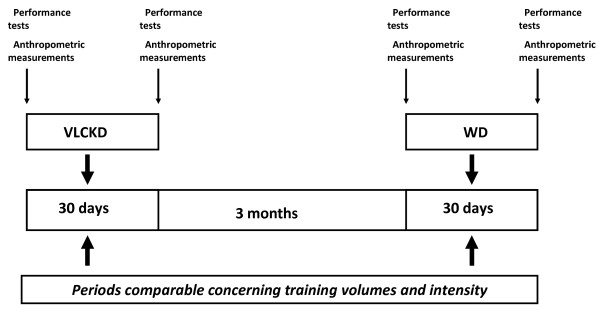
8 athletes, elite artistic gymnasts (age 20.9 ± 5.5 yrs) were recruited. We analyzed body composition and various performance aspects (hanging straight leg raise, ground push up, parallel bar dips, pull up, squat jump, countermovement jump, 30 sec continuous jumps) before and after 30 days of a modified ketogenic diet. The diet was based on green vegetables, olive oil, fish and meat plus dishes composed of high quality protein and virtually zero carbohydrates, but which mimicked their taste, with the addition of some herbal extracts. During the VLCKD the athletes performed the normal training program. After three months the same protocol, tests were performed before and after 30 days of the athletes' usual diet (a typically western diet, WD). A one-way Anova for repeated measurements was used.
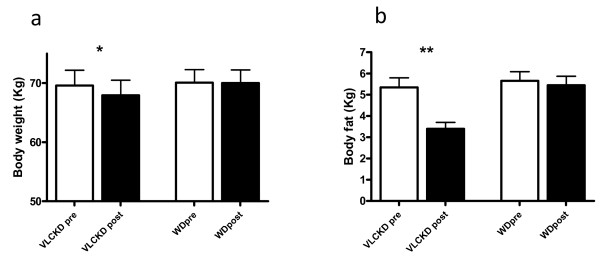
No significant differences were detected between VLCKD and WD in all strength tests. Significant differences were found in body weight and body composition: after VLCKD there was a decrease in body weight (from 69.6 ± 7.3 Kg to 68.0 ± 7.5 Kg) and fat mass (from 5.3 ± 1.3 Kg to 3.4 ± 0.8 Kg p < 0.001) with a non-significant increase in muscle mass.
Despite concerns of coaches and doctors about the possible detrimental effects of low carbohydrate diets on athletic performance and the well known importance of carbohydrates there are no data about VLCKD and strength performance. The undeniable and sudden effect of VLCKD on fat loss may be useful for those athletes who compete in sports based on weight class. We have demonstrated that using VLCKD for a relatively short time period (i.e. 30 days) can decrease body weight and body fat without negative effects on strength performance in high level athletes.
尽管极低碳水化合物生酮饮食(VLCKD)在体重控制和代谢综合征管理中的应用越来越多,但关于 VLCKD 对运动表现影响的研究却很少。生酮饮食可能对包括体重分级的运动项目有用,我们的研究目的是调查 VLCKD 对爆发力表现的影响。
招募了 8 名精英艺术体操运动员(年龄 20.9±5.5 岁)。我们分析了身体成分和各种表现方面(悬挂直腿抬高、地面俯卧撑、双杠臂屈伸、引体向上、深蹲跳、反向纵跳、30 秒连续跳跃),在 30 天的改良生酮饮食前后进行了测试。饮食基于绿色蔬菜、橄榄油、鱼和肉,加上由高质量蛋白质制成的菜肴,几乎没有碳水化合物,但味道与碳水化合物相似,加入了一些草药提取物。在 VLCKD 期间,运动员进行了正常的训练计划。三个月后,同样的方案,在运动员通常的饮食(典型的西方饮食,WD)的 30 天后进行了测试。采用重复测量单向方差分析。
在所有力量测试中,VLCKD 和 WD 之间没有发现显著差异。体重和身体成分有显著差异:VLCKD 后体重(从 69.6±7.3 Kg 降至 68.0±7.5 Kg)和脂肪量(从 5.3±1.3 Kg 降至 3.4±0.8 Kg,p<0.001)下降,肌肉量略有增加。
尽管教练和医生对低碳水化合物饮食对运动表现的可能不利影响以及碳水化合物的重要性存在担忧,但关于 VLCKD 和力量表现的数据却很少。VLCKD 对脂肪减少的不可否认的突然影响可能对那些参加基于体重分级的运动项目的运动员有用。我们已经证明,使用 VLCKD 相对较短的时间(即 30 天)可以降低体重和体脂,而不会对高水平运动员的力量表现产生负面影响。