Sheipouri Diba, Braidy Nady, Guillemin Gilles J
University of New South Wales, School of Medical Sciences, Dept of Pharmacology, Sydney, Australia.
Int J Tryptophan Res. 2012;5:15-25. doi: 10.4137/IJTR.S9835. Epub 2012 Jul 3.
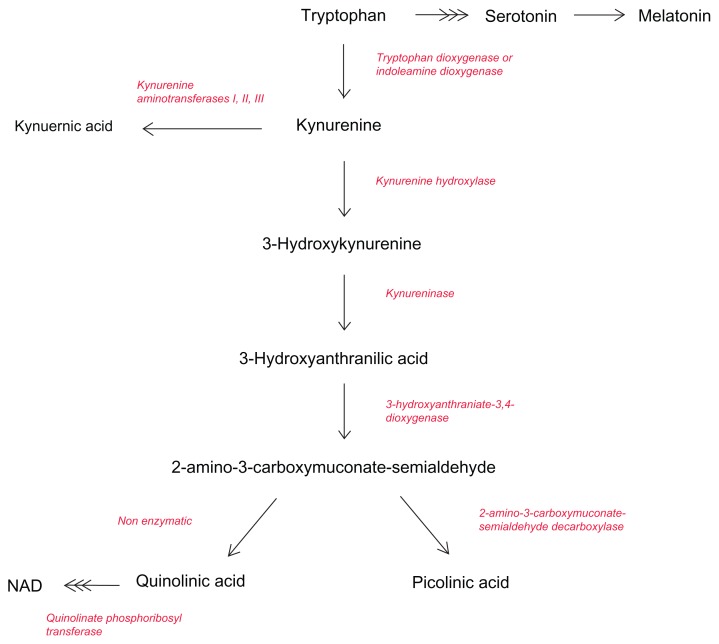
The kynurenine pathway (KP) is the principle route of catabolism of the essential amino acid tryptophan, leading to the production of several neuroactive and immunoregulatory metabolites. Alterations in the KP have been implicated in various neuropsychiatric and neurodegenerative diseases, immunological disorders, and many other diseased states. Although the role of the KP in the skin has been evaluated in small niche fields, limited studies are available regarding the effect of acute ultra violet exposure and the induction of the KP in human skin-derived fibroblasts and keratinocytes. Since UV exposure can illicit an inflammatory component in skin cells, it is highly likely that the KP may be induced in these cells in response to UV exposure. It is also possible that some KP metabolites may act as pro-inflammatory and anti-inflammatory mediators, since the KP is important in immunomodulation.
犬尿氨酸途径(KP)是必需氨基酸色氨酸分解代谢的主要途径,可产生多种具有神经活性和免疫调节作用的代谢产物。KP的改变与多种神经精神疾病、神经退行性疾病、免疫紊乱及许多其他疾病状态有关。尽管在一些小众领域已对KP在皮肤中的作用进行了评估,但关于急性紫外线照射对人皮肤成纤维细胞和角质形成细胞中KP的诱导作用的研究仍然有限。由于紫外线照射可在皮肤细胞中引发炎症反应,因此很有可能这些细胞会因紫外线照射而诱导KP。鉴于KP在免疫调节中很重要,一些KP代谢产物也可能作为促炎和抗炎介质发挥作用。