Department of Pharmaceutical Sciences, College of Pharmacy, Washington State University, P,O, Box 646534, Pullman, WA, 99164-6534, USA.
Mol Cancer. 2012 Jul 29;11:48. doi: 10.1186/1476-4598-11-48.
Cell death induced by poly(ADP-ribose) (PAR) and mediated by apoptosis-inducing factor (AIF) is well-characterized in models of ischemic tissue injury, but their roles in cancer cell death after chemotherapy are less understood.
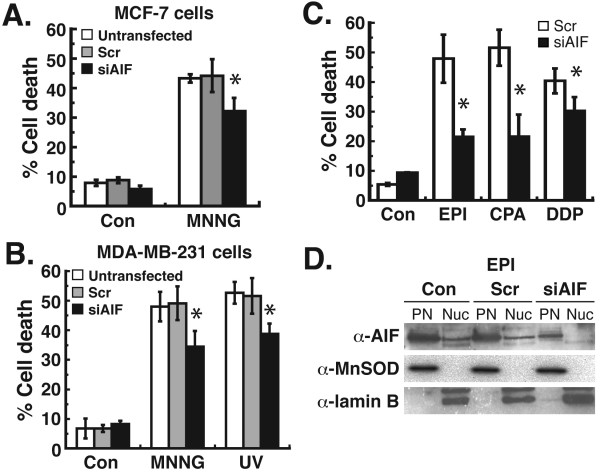
Here we investigated the roles of PAR and AIF by RNA interference (RNAi) in MDA-MB-231 and MCF-7 breast adenocarcinoma cells after chemotherapy. Differences in effects were statistically tested by analysis-of-variance and unpaired student's t-test.
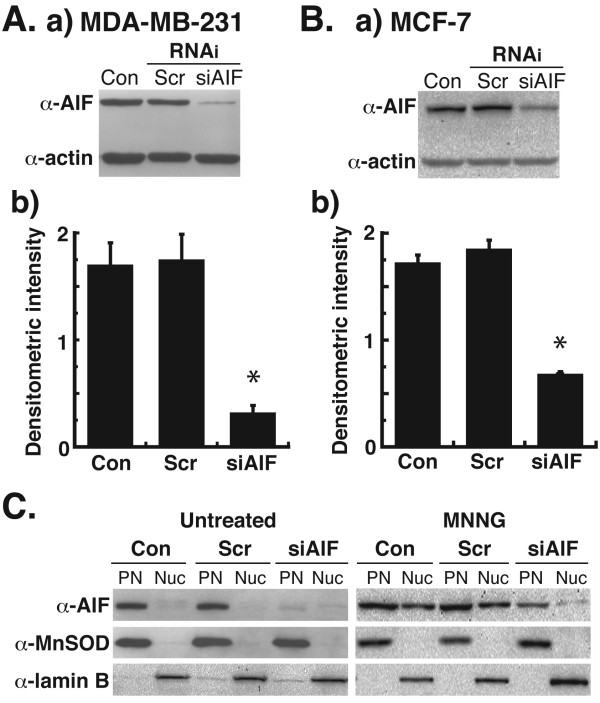
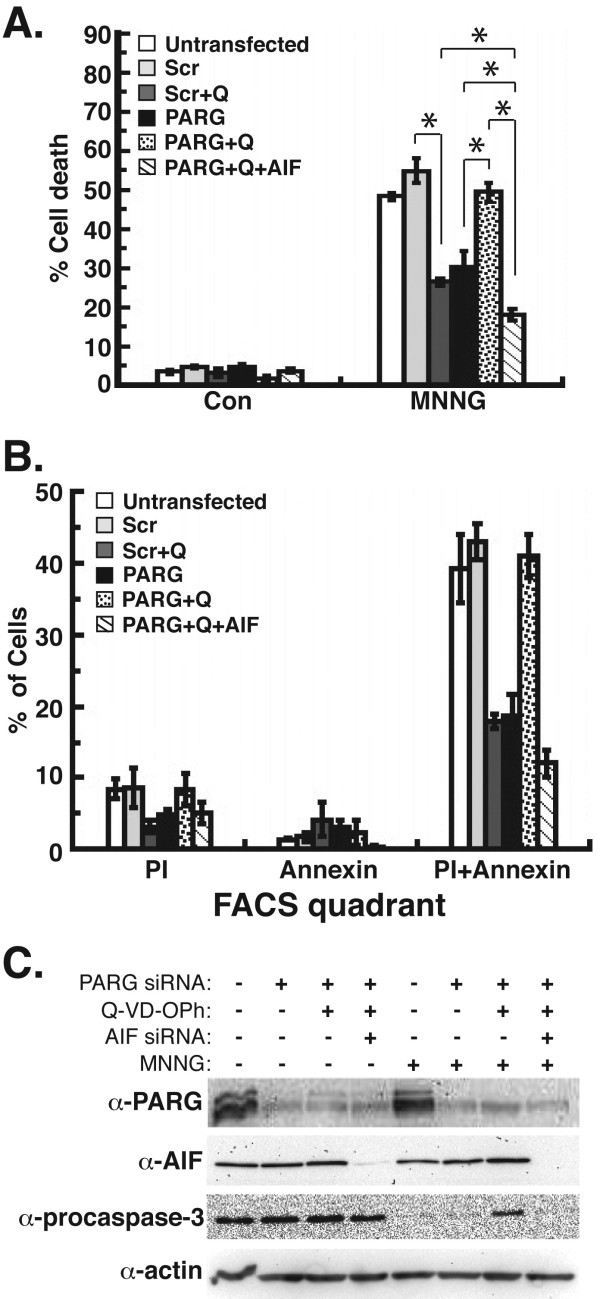
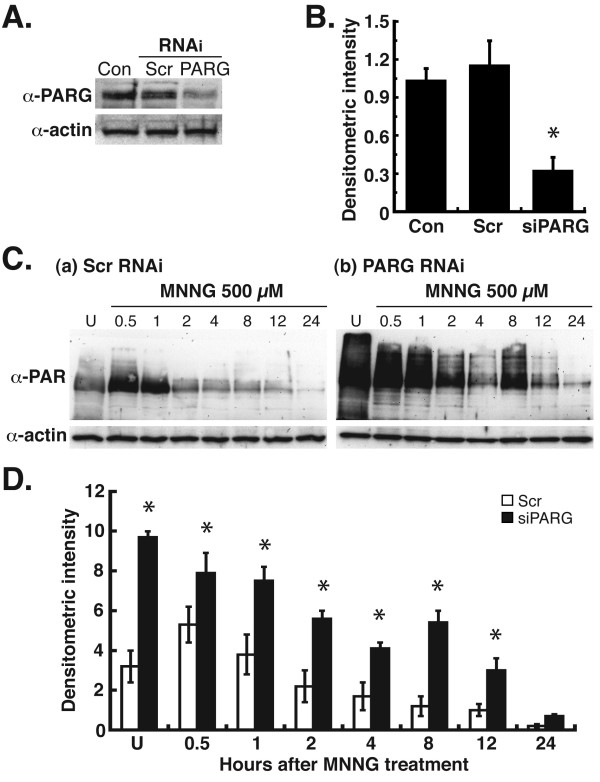
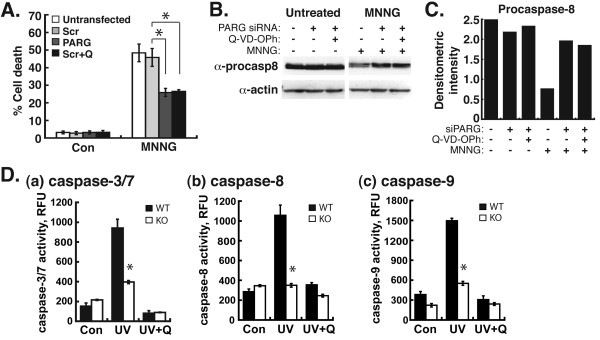
Silencing of AIF by RNAi led to decreased MDA-MB-231 and MCF-7 breast cancer cell death after chemotherapy, which demonstrates a critical role for AIF. RNAi silencing of PAR glycohydrolase (PARG), the primary enzyme that catalyzes the hydrolysis of PAR, led to increased PAR levels but decreased cell death. Further investigation into the possible role of PAR in apoptosis revealed decreased caspase-3/7/8/9 activity in PARG-null cells. Interestingly, the pharmacologic inhibition of caspase activity in PARG-silenced breast cancer cells led to increased cell death after chemotherapy, which indicates that an alternative cell death pathway is activated due to elevated PAR levels and caspase inhibition. AIF silencing in these cells led to profound protection from chemotherapy, which demonstrates that the increased cell death after PARG silencing and caspase inhibition was mediated by AIF.
The results show a role for AIF in breast cancer cell death after chemotherapy, the ability of PAR to regulate caspase activity, and the ability of AIF to substitute as a primary mediator of breast cancer cell death in the absence of caspases. Thus, the induction of cell death by PAR/AIF may represent a novel strategy to optimize the eradication of breast tumors by activating an alternative cell death pathway.
多聚(ADP-核糖)(PAR)诱导的细胞死亡以及凋亡诱导因子(AIF)介导的细胞死亡在缺血性组织损伤模型中已有很好的描述,但它们在化疗后乳腺癌细胞死亡中的作用知之甚少。
本研究通过化疗后 MDA-MB-231 和 MCF-7 乳腺癌腺癌细胞中的 RNA 干扰(RNAi)来研究 PAR 和 AIF 的作用。通过方差分析和未配对学生 t 检验对效应差异进行统计学检验。
AIF 的 RNAi 沉默导致化疗后 MDA-MB-231 和 MCF-7 乳腺癌细胞死亡减少,这表明 AIF 起着关键作用。PAR 糖基水解酶(PARG)的 RNAi 沉默,该酶主要催化 PAR 的水解,导致 PAR 水平增加而细胞死亡减少。进一步研究 PAR 在凋亡中的可能作用表明,PARG 缺失细胞中的 caspase-3/7/8/9 活性降低。有趣的是,PARG 沉默乳腺癌细胞中 caspase 活性的药理学抑制导致化疗后细胞死亡增加,这表明由于 PAR 水平升高和 caspase 抑制,激活了另一种细胞死亡途径。在这些细胞中沉默 AIF 导致对化疗的显著保护,这表明由于 PARG 沉默和 caspase 抑制导致的细胞死亡增加是由 AIF 介导的。
结果表明 AIF 在乳腺癌细胞化疗后死亡中起作用,PAR 调节 caspase 活性的能力,以及在缺乏 caspase 的情况下,AIF 作为乳腺癌细胞死亡的主要介导物的替代能力。因此,PAR/AIF 诱导的细胞死亡可能代表一种通过激活替代细胞死亡途径来优化乳腺癌肿瘤清除的新策略。