Song Tae Min, An Ji-Young, Hayman Laura L, Kim Gye Soo, Lee Ju Yul, Jang Hae Lan
U-Health & Welfare, Korea Institute for Health and Social Affairs, Seoul, Korea.
Healthc Inform Res. 2012 Jun;18(2):115-24. doi: 10.4258/hir.2012.18.2.115. Epub 2012 Jun 30.
Previous studies have been limited to the use of cross sectional data to identify the relationships between nicotine dependence and smoking. Therefore, it is difficult to determine a causal direction between the two variables. The purposes of this study were to 1) test whether nicotine dependence or average smoking was a more influential factor in smoking cessation; and 2) propose effective ways to quit smoking as determined by the causal relations identified.
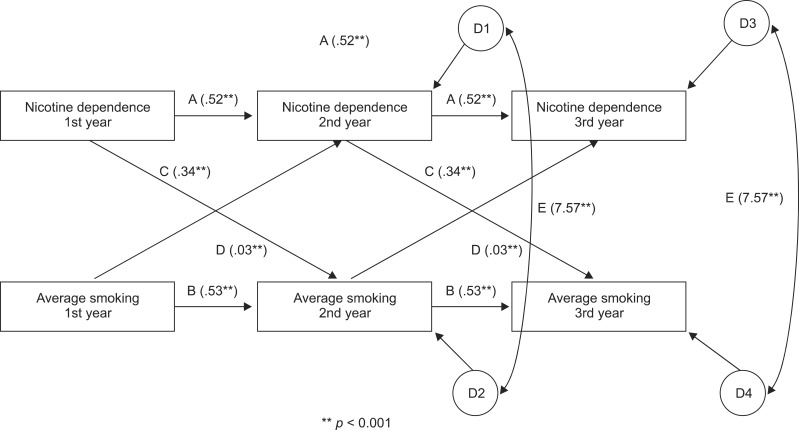
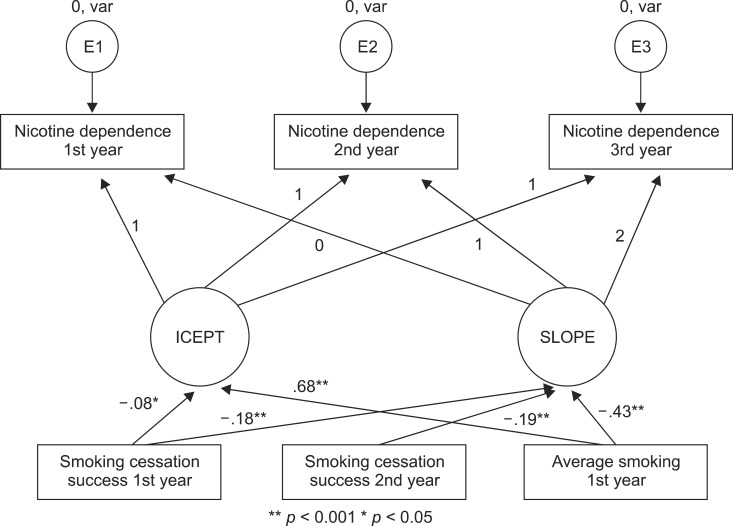
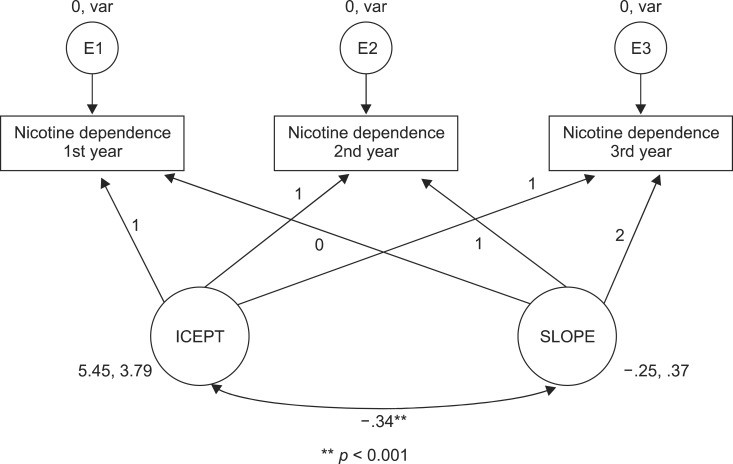
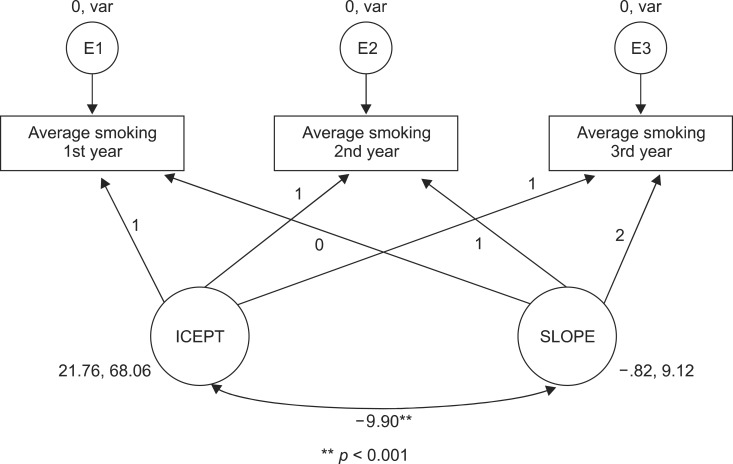
This study used a panel dataset from the central computerized management systems of community-based smoking cessation programs in Korea. Data were stored from July 16, 2005 to July 15, 2008. 711,862 smokers were registered and re-registered for the programs during the period. 860 of those who were retained in the programs for three years were finally included in the dataset. To measure nicotine dependence, this study used a revised Fagerström Test for Nicotine Dependence. To examine the relationship between nicotine dependence and average smoking, an autoregressive cross-lagged model was explored in the study.
The results indicate that 1) nicotine dependence and average smoking were stable over time; 2) the impact of nicotine dependence on average smoking was significant and vice versa; and 3) the impact of average smoking on nicotine dependence is greater than the impact of nicotine dependence on average smoking.
These results support the existing data obtained from previous research. Collectively, reducing the amount of smoking in order to decrease nicotine dependence is important for evidence-based policy making for smoking cessation.
以往的研究仅限于使用横断面数据来确定尼古丁依赖与吸烟之间的关系。因此,很难确定这两个变量之间的因果方向。本研究的目的是:1)测试尼古丁依赖或平均吸烟量在戒烟中哪个是更具影响力的因素;2)根据所确定的因果关系提出有效的戒烟方法。
本研究使用了韩国社区戒烟项目中央计算机管理系统的面板数据集。数据存储于2005年7月16日至2008年7月15日。在此期间,711,862名吸烟者注册并重新注册参加了这些项目。最终,860名在项目中留存三年的吸烟者被纳入数据集。为了测量尼古丁依赖,本研究使用了修订后的尼古丁依赖Fagerström测试。为了检验尼古丁依赖与平均吸烟量之间的关系,研究中探索了自回归交叉滞后模型。
结果表明:1)尼古丁依赖和平均吸烟量随时间保持稳定;2)尼古丁依赖对平均吸烟量的影响显著,反之亦然;3)平均吸烟量对尼古丁依赖的影响大于尼古丁依赖对平均吸烟量的影响。
这些结果支持了以往研究获得的现有数据。总体而言,为了降低尼古丁依赖而减少吸烟量对于基于证据的戒烟政策制定很重要。