Center for Integrative Chemical Biology and Drug Discovery, Division of Chemical Biology and Medicinal Chemistry, UNC Eshelman School of Pharmacy, University of North Carolina at Chapel Hill, Chapel Hill, North Carolina 27599, United States.
J Med Chem. 2012 Aug 23;55(16):7141-53. doi: 10.1021/jm300603y. Epub 2012 Aug 13.
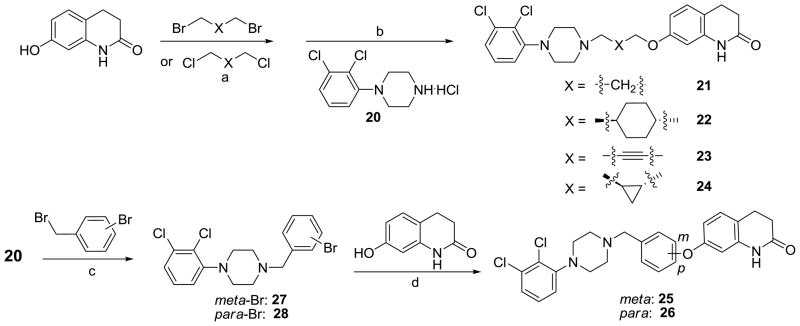
Functionally selective G protein-coupled receptor (GPCR) ligands, which differentially modulate canonical and noncanonical signaling, are extremely useful for elucidating key signal transduction pathways essential for both the therapeutic actions and side effects of drugs. However, few such ligands have been created, and very little purposeful attention has been devoted to studying what we term: "structure-functional selectivity relationships" (SFSR). We recently disclosed the first β-arrestin-biased dopamine D(2) receptor (D(2)R) agonists UNC9975 (44) and UNC9994 (36), which have robust in vivo antipsychotic drug-like activities. Here we report the first comprehensive SFSR studies focused on exploring four regions of the aripiprazole scaffold, which resulted in the discovery of these β-arrestin-biased D(2)R agonists. These studies provide a successful proof-of-concept for how functionally selective ligands can be discovered.
具有功能选择性的 G 蛋白偶联受体(GPCR)配体可以差异化调节经典和非经典信号,对于阐明药物的治疗作用和副作用所必需的关键信号转导途径非常有用。然而,这样的配体很少被创造出来,并且很少有针对性地关注我们所谓的“结构-功能选择性关系”(SFSR)的研究。我们最近披露了第一个β-arrestin 偏向性多巴胺 D2 受体(D2R)激动剂 UNC9975(44)和 UNC9994(36),它们具有强大的体内抗精神病药物样活性。在这里,我们报告了首次全面的 SFSR 研究,重点探索阿立哌唑支架的四个区域,从而发现了这些β-arrestin 偏向性 D2R 激动剂。这些研究为如何发现具有功能选择性的配体提供了一个成功的概念验证。