Institute of Biology, University of Białystok, Białystok, Poland.
J Comp Physiol B. 2013 Jan;183(1):27-41. doi: 10.1007/s00360-012-0698-z. Epub 2012 Jul 31.
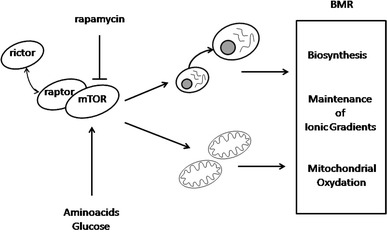
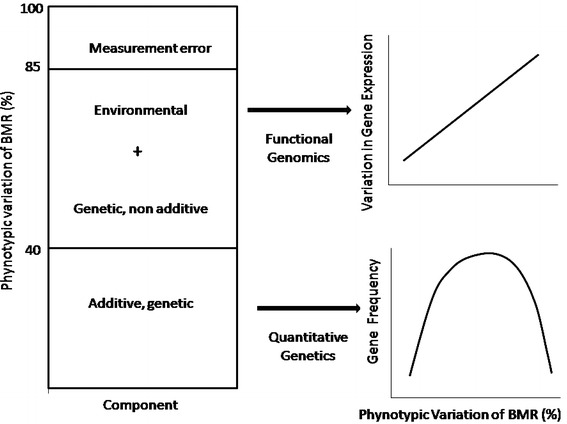
Basal metabolic rate (BMR) provides a widely accepted benchmark of metabolic expenditure for endotherms under laboratory and natural conditions. While most studies examining BMR have concentrated on inter-specific variation, relatively less attention has been paid to the determinants of within-species variation. Even fewer studies have analysed the determinants of within-species BMR variation corrected for the strong influence of body mass by appropriate means (e.g. ANCOVA). Here, we review recent advancements in studies on the quantitative genetics of BMR and organ mass variation, along with their molecular genetics. Next, we decompose BMR variation at the organ, tissue and molecular level. We conclude that within-species variation in BMR and its components have a clear genetic signature, and are functionally linked to key metabolic process at all levels of biological organization. We highlight the need to integrate molecular genetics with conventional metabolic field studies to reveal the adaptive significance of metabolic variation. Since comparing gene expressions inter-specifically is problematic, within-species studies are more likely to inform us about the genetic underpinnings of BMR. We also urge for better integration of animal and medical research on BMR; the latter is quickly advancing thanks to the application of imaging technologies and 'omics' studies. We also suggest that much insight on the biochemical and molecular underpinnings of BMR variation can be gained from integrating studies on the mammalian target of rapamycin (mTOR), which appears to be the major regulatory pathway influencing the key molecular components of BMR.
基础代谢率 (BMR) 为实验室和自然条件下的恒温动物的代谢消耗提供了广泛接受的基准。虽然大多数研究都集中在种间变异上,但对种内变异的决定因素关注较少。更少的研究通过适当的方法(例如协方差分析)分析了种内 BMR 变异的决定因素,这些方法可纠正体重的强烈影响。在这里,我们回顾了关于 BMR 和器官质量变异的定量遗传学及其分子遗传学的最新进展。接下来,我们分解器官、组织和分子水平的 BMR 变异。我们得出结论,BMR 及其组成部分的种内变异具有明显的遗传特征,并且与所有生物组织层次的关键代谢过程在功能上相关。我们强调需要将分子遗传学与传统的代谢野外研究相结合,以揭示代谢变异的适应意义。由于种间比较基因表达存在问题,因此种内研究更有可能为我们提供 BMR 的遗传基础。我们还敦促更好地整合关于 BMR 的动物和医学研究;后者由于成像技术和“组学”研究的应用而迅速发展。我们还建议,通过整合关于雷帕霉素靶蛋白 (mTOR) 的研究,可以获得关于 BMR 变异的生化和分子基础的很多见解,mTOR 似乎是影响 BMR 的关键分子成分的主要调节途径。