Center for Neuroscience, Institute for Behavioral Genetics, Department of Neuroscience, University of Colorado at Boulder, Boulder, Colorado, United States of America.
PLoS One. 2012;7(7):e41108. doi: 10.1371/journal.pone.0041108. Epub 2012 Jul 25.
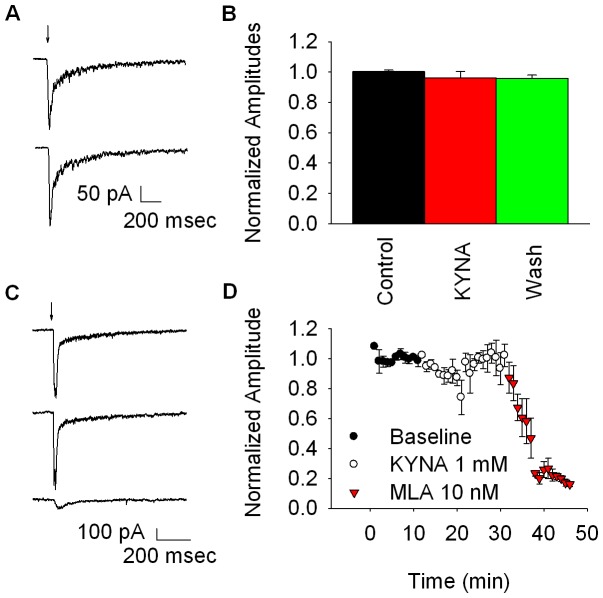
Kynurenic acid (KYNA), a classical ionotropic glutamate receptor antagonist is also purported to block the α7-subtype nicotinic acetylcholine receptor (α7* nAChR). Although many published studies cite this potential effect, few have studied it directly. In this study, the α7*-selective agonist, choline, was pressure-applied to interneurons in hippocampal subregions, CA1 stratum radiatum and hilus of acute brain hippocampal slices from adolescent to adult mice and adolescent rats. Stable α7* mediated whole-cell currents were measured using voltage-clamp at physiological temperatures. The effects of bath applied KYNA on spontaneous glutamatergic excitatory postsynaptic potentials (sEPSC) as well as choline-evoked α7* currents were determined. In mouse hilar interneurons, KYNA totally blocked sEPSC whole-cell currents in a rapid and reversible manner, but had no effect on choline-evoked α7* whole-cell currents. To determine if this lack of KYNA effect on α7* function was due to regional and/or species differences in α7* nAChRs, the effects of KYNA on choline-evoked α7* whole-cell currents in mouse and rat stratum radiatum interneurons were tested. KYNA had no effect on either mouse or rat stratum radiatum interneuron choline-evoked α7* whole-cell currents. Finally, to test whether the lack of effect of KYNA was due to unlikely slow kinetics of KYNA interactions with α7* nAChRs, recordings of a7*-mediated currents were made from slices that were prepared and stored in the presence of 1 mM KYNA (>90 minutes exposure). Under these conditions, KYNA had no measurable effect on α7* nAChR function. The results show that despite KYNA-mediated blockade of glutamatergic sEPSCs, two types of hippocampal interneurons that express choline-evoked α7* nAChR currents fail to show any degree of modulation by KYNA. Our results indicate that under our experimental conditions, which produced complete KYNA-mediated blockade of sEPSCs, claims of KYNA effects on choline-evoked α7* nAChR function should be made with caution.
犬尿酸(KYNA)是一种经典的离子型谷氨酸受体拮抗剂,据称也可阻断α7 型烟碱型乙酰胆碱受体(α7nAChR)。尽管许多已发表的研究都提到了这种潜在的作用,但很少有研究直接研究过它。在这项研究中,α7-选择性激动剂胆碱被加压应用于急性脑海马脑片的海马亚区 CA1 放射层和门区的中间神经元,这些脑片来自青少年至成年小鼠和青少年大鼠。在生理温度下使用电压钳测量稳定的α7介导的全细胞电流。确定浴施加的 KYNA 对自发谷氨酸能兴奋性突触后电位(sEPSP)以及胆碱诱导的α7电流的影响。在小鼠门区中间神经元中,KYNA 以快速和可逆的方式完全阻断 sEPSP 全细胞电流,但对胆碱诱导的α7全细胞电流没有影响。为了确定 KYNA 对α7功能缺乏影响是否是由于α7nAChR 在区域和/或物种上的差异,测试了 KYNA 对小鼠和大鼠放射层中间神经元中胆碱诱导的α7全细胞电流的影响。KYNA 对小鼠或大鼠放射层中间神经元胆碱诱导的α7全细胞电流均无影响。最后,为了测试 KYNA 缺乏作用是否是由于 KYNA 与α7nAChR 相互作用的可能性较慢动力学,从在 1 mM KYNA(>90 分钟暴露)存在下制备和储存的切片中记录α7*-介导的电流。在这些条件下,KYNA 对α7nAChR 功能没有可测量的影响。结果表明,尽管 KYNA 介导的阻断谷氨酸能 sEPSC,但表达胆碱诱导的α7nAChR 电流的两种类型的海马中间神经元均未显示出任何程度的调制。我们的结果表明,在我们的实验条件下,KYNA 完全介导了 sEPSC 的阻断,关于 KYNA 对胆碱诱导的α7*nAChR 功能的影响的说法应该谨慎提出。