Department of Cognitive and Behavioral Sciences, Graduate School of Arts and Sciences, University of Tokyo, Tokyo, Japan.
PLoS One. 2012;7(7):e41328. doi: 10.1371/journal.pone.0041328. Epub 2012 Jul 27.
When a second sound follows a long first sound, its location appears to be perceived away from the first one (the localization/lateralization aftereffect). This aftereffect has often been considered to reflect an efficient neural coding of sound locations in the auditory system. To understand determinants of the localization aftereffect, the current study examined whether it is induced by an interaural temporal difference (ITD) in the amplitude envelope of high frequency transposed tones (over 2 kHz), which is known to function as a sound localization cue.
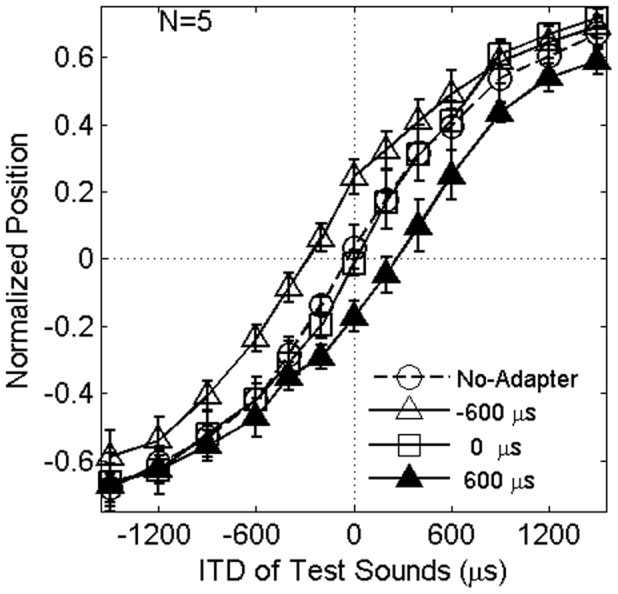
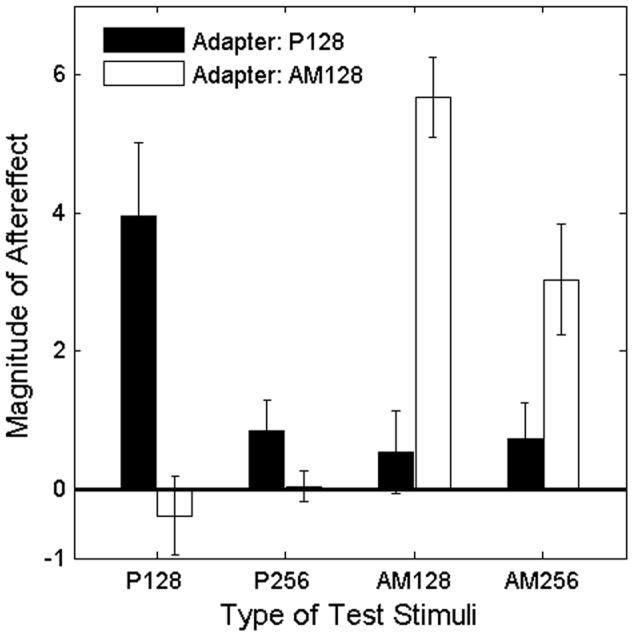
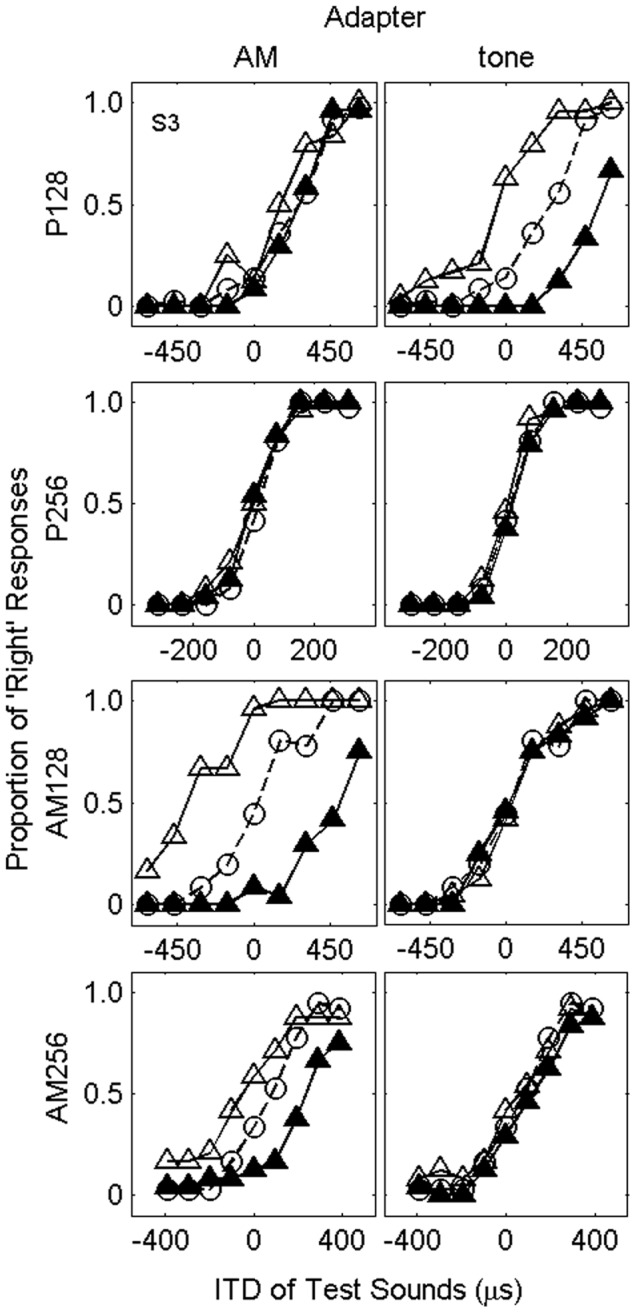
METHODOLOGY/PRINCIPAL FINDINGS: In Experiment 1, participants were required to adjust the position of a pointer to the perceived location of test stimuli before and after adaptation. Test and adapter stimuli were amplitude modulated (AM) sounds presented at high frequencies and their positional differences were manipulated solely by the envelope ITD. Results showed that the adapter's ITD systematically affected the perceived position of test sounds to the directions expected from the localization/lateralization aftereffect when the adapter was presented at ±600 µs ITD; a corresponding significant effect was not observed for a 0 µs ITD adapter. In Experiment 2, the observed adapter effect was confirmed using a forced-choice task. It was also found that adaptation to the AM sounds at high frequencies did not significantly change the perceived position of pure-tone test stimuli in the low frequency region (128 and 256 Hz).
CONCLUSIONS/SIGNIFICANCE: The findings in the current study indicate that ITD in the envelope at high frequencies induces the localization aftereffect. This suggests that ITD in the high frequency region is involved in adaptive plasticity of auditory localization processing.
当一个长音后面跟着一个短音时,短音的位置似乎会被感知到远离长音(定位/侧化后效)。这种后效通常被认为反映了听觉系统中声音位置的有效神经编码。为了理解定位后效的决定因素,本研究检查了高频转位音(超过 2 kHz)的幅度包络中的耳间时间差(ITD)是否会引起这种后效,因为已知这种 ITD 是声音定位线索。
方法/主要发现:在实验 1 中,参与者需要在适应前后调整指针的位置以适应测试刺激的感知位置。测试和适配器刺激是在高频呈现的幅度调制(AM)声音,其位置差异仅通过包络 ITD 来操纵。结果表明,当适配器呈现 ±600 µs ITD 时,适配器的 ITD 系统地影响了测试声音的感知位置,朝向从定位/侧化后效中预期的方向;当适配器的 ITD 为 0 µs 时,没有观察到相应的显著效果。在实验 2 中,使用强制选择任务确认了观察到的适配器效应。还发现,高频 AM 声音的适应不会显著改变低频区域(128 和 256 Hz)的纯音测试刺激的感知位置。
结论/意义:本研究的结果表明,高频包络中的 ITD 会引起定位后效。这表明高频区域的 ITD 参与了听觉定位处理的适应性可塑性。