School of Nursing, University of Michigan, Ann Arbor, MI 48109-5482, USA.
Trials. 2012 Aug 1;13:125. doi: 10.1186/1745-6215-13-125.
The objectives of this smoking cessation study among hospitalized smokers are to: 1) determine provider and patient receptivity, barriers, and facilitators to implementing the nurse-administered, inpatient Tobacco Tactics intervention versus usual care using face-to-face feedback and surveys; 2) compare the effectiveness of the nurse-administered, inpatient Tobacco Tactics intervention versus usual care across hospitals, units, and patient characteristics using thirty-day point prevalence abstinence at thirty days and six months (primary outcome) post-recruitment; and 3) determine the cost-effectiveness of the nurse-administered, inpatient Tobacco Tactics intervention relative to usual care including cost per quitter, cost per life-year saved, and cost per quality-adjusted life-year saved.
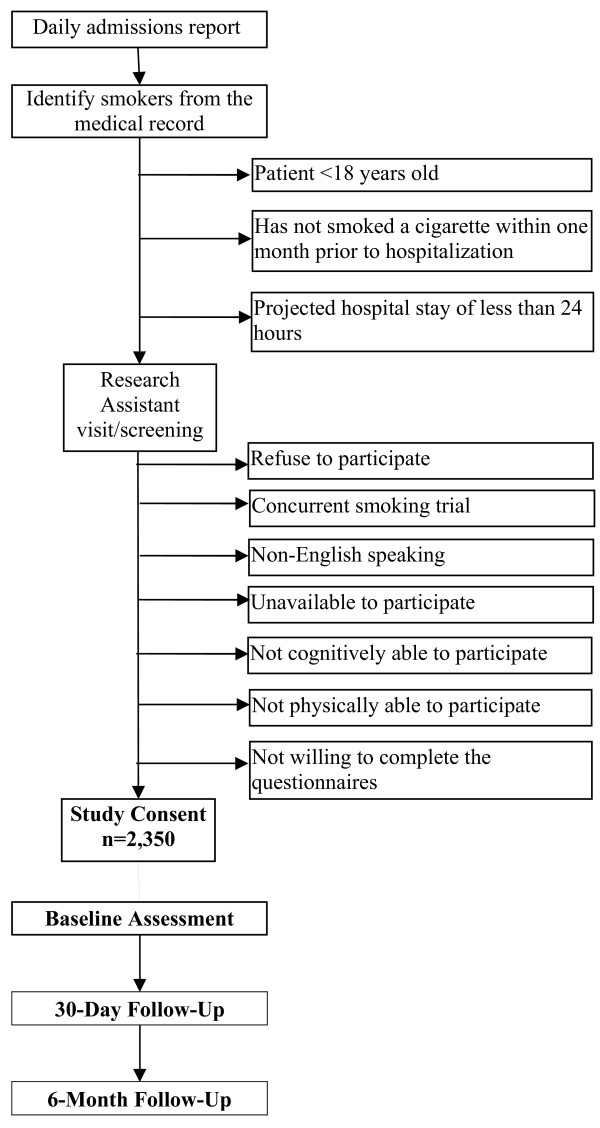
METHODS/DESIGN: This effectiveness study will be a quasi-experimental design of six Michigan community hospitals of which three will get the nurse-administered Tobacco Tactics intervention and three will provide their usual care. In both the intervention and usual care sites, research assistants will collect data from patients on their smoking habits and related variables while in the hospital and at thirty days and six months post-recruitment. The intervention will be integrated into the experimental sites by a research nurse who will train Master Trainers at each intervention site. The Master Trainers, in turn, will teach the intervention to all staff nurses. Research nurses will also conduct formative evaluation with nurses to identify barriers and facilitators to dissemination.Descriptive statistics will be used to summarize the results of surveys administered to nurses, nurses' participation rates, smokers' receipt of specific cessation services, and satisfaction with services. General estimating equation analyses will be used to determine differences between intervention groups on satisfaction and quit rates, respectively, with adjustment for the clustering of patients within hospital units. Regression analyses will test the moderation of the effects of the interventions by patient characteristics. Cost-effectiveness will be assessed by constructing three ratios including cost per quitter, cost per life-year saved, and cost per quality-adjusted life-year saved.
Given that nurses represent the largest group of front-line providers, this intervention, if proven effective, has the potential for having a wide reach and thus decrease smoking, morbidity and mortality among inpatient smokers.
Dissemination of Tobacco Tactics for Hospitalized Smokers NCT01309217.
本项针对住院吸烟者的戒烟研究旨在:1)通过面对面反馈和调查,确定与常规护理相比,实施护士主导的住院烟草控制策略干预措施在医生和患者中接受程度如何、存在哪些障碍和促进因素;2)通过 30 天和 6 个月(主要结局)的随访评估,比较不同医院、科室和患者特征下,护士主导的住院烟草控制策略干预与常规护理的效果;3)评估护士主导的住院烟草控制策略干预与常规护理的成本效益,包括每个戒烟者的成本、每个挽救生命年的成本和每个挽救质量调整生命年的成本。
方法/设计:本项有效性研究将采用准实验设计,选择密歇根州的六家社区医院,其中三家将提供护士主导的烟草控制策略干预,三家将提供常规护理。在干预和常规护理点,研究助理将在患者住院期间以及随访的 30 天和 6 个月时收集其吸烟习惯和相关变量的数据。在实验点,研究护士将通过培训各干预点的主培训师,将干预措施融入其中。主培训师将进一步向所有护士传授干预措施。研究护士还将与护士进行形成性评估,以确定传播的障碍和促进因素。将使用描述性统计来总结对护士进行的调查结果、护士参与率、吸烟者接受特定戒烟服务的情况以及对服务的满意度。将使用一般估计方程分析来确定干预组在满意度和戒烟率上的差异,分别调整了患者在科室中的聚类。回归分析将检验患者特征对干预效果的调节作用。通过构建三个比值,包括每个戒烟者的成本、每个挽救生命年的成本和每个挽救质量调整生命年的成本,评估成本效益。
鉴于护士是最大的一线提供者群体,如果这种干预措施被证明有效,它有可能广泛推广,从而降低住院吸烟者的吸烟率、发病率和死亡率。
Dissemination of Tobacco Tactics for Hospitalized Smokers NCT01309217。