Department of Surgery and Division of Surgical Oncology, Louisiana State University Health Sciences Center, Shreveport, LA 71130, USA.
Surgery. 2012 Sep;152(3):441-8. doi: 10.1016/j.surg.2012.05.040. Epub 2012 Jul 31.
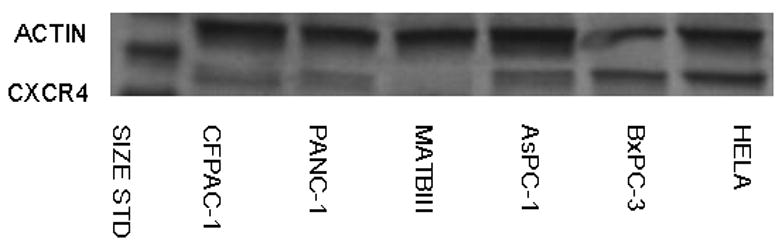
Pancreatic adenocarcinoma is an aggressive malignancy. Oncolytic adenoviruses (Ads) are modified genetically to target tumor cells while sparing normal cells. We modified the knob domain of the Ad serotype 5 with a serotype 3 knob domain and incorporated the CXCR4 promoter to regulate Ad E1A gene expression (Ad5/3-CXCR4-E1A). These modifications were made to efficiently infect and lyse pancreatic tumors.
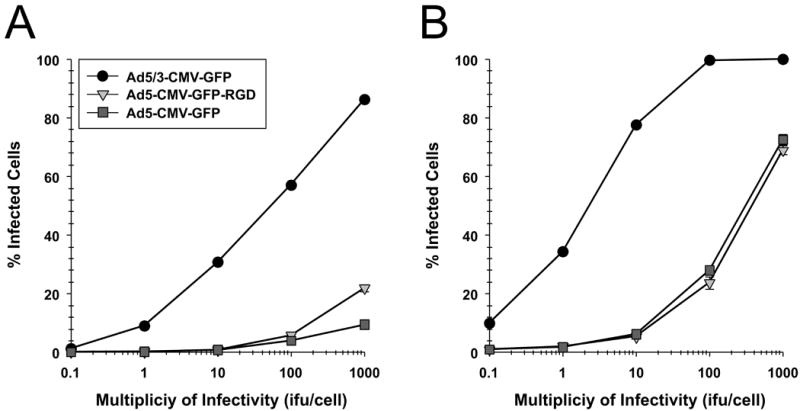
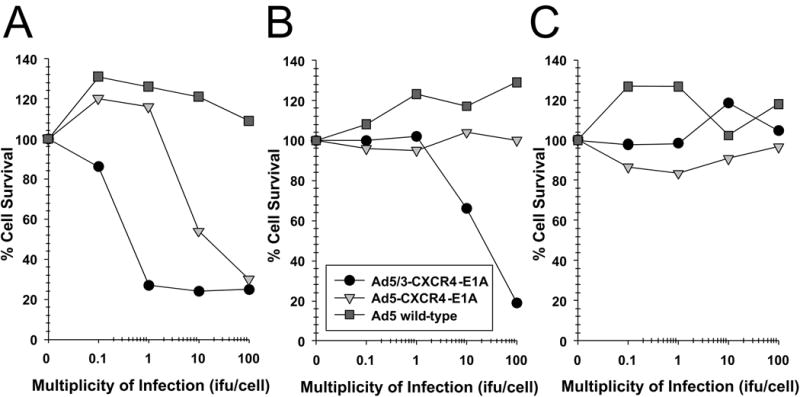
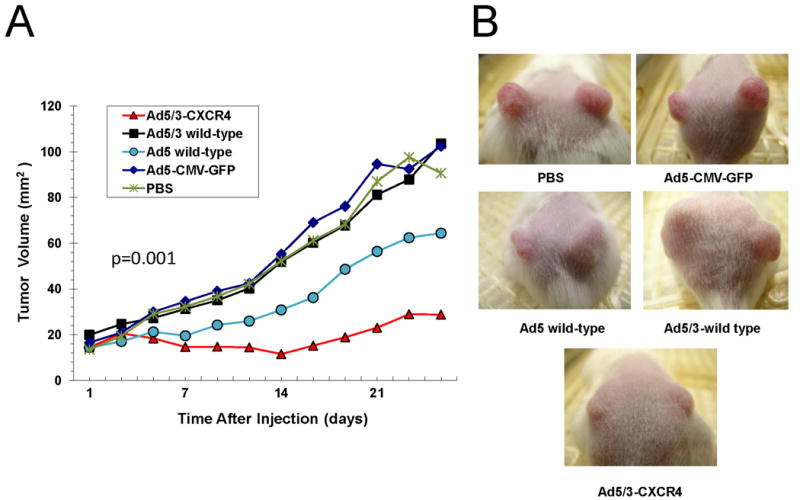
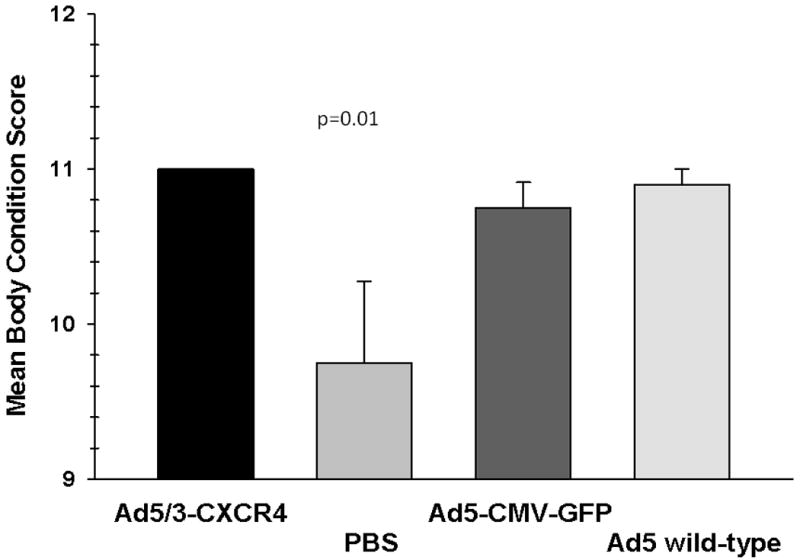
Human pancreatic cancer lines CFPAC-1, PANC-1, AsPC-1, and BxPC-3 were obtained from the American Type Culture Collection. Efficiency of Ad infection in the cells was determined by the use of an Ad construct expressing the green fluorescence protein (GFP) marker in place of the E1A gene (Ad5/3-CXCR4-GFP) and quantified by flow cytometry. Oncolytic activity in the pancreatic cancer cells was determined with the Ad5/3-CXCR4-E1A oncolytic Ad by a crystal violet staining method. To determine the oncolytic effect in vivo, pancreatic cancer cells were implanted on the flanks of 40 SCID mice (4 groups). Tumors were injected intratumorally for 3 days with Ad5/3-CXCR4-E1A, Ad5 wild-type (a positive control), or phosphate-buffered saline (a no virus control). Tumor size, overall survival, and body condition scale score were recorded. Statistical analyses included the Kaplan-Meier survival curve, the log-rank test, and one-way analysis of variance.
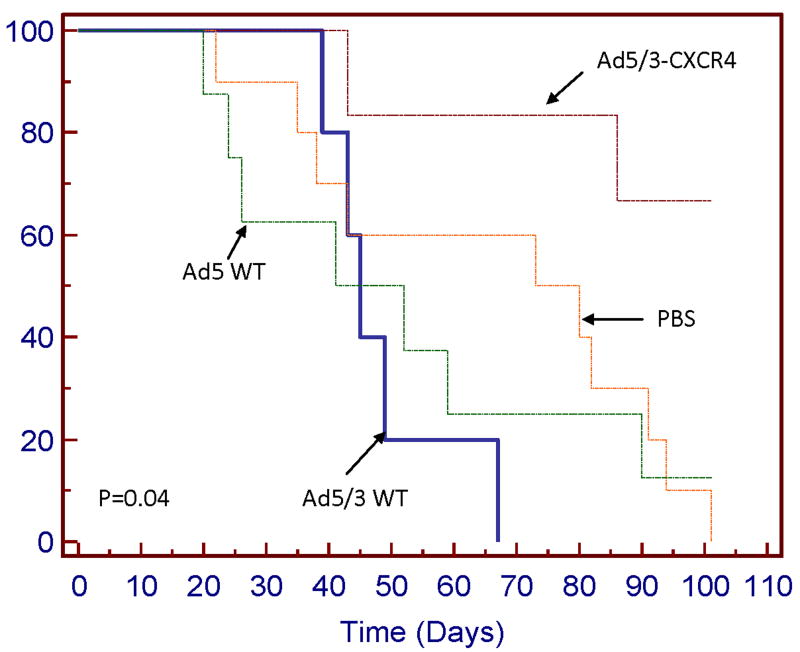
The serotype 3 fiber-modified Ad with the CXCR4 promoter (Ad5/3-CXCR4-E1A) was most efficient in infecting and lysing pancreatic cancer cells compared with an Ad containing an unmodified fiber knob (Ad5-CXCR4-E1A). Treatment of pancreatic tumor xenografts in vivo with Ad5/3-CXCR4-E1A group resulted in smaller tumors (P = .001), greater body condition scale score (P = .01), and greater survival time (P = .04) than the other treatment groups.
Ad5/3-CXCR4-E1A treatment significantly prolonged survival in SCID mice pancreatic tumor xenografts. This novel construct represents a potential new therapy against pancreatic cancer.
胰腺腺癌是一种侵袭性恶性肿瘤。溶瘤腺病毒(Ads)经过基因改造,专门针对肿瘤细胞,而不会损伤正常细胞。我们用 3 型腺病毒的 knob 结构域替换 5 型腺病毒的 knob 结构域,并加入 CXCR4 启动子来调节腺病毒 E1A 基因的表达(Ad5/3-CXCR4-E1A)。这些修饰旨在有效地感染和裂解胰腺肿瘤。
人胰腺癌细胞系 CFPAC-1、PANC-1、AsPC-1 和 BxPC-3 购自美国典型培养物保藏中心。用表达绿色荧光蛋白(GFP)标记物代替 E1A 基因的腺病毒构建体(Ad5/3-CXCR4-GFP)测定细胞中 Ad 感染的效率,并通过流式细胞术进行定量。用 Ad5/3-CXCR4-E1A 溶瘤腺病毒通过结晶紫染色法测定胰腺癌细胞的溶瘤活性。为了确定体内的溶瘤作用,将胰腺癌细胞植入 40 只 SCID 小鼠(4 组)的侧腹。肿瘤连续 3 天瘤内注射 Ad5/3-CXCR4-E1A、Ad5 野生型(阳性对照)或磷酸盐缓冲盐水(无病毒对照)。记录肿瘤大小、总生存期和身体状况评分。统计分析包括 Kaplan-Meier 生存曲线、对数秩检验和单因素方差分析。
与含有未修饰纤维 knob 的腺病毒(Ad5-CXCR4-E1A)相比,带有 CXCR4 启动子的 3 型纤维修饰腺病毒(Ad5/3-CXCR4-E1A)在感染和裂解胰腺癌细胞方面效率最高。与其他治疗组相比,Ad5/3-CXCR4-E1A 组治疗胰腺肿瘤异种移植小鼠的肿瘤更小(P =.001)、身体状况评分更高(P =.01)和生存时间更长(P =.04)。
Ad5/3-CXCR4-E1A 治疗显著延长了 SCID 小鼠胰腺肿瘤异种移植的生存时间。这种新型构建体代表了针对胰腺癌的潜在新疗法。