The Wellcome Trust Centre for Cell Biology, School of Biological Sciences, The University of Edinburgh, Edinburgh EH9 3JR, UK.
J Cell Sci. 2012 Oct 1;125(Pt 19):4457-62. doi: 10.1242/jcs.107979. Epub 2012 Aug 1.
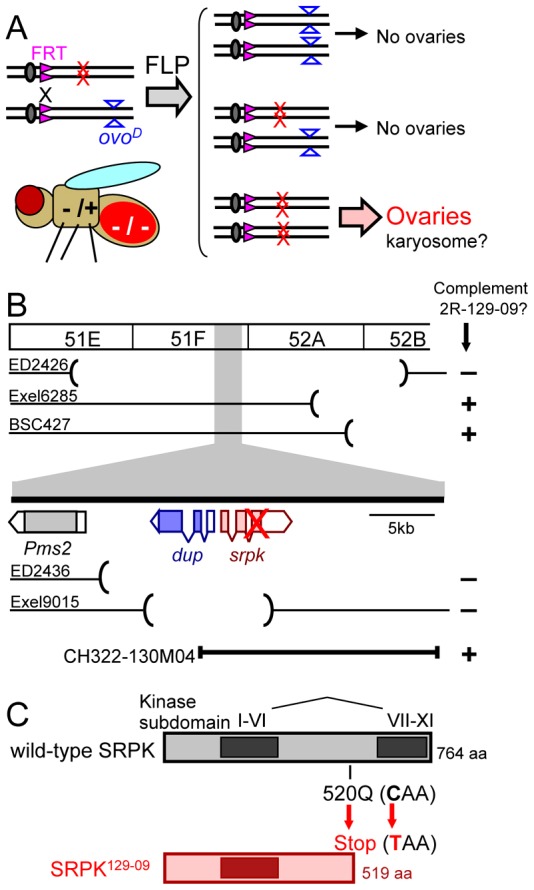
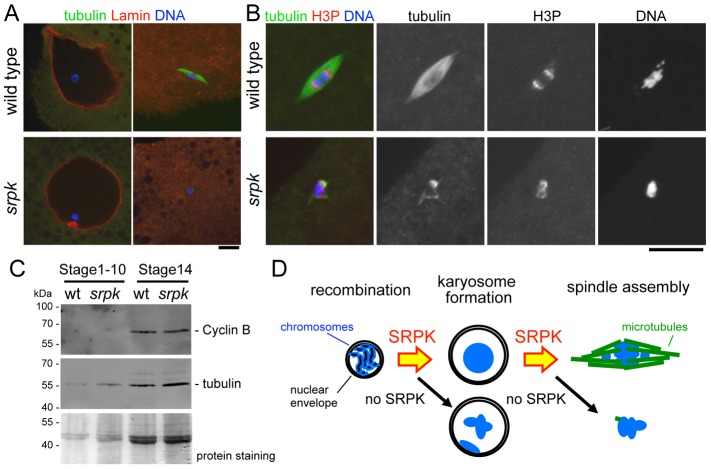
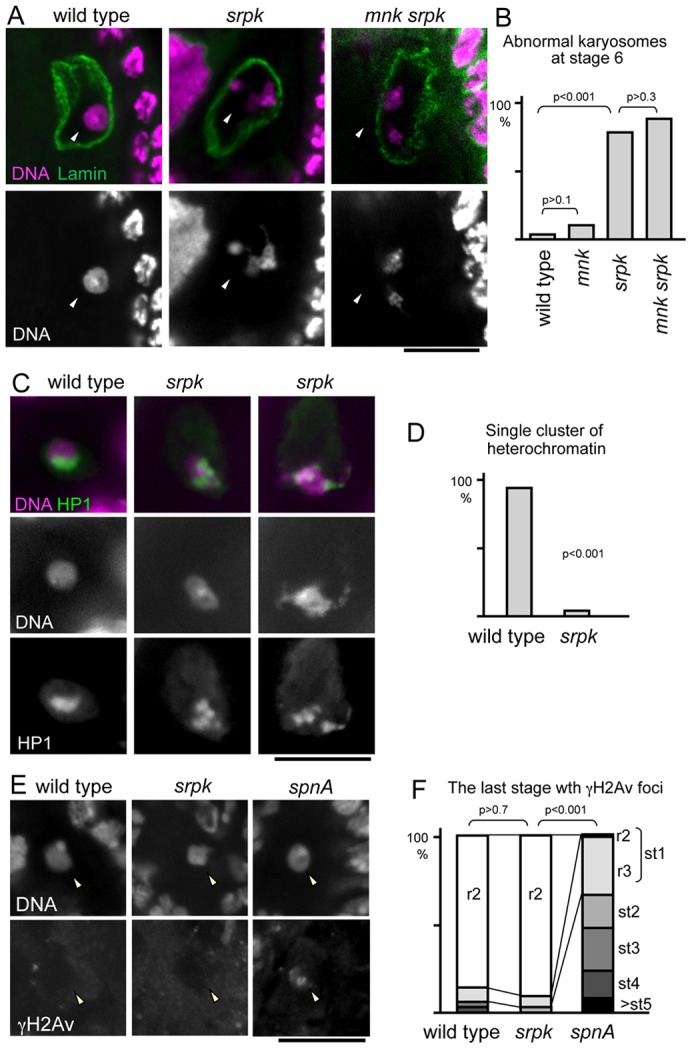
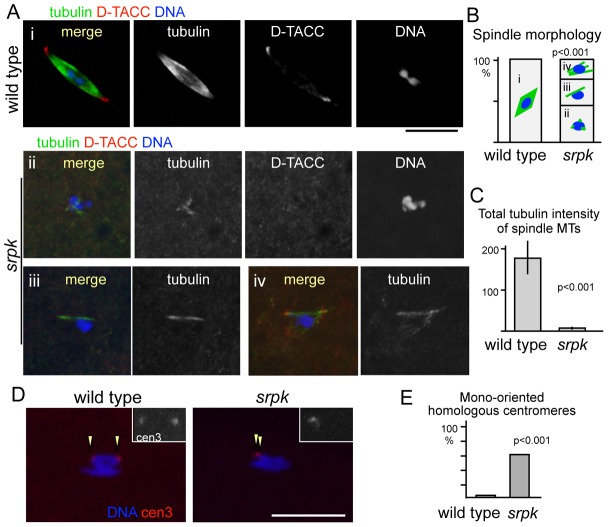
In Drosophila oocytes, after the completion of recombination, meiotic chromosomes form a compact cluster called the karyosome within the nucleus, and later assemble spindle microtubules without centrosomes. Although these oocyte-specific phenomena are also observed in humans, their molecular basis is not well understood. Here, we report essential roles for the conserved kinase SRPK in both karyosome formation and spindle microtubule assembly in oocytes. We have identified a female-sterile srpk mutant through a cytological screen for karyosome defects. Unlike most karyosome mutants, the karyosome defect is independent of the meiotic recombination checkpoint. Heterochromatin clustering found within the wild-type karyosome is disrupted in the mutant. Strikingly, a loss of SRPK severely prevents microtubule assembly for acentrosomal spindles in mature oocytes. Subsequently, bi-orientation and segregation of meiotic chromosomes are also defective. Therefore, this study demonstrates new roles of this conserved kinase in two independent meiotic steps specific to oocytes.
在果蝇卵母细胞中,完成重组后,减数分裂染色体在核内形成一个称为核体的紧密簇,然后在没有中心体的情况下组装纺锤体微管。尽管这些卵母细胞特有的现象也在人类中观察到,但它们的分子基础尚不清楚。在这里,我们报告了保守激酶 SRPK 在卵母细胞中核体形成和纺锤体微管组装中的重要作用。我们通过对核体缺陷的细胞学筛选鉴定出一个雌性不育 srpk 突变体。与大多数核体突变体不同,核体缺陷不依赖于减数分裂重组检查点。在突变体中,发现野生型核体内部的异染色质簇集被破坏。引人注目的是,SRPK 的缺失严重阻止了无中心体纺锤体的微管组装。随后,减数分裂染色体的双定向和分离也出现缺陷。因此,这项研究表明这种保守激酶在两个独立的卵母细胞特有的减数分裂步骤中具有新的作用。