Laboratory of Biosystem Dynamics, Computational Systems Biology Research Group, Department of Signal Processing, Tampere University of Technology, Tampere, Finland.
PLoS One. 2012;7(7):e42018. doi: 10.1371/journal.pone.0042018. Epub 2012 Jul 30.
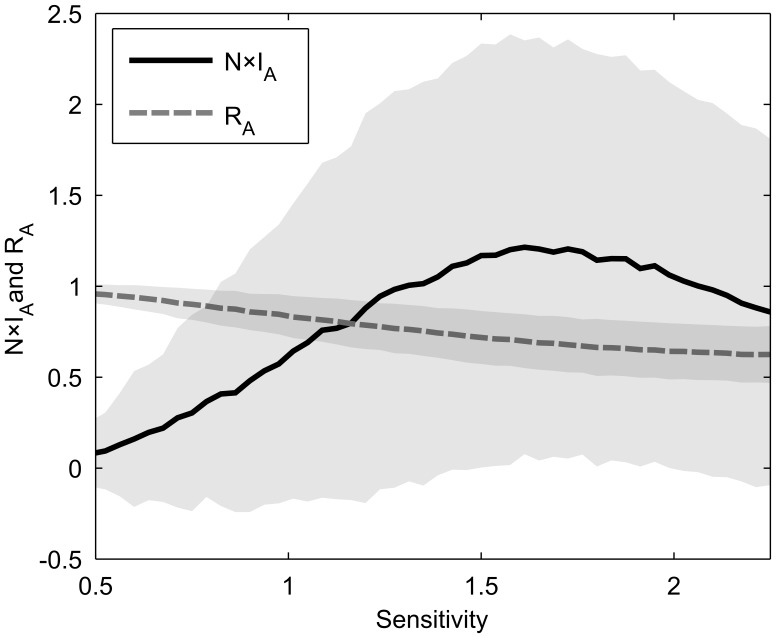
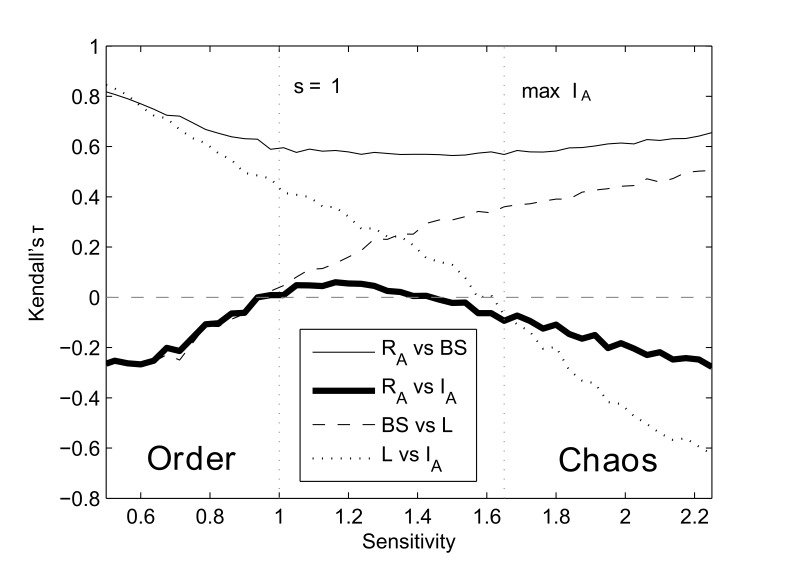
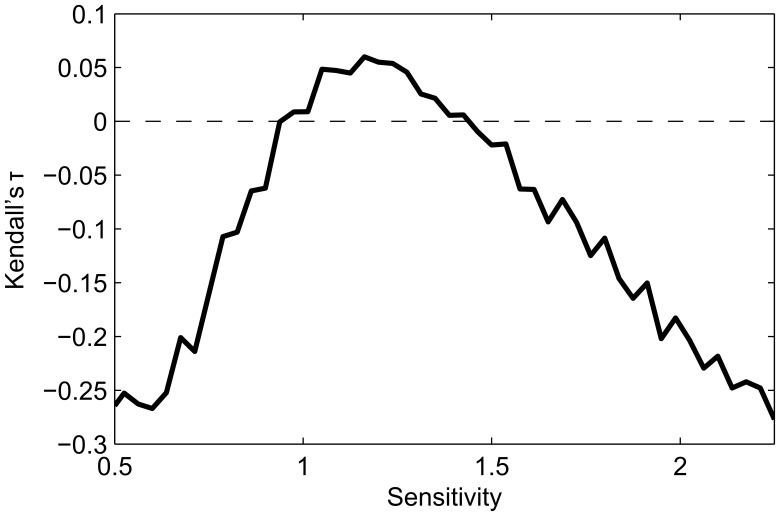
Attractors represent the long-term behaviors of Random Boolean Networks. We study how the amount of information propagated between the nodes when on an attractor, as quantified by the average pairwise mutual information (I(A)), relates to the robustness of the attractor to perturbations (R(A)). We find that the dynamical regime of the network affects the relationship between I(A) and R(A). In the ordered and chaotic regimes, I(A) is anti-correlated with R(A), implying that attractors that are highly robust to perturbations have necessarily limited information propagation. Between order and chaos (for so-called "critical" networks) these quantities are uncorrelated. Finite size effects cause this behavior to be visible for a range of networks, from having a sensitivity of 1 to the point where I(A) is maximized. In this region, the two quantities are weakly correlated and attractors can be almost arbitrarily robust to perturbations without restricting the propagation of information in the network.
吸引子代表随机布尔网络的长期行为。我们研究了当处于吸引子时,节点之间传播的信息量(由平均成对互信息(I(A))量化)与吸引子对扰动的鲁棒性(R(A))之间的关系。我们发现网络的动力学状态会影响 I(A)和 R(A)之间的关系。在有序和混沌状态下,I(A)与 R(A)呈反相关,这意味着对扰动具有高度鲁棒性的吸引子必然具有有限的信息传播。在有序和混沌之间(对于所谓的“临界”网络),这两个数量没有相关性。有限大小的效应导致这种行为在一系列网络中可见,从对 1 的敏感性到 I(A)最大化的点。在这个区域,这两个数量是弱相关的,吸引子可以几乎任意地对扰动具有鲁棒性,而不会限制网络中信息的传播。