UMR INRA ENVT 1225, Interactions Hôte Agent Pathogène, Ecole Nationale Vétérinaire de Toulouse, Toulouse, France.
PLoS One. 2012;7(7):e42019. doi: 10.1371/journal.pone.0042019. Epub 2012 Jul 31.
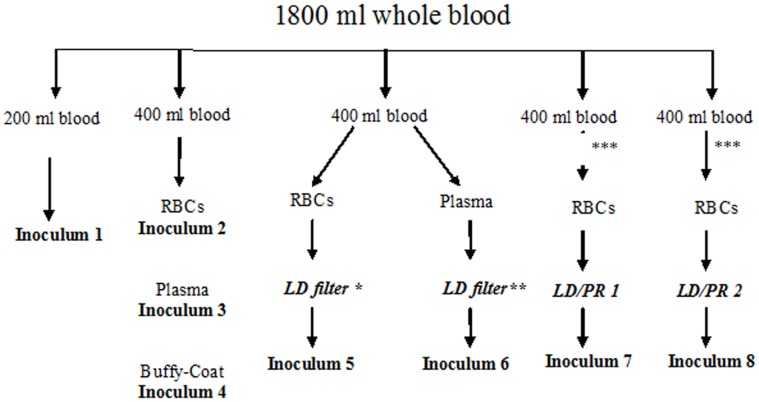
The identification in the UK of 4 v-CJD infected patients thought to be due to the use of transfused Red Blood Cell units prepared from blood of donors incubating v-CJD raised major concerns in transfusion medicine. The demonstration of leucocyte associated infectivity using various animal models of TSE infection led to the implementation of systematic leuco-depletion (LD) of Red Blood cells concentrates (RBCs) in a number of countries. In the same models, plasma also demonstrated a significant level of infectivity which raised questions on the impact of LD on the v-CJD transmission risk. The recent development of filters combining LD and the capture of non-leucocyte associated prion infectivity meant a comparison of the benefits of LD alone versus LD/prion-reduction filters (LD/PR) on blood-borne TSE transmission could be made. Due to the similarity of blood/plasma volumes to human transfusion medicine an experimental TSE sheep model was used to characterize the abilities of whole blood, RBCs, plasma and buffy-coat to transmit the disease through the transfusion route. The impact of a standard RBCs LD filter and of two different RBCs LD/PR prototype filters on the disease transmission was then measured. Homologous recipients transfused with whole-blood, buffy-coat and RBCs developed the disease with 100% efficiency. Conversely, plasma, when intravenously administered resulted in an inconstant infection of the recipients and no disease transmission was observed in sheep that received cryo-precipitated fraction or supernatant obtained from infectious plasma. Despite their high efficacy, LD and LD/PR filtration of the Red Blood Cells concentrate did not provide absolute protection from infection. These results support the view that leuco-depletion strongly mitigates the v-CJD blood borne transmission risk and provide information about the relative benefits of prion reduction filters.
在英国发现了 4 例疑似因使用来自潜伏期朊病毒感染供体的输血而感染 v-CJD 的患者,这在输血医学领域引起了重大关注。使用各种朊病毒感染的动物模型证明了白细胞相关感染性,导致在许多国家实施了红细胞浓缩物(RBC)的系统白细胞去除(LD)。在相同的模型中,血浆也显示出了显著的感染性,这引发了关于 LD 对 v-CJD 传播风险影响的问题。最近开发的结合 LD 和捕获非白细胞相关朊病毒感染性的过滤器意味着可以比较 LD 单独与 LD/朊病毒减少过滤器(LD/PR)对血液传播朊病毒病传播的益处。由于血液/血浆量与人类输血医学相似,因此使用实验性 TSE 绵羊模型来表征全血、RBC、血浆和白细胞层在通过输血途径传播疾病的能力。然后测量了标准 RBCs LD 过滤器和两种不同 RBCs LD/PR 原型过滤器对疾病传播的影响。用全血、白细胞层和 RBC 输血的同源受者以 100%的效率发病。相反,当静脉内给予时,血浆导致受者的感染不一致,并且在接受传染性血浆的冷冻沉淀物或上清液的绵羊中未观察到疾病传播。尽管 LD 和 RBCs 浓缩物的 LD/PR 过滤具有很高的功效,但它们并不能提供感染的绝对保护。这些结果支持白细胞去除强烈减轻 v-CJD 血液传播风险的观点,并提供了关于朊病毒减少过滤器相对益处的信息。