Department of Developmental Genetics, Institute of Advanced Medicine, Wakayama Medical University, Wakayama, Japan.
PLoS One. 2012;7(7):e42245. doi: 10.1371/journal.pone.0042245. Epub 2012 Jul 30.
Congenital diseases of the urinary tract are frequently observed in infants. Such diseases present a number of developmental anomalies such as hydroureter and hydronephrosis. Although some genetically-modified mouse models of growth factor signaling genes reproduce urinary phenotypes, the pathogenic mechanisms remain obscure. Previous studies suggest that a portion of the cells in the external genitalia and bladder are derived from peri-cloacal mesenchymal cells that receive Hedgehog (Hh) signaling in the early developmental stages. We hypothesized that defects in such progenitor cells, which give rise to urinary tract tissues, may be a cause of such diseases.
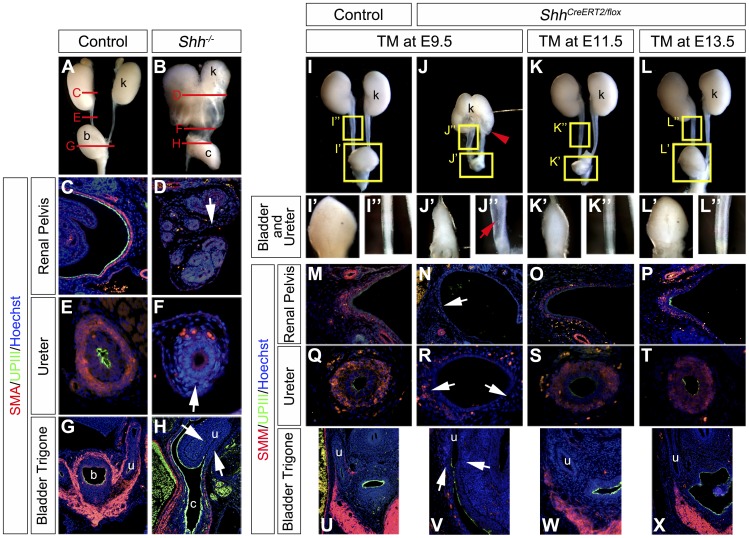
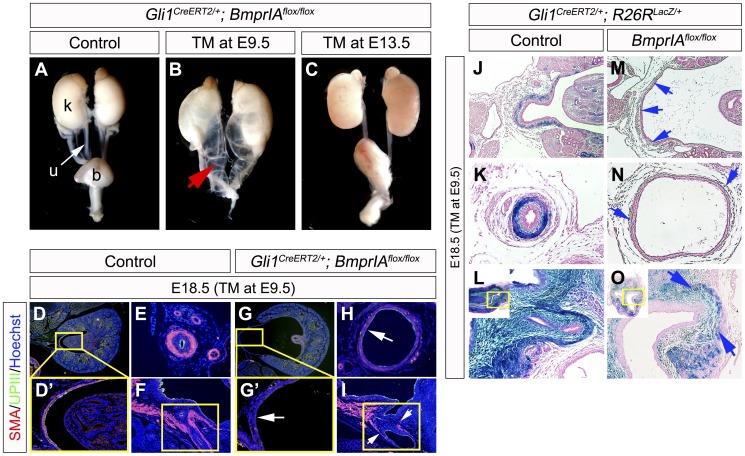
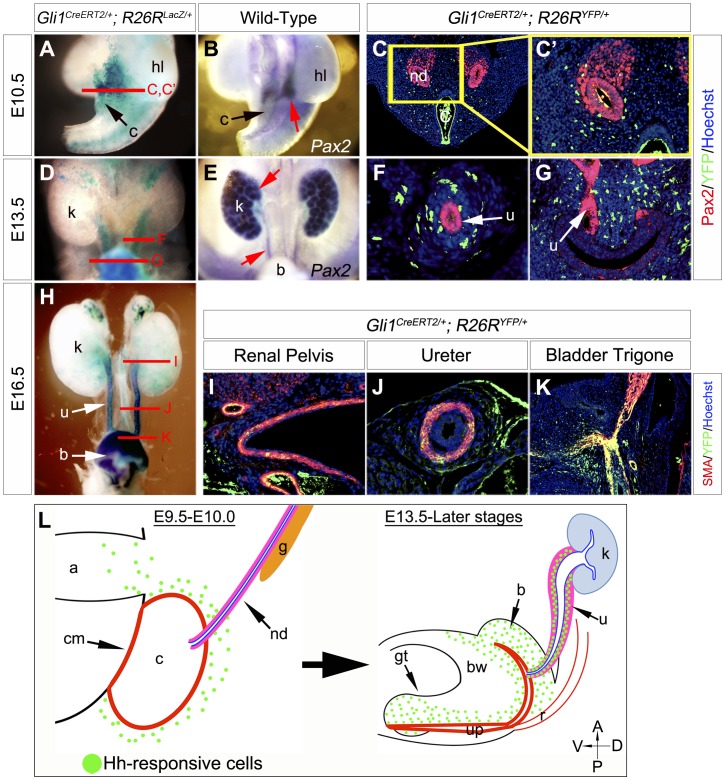
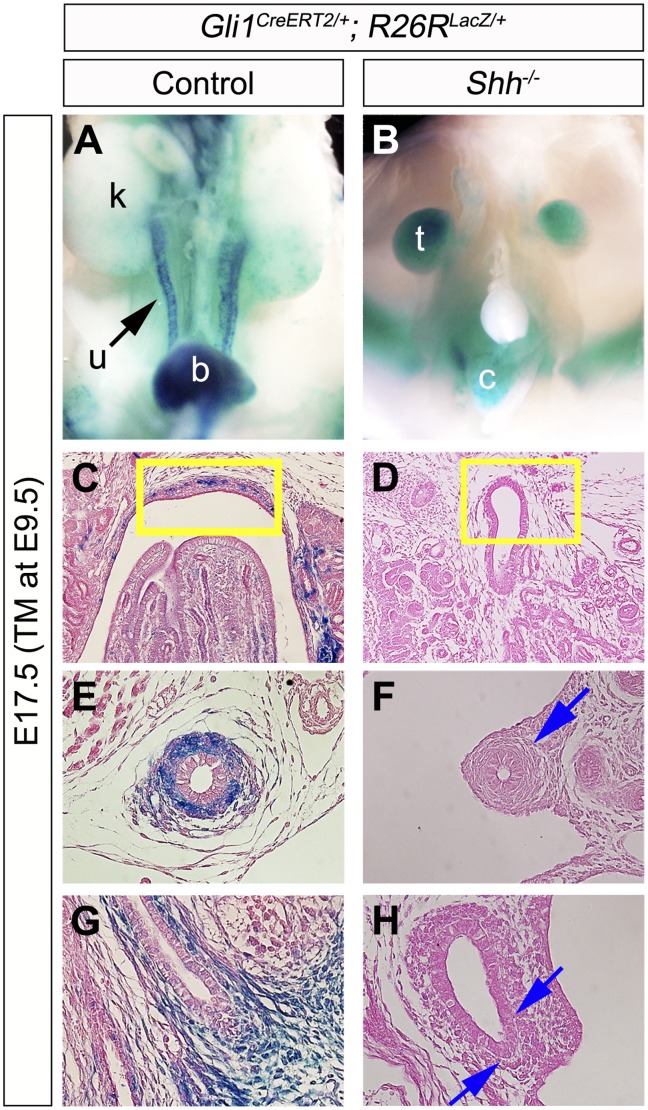
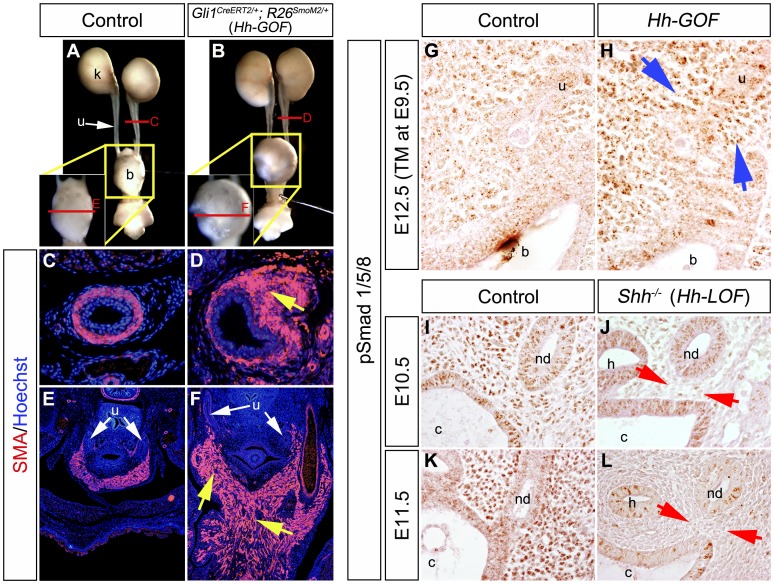
METHODOLOGY/PRINCIPAL FINDINGS: To elucidate the pathogenic mechanisms of upper urinary tract malformations, we analyzed a series of Sonic hedgehog (Shh) deficient mice. Shh(-/-) displayed hydroureter and hydronephrosis phenotypes and reduced expression of several developmental markers. In addition, we suggested that Shh modulation at an early embryonic stage is responsible for such phenotypes by analyzing the Shh conditional mutants. Tissue contribution assays of Hh-responsive cells revealed that peri-cloacal mesenchymal cells, which received Hh signal secreted from cloacal epithelium, could contribute to the ureteral mesenchyme. Gain- and loss-of-functional mutants for Hh signaling revealed a correlation between Hh signaling and Bone morphogenetic protein (Bmp) signaling. Finally, a conditional ablation of Bmp receptor type IA (BmprIA) gene was examined in Hh-responsive cell lineages. This system thus made it possible to analyze the primary functions of the growth factor signaling relay. The defective Hh-to-Bmp signaling relay resulted in severe urinary tract phenotypes with a decrease in the number of Hh-responsive cells.
CONCLUSIONS/SIGNIFICANCE: This study identified the essential embryonic stages for the pathogenesis of urinary tract phenotypes. These results suggested that Hh-responsive mesenchymal Bmp signaling maintains the population of peri-cloacal mesenchyme cells, which is essential for the development of the ureter and the upper urinary tract.
先天性尿路疾病在婴儿中较为常见。这些疾病表现出多种发育异常,如输尿管扩张和肾积水。虽然一些生长因子信号基因的基因修饰小鼠模型可再现尿路上皮表型,但发病机制尚不清楚。先前的研究表明,外生殖器和膀胱的一部分细胞来源于接受早期发育阶段 Hedgehog(Hh)信号的围肛间充质细胞。我们假设,产生尿路上皮组织的祖细胞缺陷可能是这些疾病的原因之一。
方法/主要发现:为了阐明上尿路畸形的发病机制,我们分析了一系列 Sonic hedgehog(Shh)缺陷小鼠。Shh(-/-)表现出输尿管扩张和肾积水表型,并且几种发育标志物的表达减少。此外,我们通过分析 Shh 条件性突变体,提出了早期胚胎阶段的 Shh 调节是导致这种表型的原因。Hh 反应性细胞的组织贡献测定表明,接受来自泄殖腔上皮分泌的 Hh 信号的围肛间充质细胞可有助于输尿管间充质。Hh 信号的获得和丧失功能突变体揭示了 Hh 信号与骨形态发生蛋白(Bmp)信号之间的相关性。最后,在 Hh 反应性细胞谱系中检查了 Bmp 受体 I 型 A(BmprIA)基因的条件性缺失。该系统因此使得分析生长因子信号转导的主要功能成为可能。有缺陷的 Hh 到 Bmp 信号转导导致严重的尿路上皮表型,Hh 反应性细胞数量减少。
结论/意义:本研究确定了尿路上皮表型发病机制的必要胚胎阶段。这些结果表明,Hh 反应性间充质 Bmp 信号维持围肛间充质细胞的群体,这对于输尿管和上尿路的发育是必需的。