King's College London, UK.
Behav Res Ther. 2012 Oct;50(10):636-46. doi: 10.1016/j.brat.2012.06.007. Epub 2012 Jul 7.
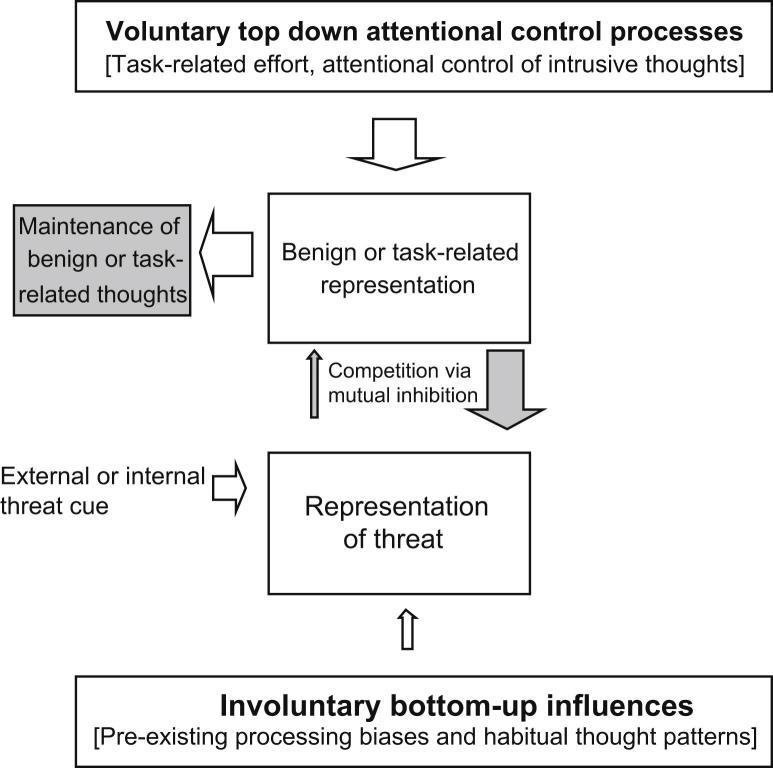
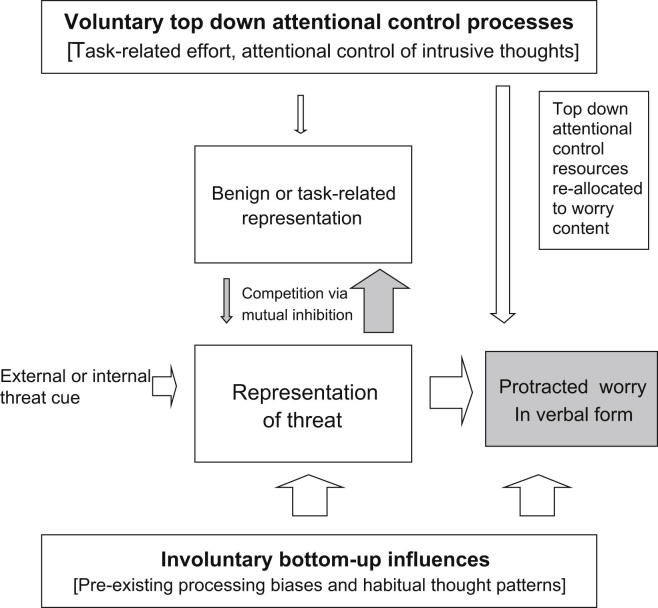
We present an evidence-based model of pathological worry in which worry arises from an interaction between involuntary (bottom-up) processes, such as habitual biases in attention and interpretation favouring threat content, and voluntary (top-down) processes, such as attentional control. At a pre-conscious level, these processes influence the competition between mental representations when some correspond to the intended focus of attention and others to threat distracters. Processing biases influence the probability of threat representations initially intruding into awareness as negative thoughts. Worry in predominantly verbal form then develops, influenced by conscious processes such as attempts to resolve the perceived threat and the redirection of attentional control resources to worry content, as well as the continuing influence of habitual processing biases. After describing this model, we present evidence for each component process and for their causal role in pathological worry, together with implications for new directions in the treatment of pathological worry.
我们提出了一个病理性担忧的循证模型,其中担忧源于无意识(自下而上)过程和有意识(自上而下)过程之间的相互作用,无意识过程如注意力和解释的习惯性偏向有利于威胁内容,有意识过程如注意力控制。在潜意识水平上,这些过程影响了当某些心理表征与注意力的预期焦点相对应,而其他心理表征则与威胁干扰物相对应时,心理表征之间的竞争。加工偏差影响了威胁表征最初以消极思想形式闯入意识的可能性。然后,主要以言语形式出现的担忧会受到有意识过程的影响,例如试图解决感知到的威胁,以及将注意力控制资源重新引导到担忧内容上,同时还受到习惯性加工偏差的持续影响。在描述这个模型之后,我们提出了每个组成过程的证据,以及它们在病理性担忧中的因果作用,以及对病理性担忧治疗新方向的影响。