Goodwin Huw, Eagleson Claire, Mathews Andrew, Yiend Jenny, Hirsch Colette
Institute of Psychiatry, Psychology, and Neuroscience, King's College London, London, UK.
University of California, Davis, Davis, CA USA.
Cognit Ther Res. 2017;41(3):479-488. doi: 10.1007/s10608-016-9818-5. Epub 2016 Nov 19.
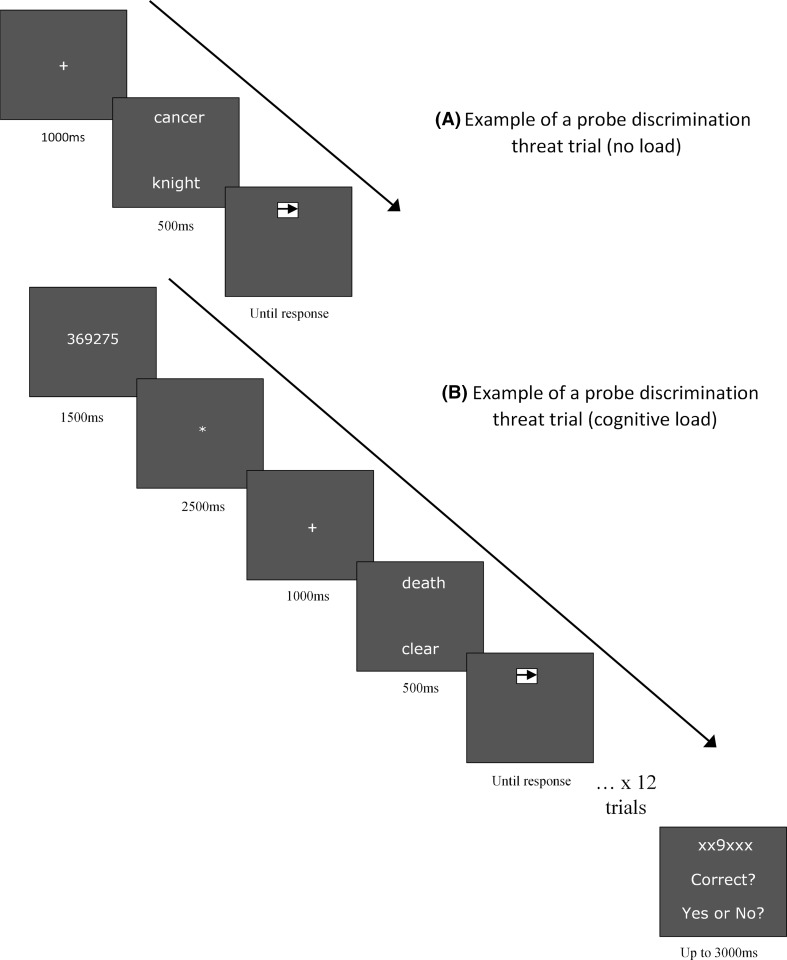
Individuals with high levels of worry are more likely than others to attend to possible threats, although the extent of top-down attentional control processes on this bias is unknown. We compared the performance of high ( = 26) and low worriers ( = 26) on a probe discrimination task designed to assess attention to threat cues, under cognitive load or no-load conditions. The expected difference between groups was confirmed, with high worriers being more likely to attend to threat cues than low worriers. Importantly however, there were no significant effects involving condition (cognitive load vs. no-load), nor any significant association with self-perceived attentional control ability. These results suggest that pathological worriers are more likely to attend to threat than are individuals with low levels of worry, regardless of task demands on limited cognitive control resources. This finding is consistent with the dominance of habitual bottom-up influences over top-down control processes in biased attention to threat.
担忧程度高的个体比其他人更有可能关注潜在威胁,尽管自上而下的注意力控制过程对这种偏差的影响程度尚不清楚。我们比较了高担忧者(n = 26)和低担忧者(n = 26)在一项旨在评估对威胁线索注意力的探测辨别任务中的表现,该任务设置了认知负荷或无负荷条件。两组之间的预期差异得到了证实,高担忧者比低担忧者更有可能关注威胁线索。然而,重要的是,没有涉及条件(认知负荷与无负荷)的显著影响,也没有与自我感知的注意力控制能力的显著关联。这些结果表明,无论对有限认知控制资源的任务要求如何,病理性担忧者比低担忧水平的个体更有可能关注威胁。这一发现与在对威胁的偏向性注意力中习惯性自下而上的影响优于自上而下的控制过程相一致。