Division of Genetics and Cell Biology, San Raffaele Scientific Institute, 20132 Milan, Italy.
J Exp Med. 2012 Aug 27;209(9):1519-28. doi: 10.1084/jem.20120189. Epub 2012 Aug 6.
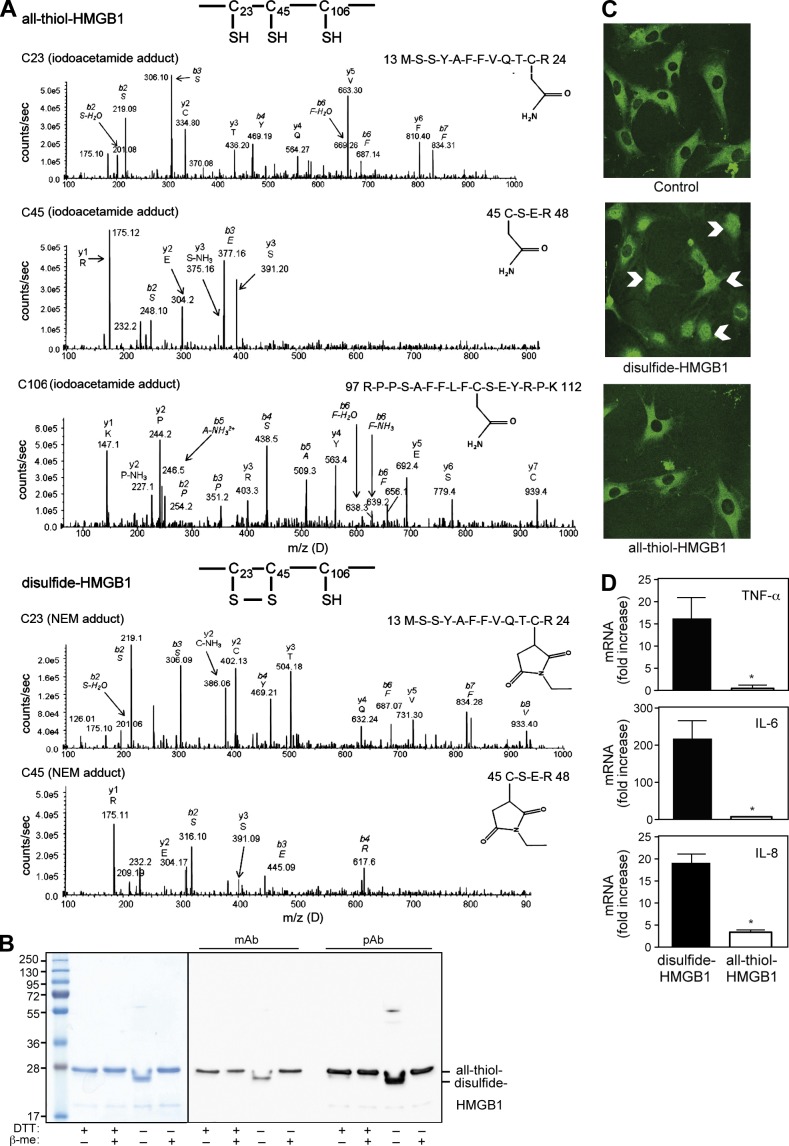
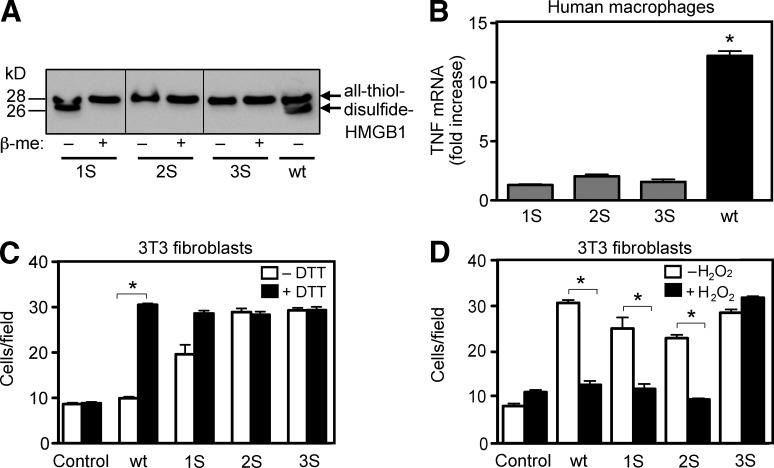
Tissue damage causes inflammation, by recruiting leukocytes and activating them to release proinflammatory mediators. We show that high-mobility group box 1 protein (HMGB1) orchestrates both processes by switching among mutually exclusive redox states. Reduced cysteines make HMGB1 a chemoattractant, whereas a disulfide bond makes it a proinflammatory cytokine and further cysteine oxidation to sulfonates by reactive oxygen species abrogates both activities. We show that leukocyte recruitment and activation can be separated. A nonoxidizable HMGB1 mutant in which serines replace all cysteines (3S-HMGB1) does not promote cytokine production, but is more effective than wild-type HMGB1 in recruiting leukocytes in vivo. BoxA, a HMGB1 inhibitor, interferes with leukocyte recruitment but not with activation. We detected the different redox forms of HMGB1 ex vivo within injured muscle. HMGB1 is completely reduced at first and disulfide-bonded later. Thus, HMGB1 orchestrates both key events in sterile inflammation, leukocyte recruitment and their induction to secrete inflammatory cytokines, by adopting mutually exclusive redox states.
组织损伤导致炎症,通过招募白细胞并激活它们释放促炎介质。我们表明,高迁移率族蛋白 B1(HMGB1)通过在相互排斥的氧化还原状态之间切换来协调这两个过程。还原半胱氨酸使 HMGB1 成为趋化因子,而二硫键使它成为促炎细胞因子,并且活性氧进一步将半胱氨酸氧化为磺酸根,从而消除了这两种活性。我们表明,白细胞的募集和激活可以分开。用丝氨酸取代所有半胱氨酸的不可氧化的 HMGB1 突变体(3S-HMGB1)不会促进细胞因子的产生,但在体内比野生型 HMGB1 更有效地招募白细胞。HMGB1 抑制剂 BoxA 干扰白细胞的募集但不干扰其激活。我们在损伤的肌肉内检测到 HMGB1 的不同氧化还原形式。HMGB1 最初完全还原,随后形成二硫键。因此,HMGB1 通过采用相互排斥的氧化还原状态来协调无菌性炎症中的两个关键事件,即白细胞募集及其诱导分泌炎症细胞因子。