Biochemistry Department, Virginia Tech, Blacksburg, Virginia, United States of America.
PLoS One. 2012;7(8):e40702. doi: 10.1371/journal.pone.0040702. Epub 2012 Aug 3.
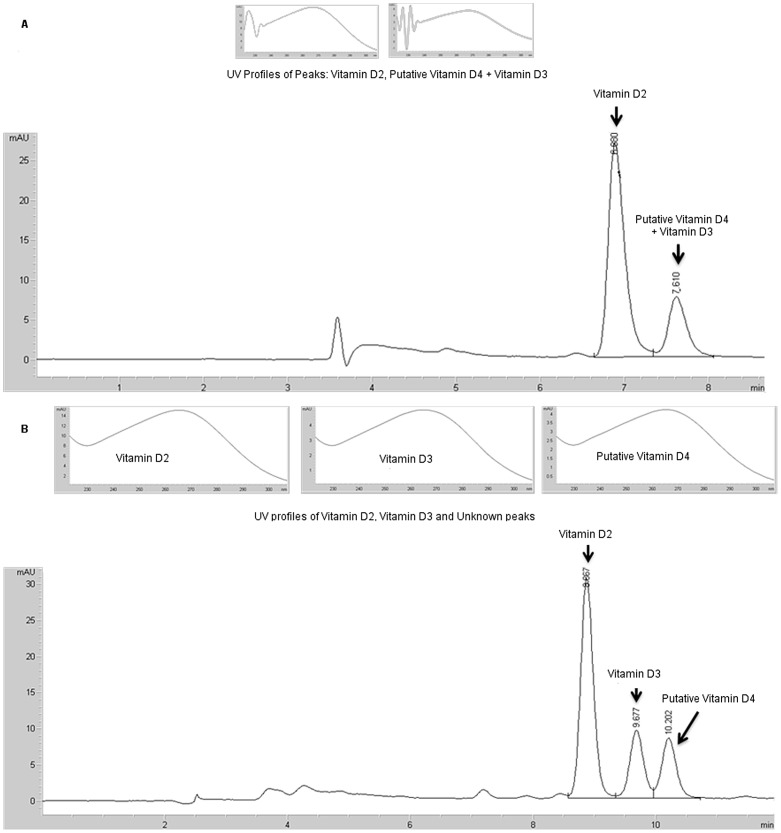
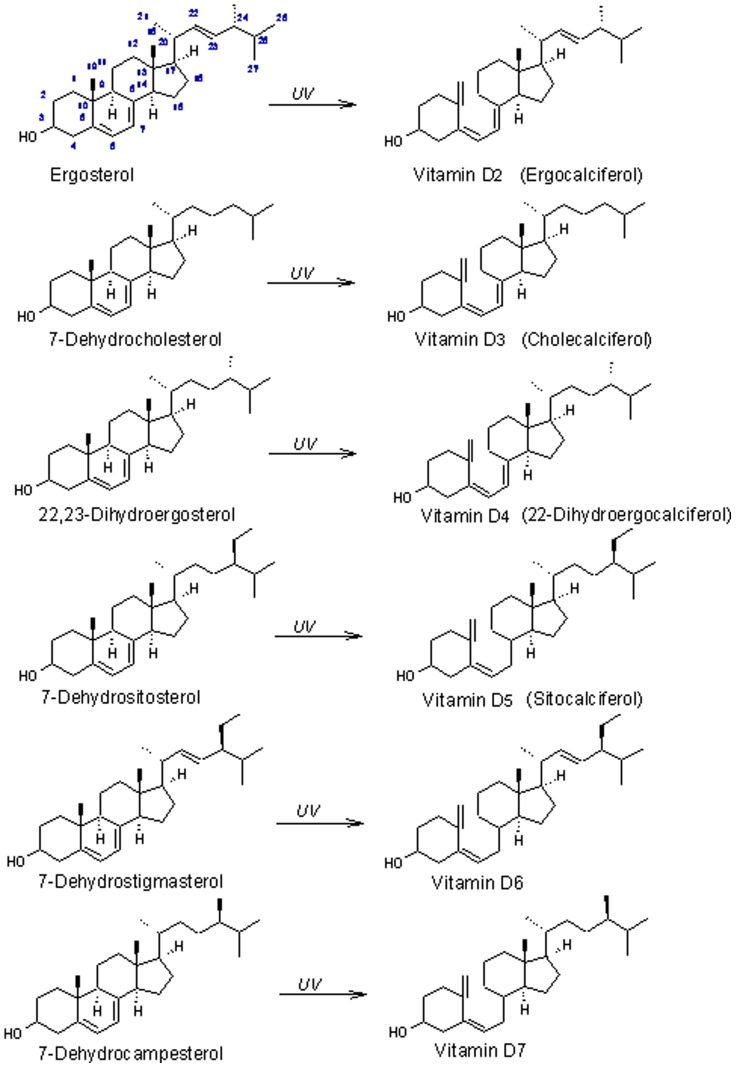
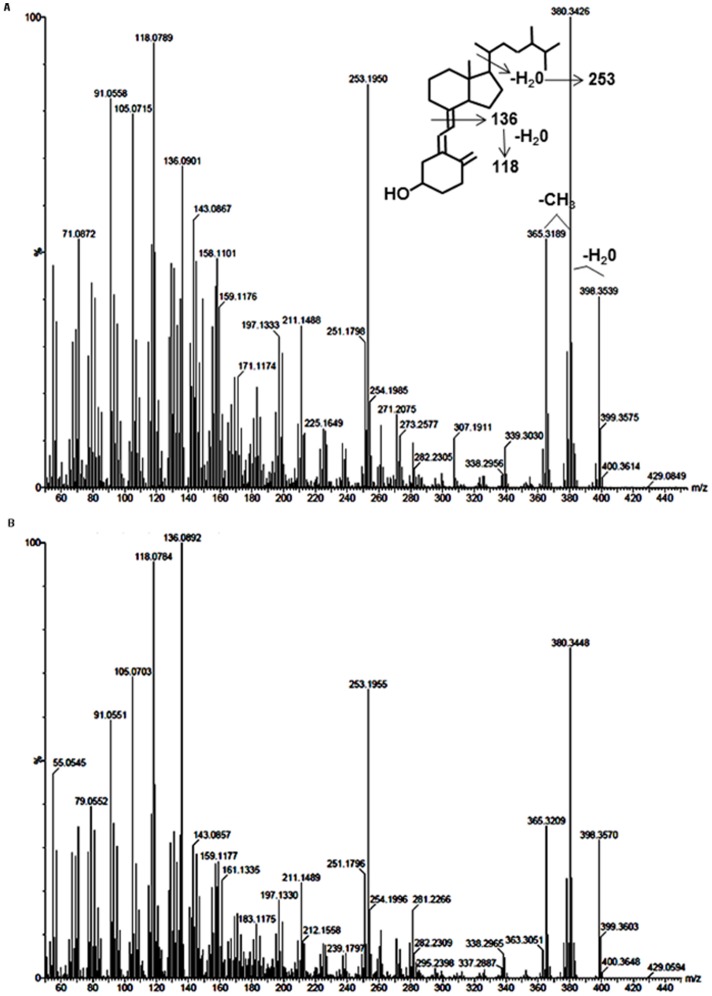
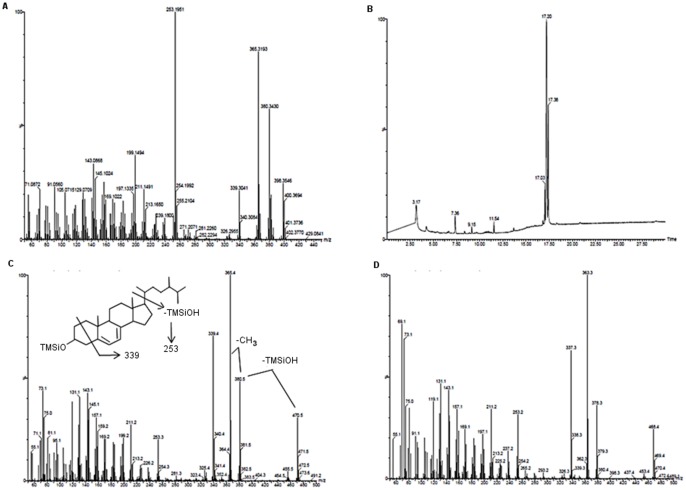
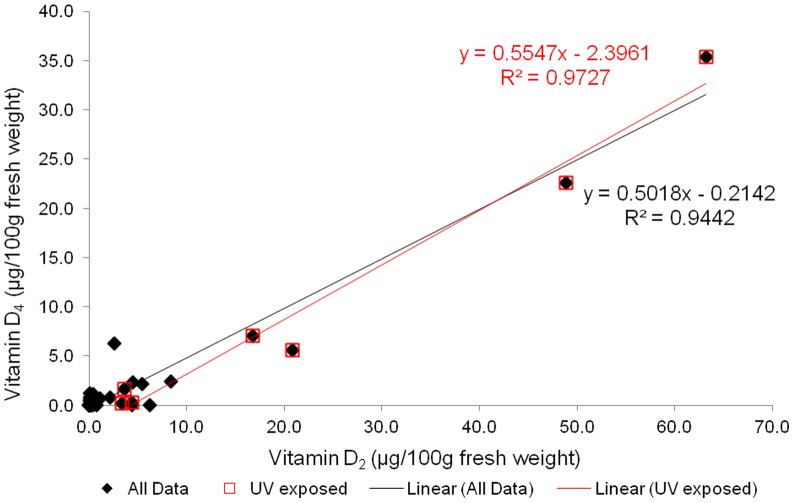
An unknown vitamin D compound was observed in the HPLC-UV chromatogram of edible mushrooms in the course of analyzing vitamin D(2) as part of a food composition study and confirmed by liquid chromatography-mass spectrometry to be vitamin D(4) (22-dihydroergocalciferol). Vitamin D(4) was quantified by HPLC with UV detection, with vitamin [(3)H] itamin D(3) as an internal standard. White button, crimini, portabella, enoki, shiitake, maitake, oyster, morel, chanterelle, and UV-treated portabella mushrooms were analyzed, as four composites each of a total of 71 samples from U.S. retail suppliers and producers. Vitamin D(4) was present (>0.1 µg/100 g) in a total of 18 composites and in at least one composite of each mushroom type except white button. The level was highest in samples with known UV exposure: vitamin D enhanced portabella, and maitake mushrooms from one supplier (0.2-7.0 and 22.5-35.4 µg/100 g, respectively). Other mushrooms had detectable vitamin D(4) in some but not all samples. In one composite of oyster mushrooms the vitamin D(4) content was more than twice that of D(2) (6.29 vs. 2.59 µg/100 g). Vitamin D(4) exceeded 2 µg/100 g in the morel and chanterelle mushroom samples that contained D(4), but was undetectable in two morel samples. The vitamin D(4) precursor 22,23-dihydroergosterol was found in all composites (4.49-16.5 mg/100 g). Vitamin D(4) should be expected to occur in mushrooms exposed to UV light, such as commercially produced vitamin D enhanced products, wild grown mushrooms or other mushrooms receiving incidental exposure. Because vitamin D(4) coeluted with D(3) in the routine HPLC analysis of vitamin D(2) and an alternate mobile phase was necessary for resolution, researchers analyzing vitamin D(2) in mushrooms and using D(3) as an internal standard should verify that the system will resolve vitamins D(3) and D(4).
在分析食品成分研究中的维生素 D(2) 时,我们在食用蘑菇的 HPLC-UV 色谱图中观察到一种未知的维生素 D 化合物,并通过液相色谱-质谱法确认为维生素 D(4)(22-去氢胆钙化醇)。我们使用 HPLC 结合紫外线检测定量维生素 D(4),以维生素 [(3)H] 维生素 D(3) 作为内标。我们分析了白蘑菇、糙皮侧耳、褐环乳牛肝菌、金针菇、香菇、舞茸、牡蛎、羊肚菌、鸡油菌、鸡油菌和经过 UV 处理的褐环乳牛肝菌,这是从美国零售供应商和生产商那里获得的总共 71 个样本的四个组合。除了白蘑菇,在每种蘑菇类型的至少一个组合中,均发现了含量超过 0.1µg/100g 的维生素 D(4)。在已知经过 UV 照射的样本中,维生素 D(4)的含量最高:经过 UV 处理的褐环乳牛肝菌和舞茸蘑菇,来自一位供应商,含量分别为 0.2-7.0 和 22.5-35.4µg/100g。其他蘑菇的某些样本中也能检测到维生素 D(4),但并非所有样本都能检测到。在一个牡蛎蘑菇的组合中,维生素 D(4)的含量是 D(2)的两倍多(6.29 与 2.59µg/100g)。在含有 D(4)的羊肚菌和鸡油菌样本中,维生素 D(4)的含量超过 2µg/100g,但在两个羊肚菌样本中未检测到。所有组合中都发现了维生素 D(4)的前体 22,23-去氢麦角固醇(4.49-16.5mg/100g)。在接受商业生产的维生素 D 强化产品、野生蘑菇或其他偶然暴露的蘑菇中,应该会发现含有紫外线的蘑菇中存在维生素 D(4)。由于在常规 HPLC 分析维生素 D(2)时,维生素 D(4)与 D(3)共洗脱,并且需要替代的流动相来实现分离,因此分析蘑菇中的维生素 D(2)并使用 D(3)作为内标时,研究人员应该验证该系统是否可以分离维生素 D(3)和 D(4)。