Hurley James C, Guidet Bertrand, Offenstadt Georges, Maury Eric
Crit Care. 2012 Aug 7;16(4):R148. doi: 10.1186/cc11462.
The interdependence between endotoxemia, gram negative (GN) bacteremia and mortality has been extensively studied. Underlying patient risk and GN bacteremia types are possible confounders of the relationship.
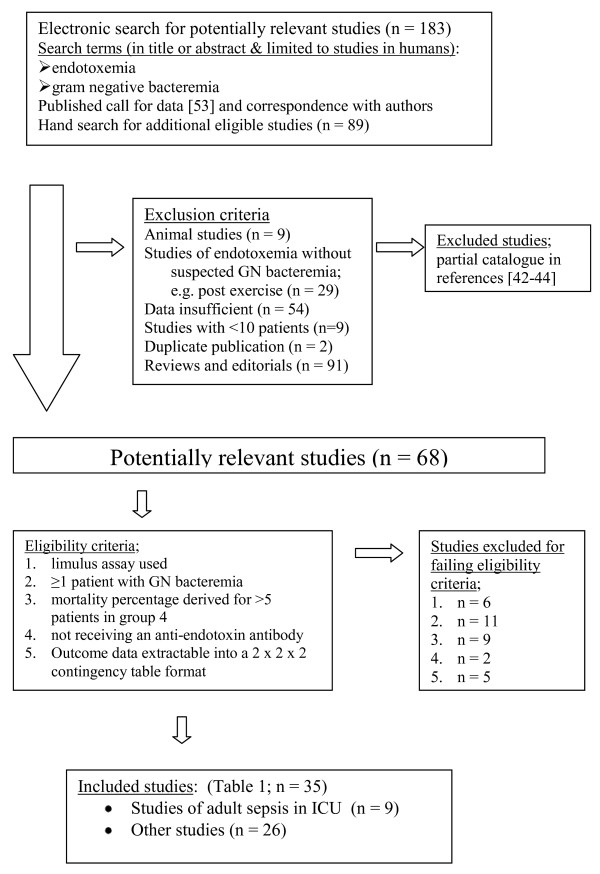
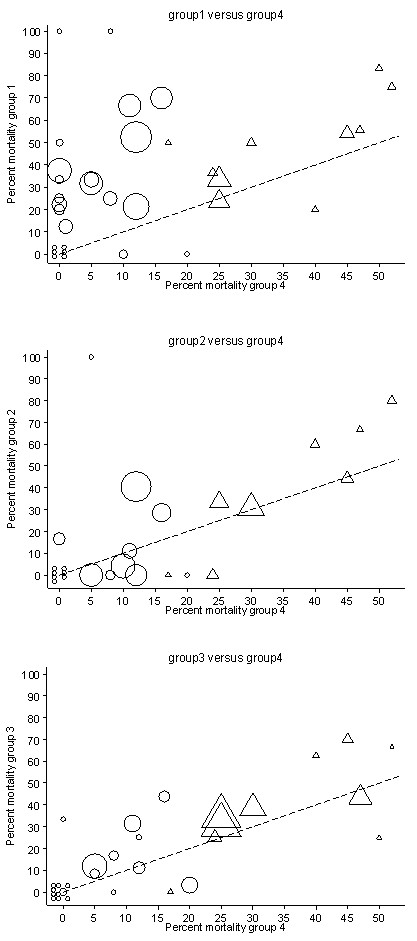
Published studies with ≥ 10 patients in either ICU or non-ICU settings, endotoxemia detection by limulus assay, reporting mortality proportions and ≥ 1 GN bacteremia were included. Summary odds ratios (OR) for mortality were derived across all studies by meta-analysis for the following contrasts: sub-groups with either endotoxemia (group three), GN bacteremia (group two) or both (group one) each versus the group with neither detected (group four; reference group). The mortality proportion for group four is the proxy measure of study level risk within L'Abbé plots.
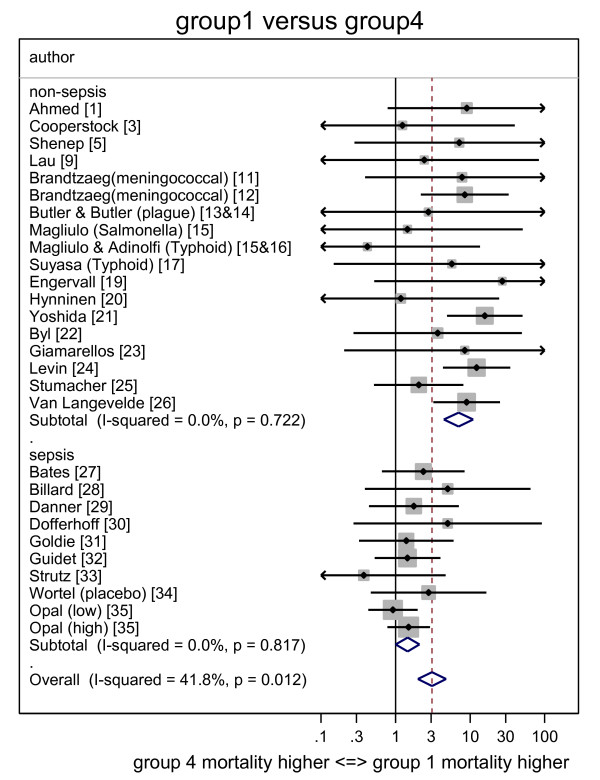
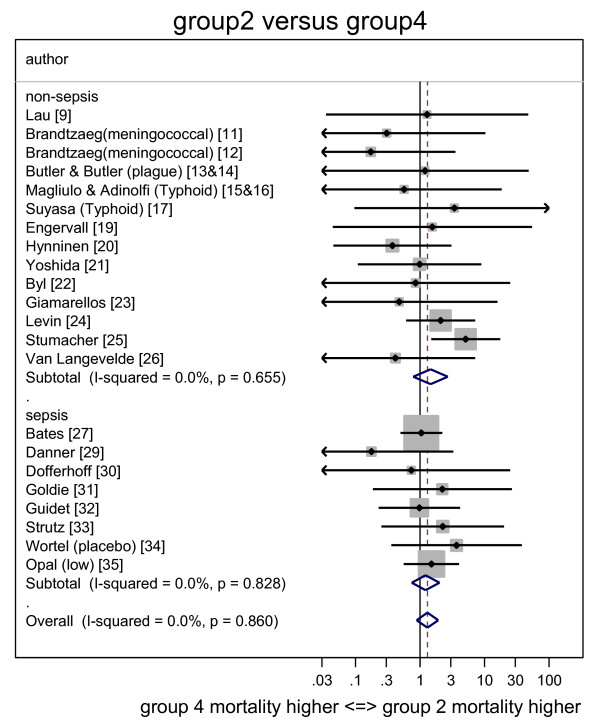
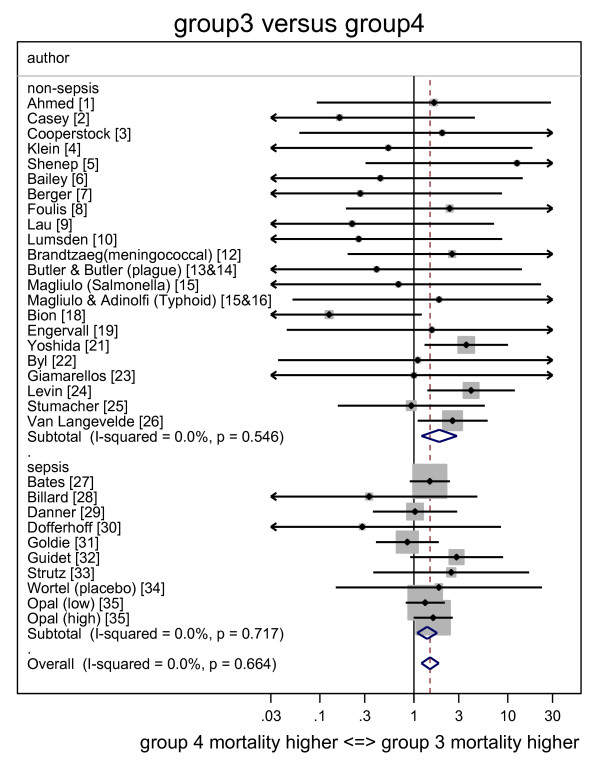
Thirty-five studies were found. Among nine studies in an ICU setting, the OR for mortality was borderline (OR <2) or non-significantly increased for groups two (GN bacteremia alone) and three (endotoxemia alone) and patient group one (GN bacteremia and endotoxemia co-detected) each versus patient group four (neither endotoxemia nor GN bacteremia detected). The ORs were markedly higher for group one versus group four (OR 6.9; 95% confidence interval (CI), 4.4 -to 11.0 when derived from non-ICU studies. The distributions of Pseudomonas aeruginosa and Escherichia coli bacteremias among groups one versus two are significantly unequal.
The co-detection of GN bacteremia and endotoxemia is predictive of increased mortality risk versus the detection of neither but only in studies undertaken in a non-ICU setting. Variation in GN bacteremia species types and underlying risk are likely unrecognized confounders in the individual studies.
内毒素血症、革兰氏阴性(GN)菌血症与死亡率之间的相互依存关系已得到广泛研究。患者的潜在风险和GN菌血症类型可能是这种关系的混杂因素。
纳入在重症监护病房(ICU)或非ICU环境中进行的、≥10例患者的已发表研究,通过鲎试剂法检测内毒素血症,报告死亡率比例和≥1次GN菌血症情况。通过荟萃分析得出所有研究中死亡率的汇总比值比(OR),用于以下对比:分别具有内毒素血症(第三组)、GN菌血症(第二组)或两者兼具(第一组)的亚组与未检测到任何一项的组(第四组;参照组)。第四组的死亡率比例是L'Abbé图中研究水平风险的替代指标。
共找到35项研究。在9项ICU环境中的研究里,第二组(仅GN菌血症)、第三组(仅内毒素血症)和第一组患者(同时检测到GN菌血症和内毒素血症)相对于第四组患者(未检测到内毒素血症和GN菌血症)的死亡率OR处于临界值(OR<2)或无显著升高。在非ICU研究中得出的第一组与第四组的OR显著更高(OR 6.9;95%置信区间(CI),4.4至11.0)。第一组和第二组之间铜绿假单胞菌菌血症和大肠杆菌菌血症的分布显著不同。
与未检测到GN菌血症和内毒素血症相比,同时检测到GN菌血症和内毒素血症预示着死亡风险增加,但仅在非ICU环境中进行的研究中如此。GN菌血症菌种类型的差异和潜在风险可能是个别研究中未被认识到的混杂因素。