Rodriguez Juan I, Kern Janet K
Stop Calling It Autism, Fort Worth, TX, USA.
Neuron Glia Biol. 2011 May;7(2-4):205-13. doi: 10.1017/S1740925X12000142. Epub 2012 Jul 6.
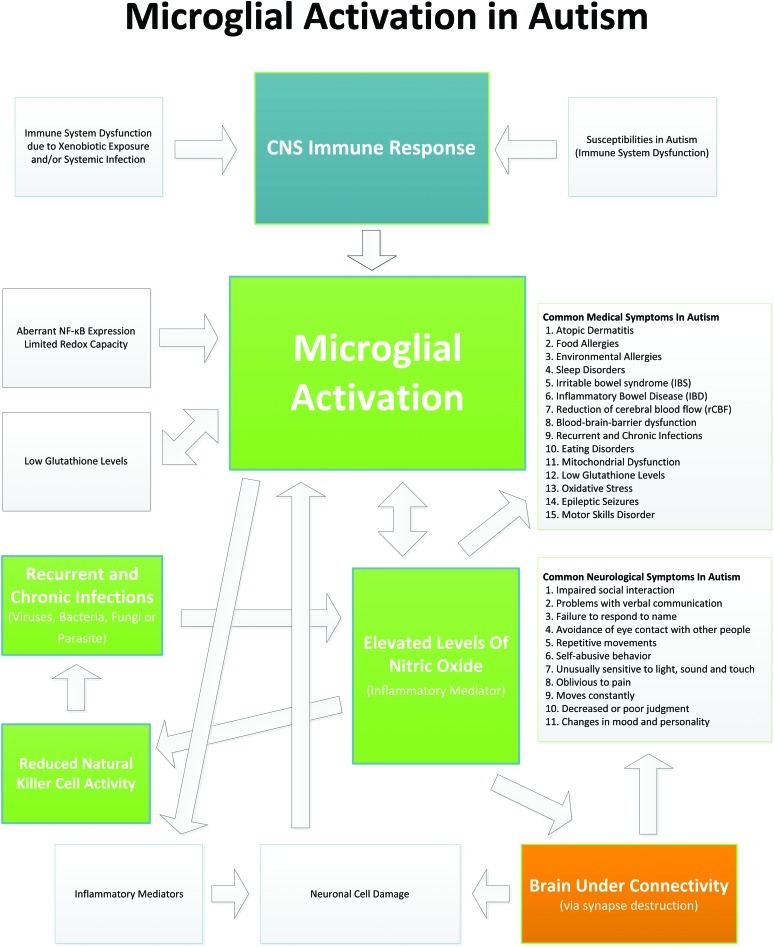
Evidence indicates that children with autism spectrum disorder (ASD) suffer from an ongoing neuroinflammatory process in different regions of the brain involving microglial activation. When microglia remain activated for an extended period, the production of mediators is sustained longer than usual and this increase in mediators contributes to loss of synaptic connections and neuronal cell death. Microglial activation can then result in a loss of connections or underconnectivity. Underconnectivity is reported in many studies in autism. One way to control neuroinflammation is to reduce or inhibit microglial activation. It is plausible that by reducing brain inflammation and microglial activation, the neurodestructive effects of chronic inflammation could be reduced and allow for improved developmental outcomes. Future studies that examine treatments that may reduce microglial activation and neuroinflammation, and ultimately help to mitigate symptoms in ASD, are warranted.
有证据表明,自闭症谱系障碍(ASD)儿童的大脑不同区域存在持续的神经炎症过程,这涉及小胶质细胞的激活。当小胶质细胞长时间保持激活状态时,介质的产生会比正常情况持续更长时间,而介质的这种增加会导致突触连接丧失和神经元细胞死亡。小胶质细胞激活随后可能导致连接丧失或连接不足。许多关于自闭症的研究都报告了连接不足的情况。控制神经炎症的一种方法是减少或抑制小胶质细胞的激活。通过减轻脑部炎症和小胶质细胞激活,有可能减少慢性炎症的神经破坏作用,并改善发育结果。未来有必要开展研究,探究可能减少小胶质细胞激活和神经炎症并最终有助于减轻ASD症状的治疗方法。