HIV Immunopathogenesis Laboratory, The Wistar Institute, Philadelphia, PA 19104, USA.
AIDS. 2012 Sep 24;26(15):1869-78. doi: 10.1097/QAD.0b013e32835861b0.
Both protective T-cell genotypes and natural killer (NK) cell genotypes have been associated with delayed progression to AIDS and shown to be co-inherited in HIV-1-infected individuals who limit viral replication in absence of antiretroviral therapy ('controllers'). However, a comparative analysis of the genotype and function of the innate and adaptive immune compartments in HIV-1-infected controller individuals has been understudied to date.
Here, we simultaneously tested NK and T-cell function in controllers to investigate the mechanism(s) that might account for host immune control over viral replication.
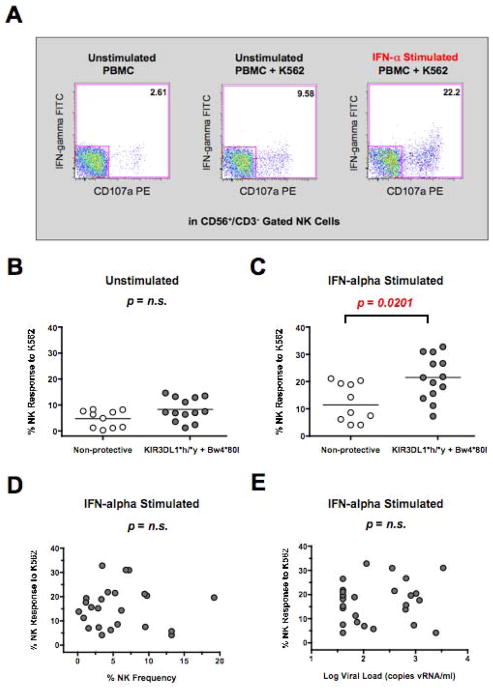
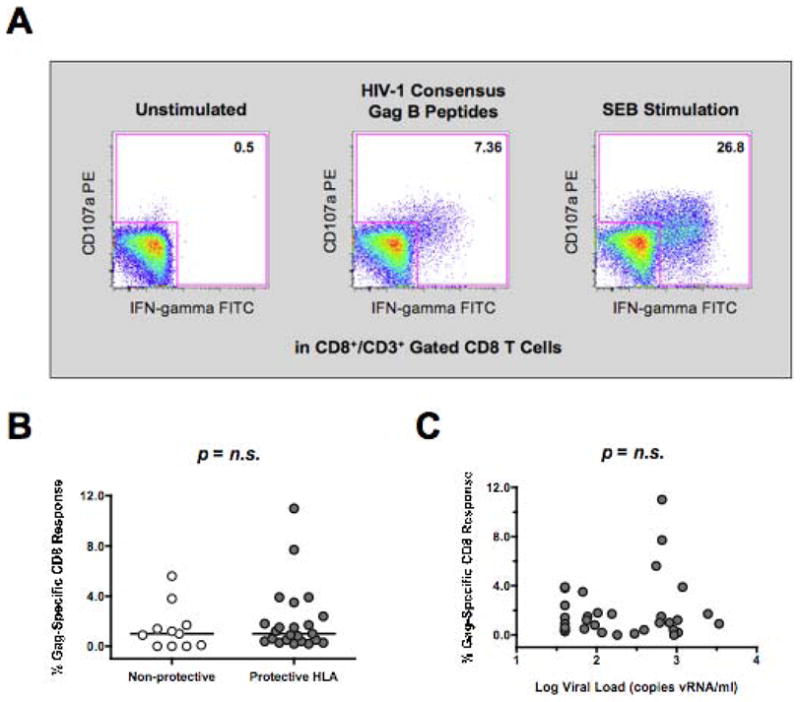
We measured CD8 T-cell responses against HIV-1 utilizing overlapping 15-mer peptides spanning the HIV-1 consensus clade B Gag protein and tested NK cell degranulation and cytokine secretion against tumor target cells following interferon-α (IFNα) stimulation.
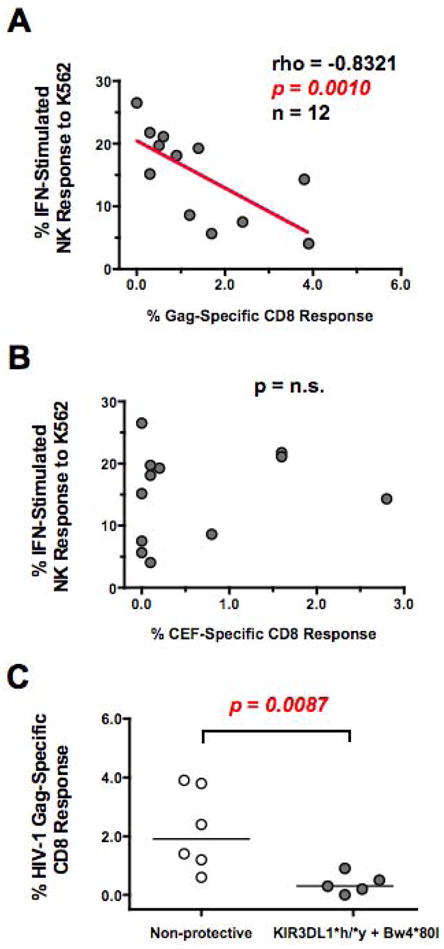
Among a cohort of 37 controllers, the presence of protective major histocompatibility complex class I human leukocyte antigen (HLA) alleles (such as HLA-B57) was not correlated with HIV-specific CD8 responses. In contrast, the inheritance of a protective killer inhibitory receptor KIR3DL1h/y receptor genotype along with the corresponding HLA-Bw480I ligand was associated with significantly heightened target cell-induced NK degranulation and cytokine secretion following IFNα stimulation (P = 0.0201, n = 13). Interestingly, we observed a significant inverse association between the IFNα stimulated NK response to K562 cells and the HIV-specific CD8 T-cell response to Gag among elite controllers (rho = -0.8321, P = 0.0010, n = 12).
Together, these results suggest that heightened NK responses can be evidenced independently of HIV-specific T-cell responses in HIV-1-infected elite controllers.
保护性 T 细胞基因型和自然杀伤 (NK) 细胞基因型都与艾滋病进展延迟有关,并在未经抗逆转录病毒治疗(“控制器”)的情况下限制病毒复制的 HIV-1 感染者中表现出共同遗传。然而,迄今为止,对 HIV-1 感染的控制器个体中先天和适应性免疫成分的基因型和功能进行比较分析的研究较少。
在这里,我们同时测试了控制器中的 NK 和 T 细胞功能,以研究可能导致宿主对病毒复制进行免疫控制的机制。
我们使用跨越 HIV-1 共识 clade B Gag 蛋白的重叠 15 -mer 肽来测量针对 HIV-1 的 CD8 T 细胞反应,并在干扰素-α (IFNα) 刺激下测试 NK 细胞脱颗粒和细胞因子分泌针对肿瘤靶细胞。
在 37 名控制器的队列中,保护性主要组织相容性复合体 I 类人类白细胞抗原 (HLA) 等位基因(如 HLA-B57)的存在与 HIV 特异性 CD8 反应无关。相反,保护性杀伤抑制受体 KIR3DL1h/y 受体基因型与相应的 HLA-Bw480I 配体的遗传与 IFNα 刺激后靶细胞诱导的 NK 脱颗粒和细胞因子分泌显著升高有关(P=0.0201,n=13)。有趣的是,我们观察到精英控制器中 IFNα 刺激的 NK 对 K562 细胞的反应与 Gag 特异性 CD8 T 细胞反应之间存在显著的负相关(rho=-0.8321,P=0.0010,n=12)。
综上所述,这些结果表明,在 HIV-1 感染的精英控制器中,NK 反应的增强可以独立于 HIV 特异性 T 细胞反应得到证明。