Department of Pathology and Program in Immunology and Virology, University of Massachusetts Medical School, Worcester, Massachusetts 01655, USA.
Nature. 2011 Nov 20;481(7381):394-8. doi: 10.1038/nature10624.
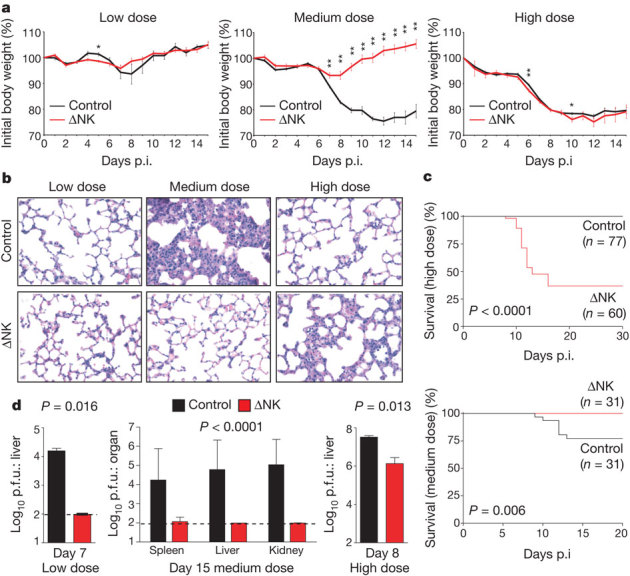
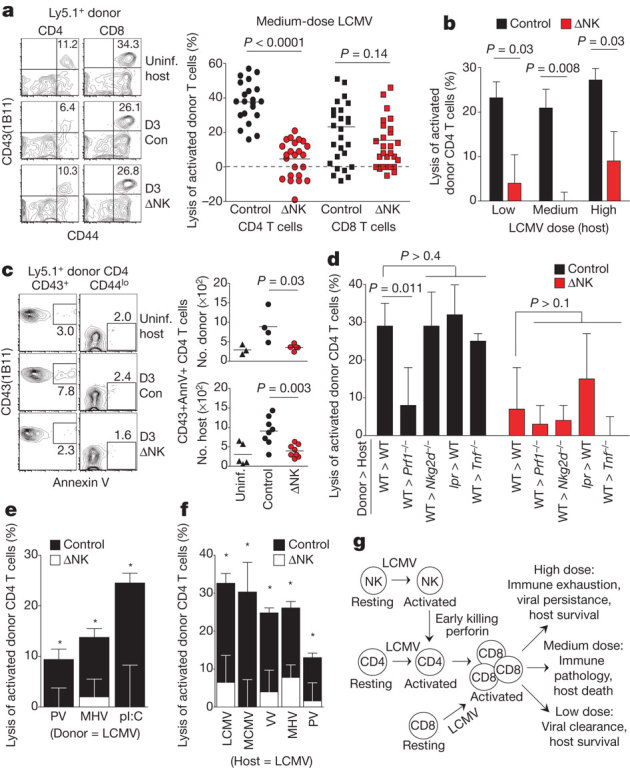
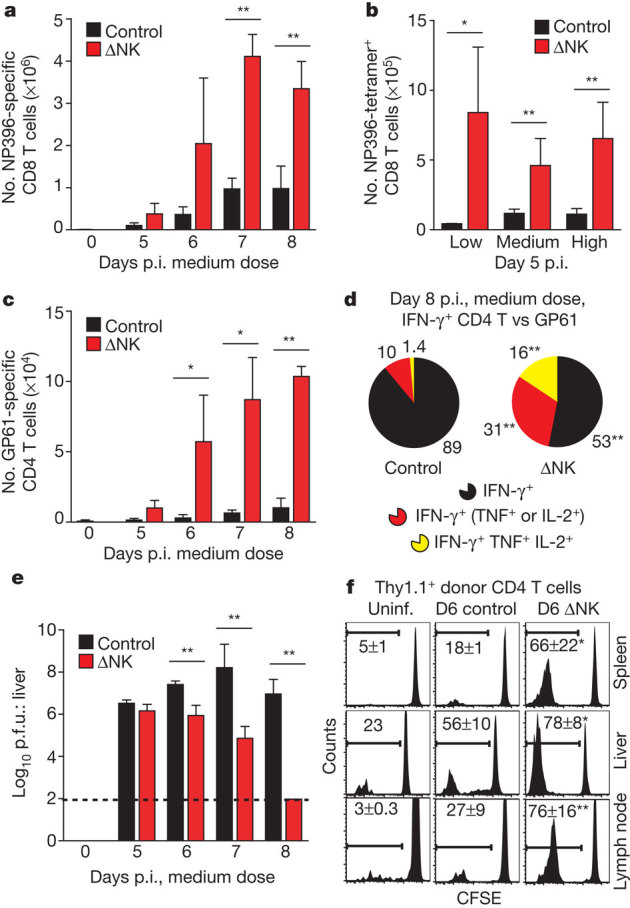
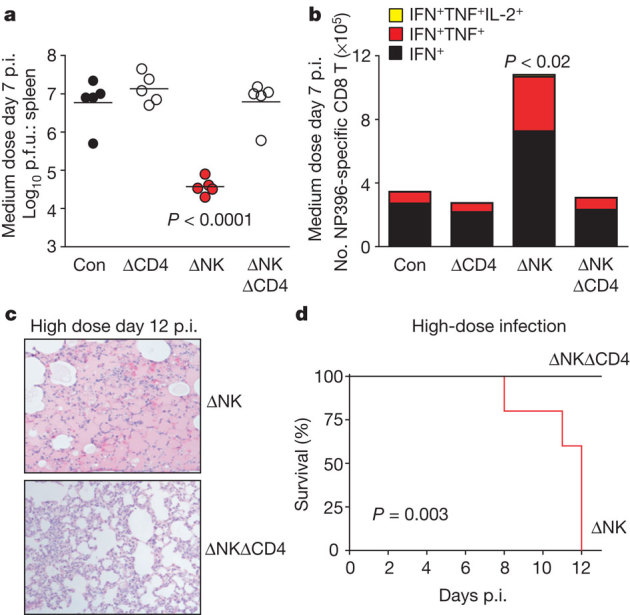
Antiviral T cells are thought to regulate whether hepatitis C virus (HCV) and human immunodeficiency virus (HIV) infections result in viral control, asymptomatic persistence or severe disease, although the reasons for these different outcomes remain unclear. Recent genetic evidence, however, has indicated a correlation between certain natural killer (NK)-cell receptors and progression of both HIV and HCV infection, implying that NK cells have a role in these T-cell-associated diseases. Although direct NK-cell-mediated lysis of virus-infected cells may contribute to antiviral defence during some virus infections--especially murine cytomegalovirus (MCMV) infections in mice and perhaps HIV in humans--NK cells have also been suspected of having immunoregulatory functions. For instance, NK cells may indirectly regulate T-cell responses by lysing MCMV-infected antigen-presenting cells. In contrast to MCMV, lymphocytic choriomeningitis virus (LCMV) infection in mice seems to be resistant to any direct antiviral effects of NK cells. Here we examine the roles of NK cells in regulating T-cell-dependent viral persistence and immunopathology in mice infected with LCMV, an established model for HIV and HCV infections in humans. We describe a three-way interaction, whereby activated NK cells cytolytically eliminate activated CD4 T cells that affect CD8 T-cell function and exhaustion. At high virus doses, NK cells prevented fatal pathology while enabling T-cell exhaustion and viral persistence, but at medium doses NK cells paradoxically facilitated lethal T-cell-mediated pathology. Thus, NK cells can act as rheostats, regulating CD4 T-cell-mediated support for the antiviral CD8 T cells that control viral pathogenesis and persistence.
抗病毒细胞被认为可以调节丙型肝炎病毒(HCV)和人类免疫缺陷病毒(HIV)感染是否导致病毒控制、无症状持续存在或严重疾病,尽管这些不同结果的原因仍不清楚。然而,最近的遗传证据表明,某些自然杀伤(NK)细胞受体与 HIV 和 HCV 感染的进展之间存在相关性,这意味着 NK 细胞在这些与 T 细胞相关的疾病中发挥作用。虽然 NK 细胞直接介导病毒感染细胞的裂解可能有助于某些病毒感染期间的抗病毒防御——特别是在小鼠中的巨细胞病毒(MCMV)感染和人类中的 HIV 感染——但 NK 细胞也被怀疑具有免疫调节功能。例如,NK 细胞可能通过裂解 MCMV 感染的抗原呈递细胞间接调节 T 细胞反应。与 MCMV 相反,小鼠中的淋巴细胞性脉络丛脑膜炎病毒(LCMV)感染似乎对 NK 细胞的任何直接抗病毒作用具有抗性。在这里,我们研究了 NK 细胞在调节感染 LCMV 的小鼠中的 T 细胞依赖性病毒持续存在和免疫病理学中的作用,LCMV 是人类 HIV 和 HCV 感染的既定模型。我们描述了一种三向相互作用,其中活化的 NK 细胞细胞毒性地消除了影响 CD8 T 细胞功能和衰竭的活化 CD4 T 细胞。在高病毒剂量下,NK 细胞防止了致命的病理,同时使 T 细胞衰竭和病毒持续存在,但在中等剂量下,NK 细胞反而促进了致命的 T 细胞介导的病理。因此,NK 细胞可以作为变阻器,调节 CD4 T 细胞介导的对控制病毒发病机制和持续存在的抗病毒 CD8 T 细胞的支持。