Division of Biotechnology, Advanced Radiation Technology Institute-ARTI, Korea Atomic Energy Research Institute-KAERI, 1266, Sinjeong-dong, Jeongeup, Jeonbuk 580-185, Korea.
Molecules. 2012 Aug 8;17(8):9462-8. doi: 10.3390/molecules17089462.
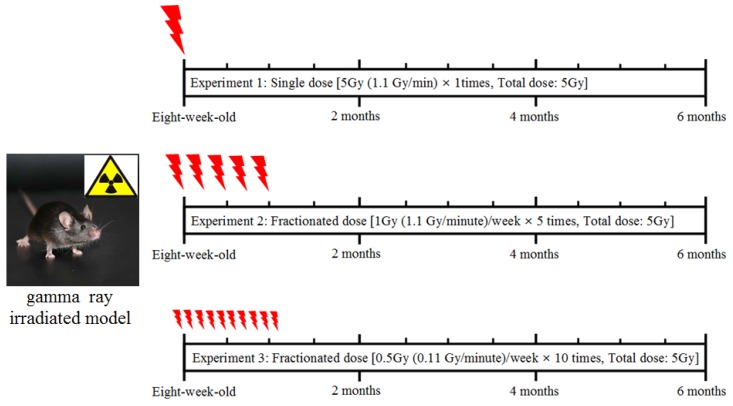
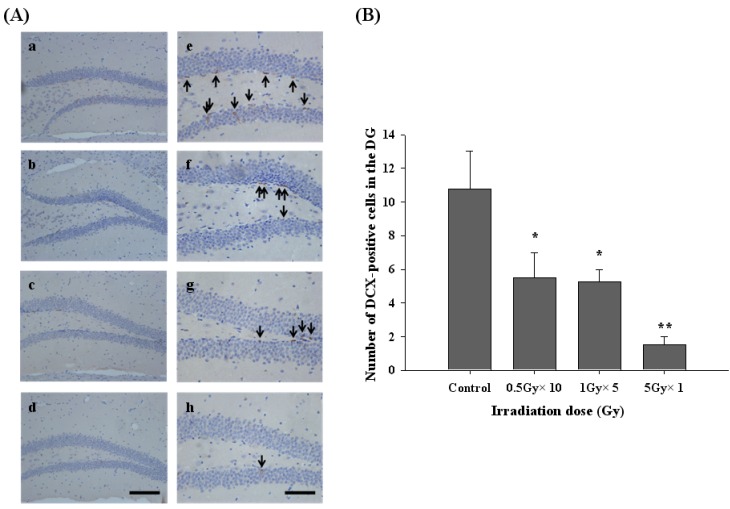
Ionizing radiation has become an inevitable health concern emanating from natural sources like space travel and from artificial sources like medical therapies. In general, exposure to ionizing radiation such as γ-rays is one of the methods currently used to stress specific model systems. In this study, we elucidated the long-term effect of acute and fractionated irradiation on DCX-positive cells in hippocampal neurogenesis. Groups of two-month-old C57BL/6 female mice were exposed to whole-body irradiation at acute dose (5 Gy) or fractional doses (1 Gy × 5 times and 0.5 Gy × 10 times). Six months after exposure to γ-irradiation, the hippocampus was analyzed. Doublecortin (DCX) immunohistochemistry was used to measure changes of neurogenesis in the subgranular zone (SGZ) of the hippocampal dentate gyrus (DG). The number of DCX-positive cells was significantly decreased in all acute and fractionally irradiation groups. The long-term changes in DCX-positive cells triggered by radiation exposure showed a very different pattern to the short-term changes which tended to return to the control level in previous studies. Furthermore, the number of DCX-positive cells was relatively lower in the acute irradiation group than the fractional irradiation groups (approximately 3.6-fold), suggesting the biological change on hippocampal neurogenesis was more susceptible to being damaged by acute than fractional irradiation. These results suggest that the exposure to γ-irradiation as a long-term effect can trigger biological responses resulting in the inhibition of hippocampal neurogenesis.
电离辐射已成为一个不可避免的健康问题,它源于自然来源,如太空旅行,也源于人工来源,如医疗疗法。一般来说,暴露于电离辐射,如γ射线,是目前用于强调特定模型系统的方法之一。在这项研究中,我们阐明了急性和分次照射对海马神经发生中 DCX 阳性细胞的长期影响。两组两个月大的 C57BL/6 雌性小鼠接受全身照射,急性剂量(5 Gy)或分次剂量(1 Gy×5 次和 0.5 Gy×10 次)。γ 射线照射 6 个月后,分析海马体。使用双皮质素(DCX)免疫组织化学测量海马齿状回(DG)颗粒下区(SGZ)神经发生的变化。所有急性和分次照射组的 DCX 阳性细胞数量均显著减少。辐射暴露引起的 DCX 阳性细胞的长期变化与短期变化的模式非常不同,在之前的研究中,短期变化往往会恢复到对照水平。此外,急性照射组的 DCX 阳性细胞数量相对低于分次照射组(约 3.6 倍),这表明海马神经发生的生物学变化对急性照射比分次照射更易受损。这些结果表明,γ 射线照射的长期影响可引发生物反应,导致海马神经发生抑制。