El Sayed Ma, Saeed Mh
Department of Conservative Dentistry, Ajman University, United Arab Emirates.
J Conserv Dent. 2012 Jul;15(3):249-52. doi: 10.4103/0972-0707.97950.
This in vitro study evaluated and compared sealing ability of Diadent BioAggregate (DBA) as a new root-end filling material (REFM) versus amalgam, intermediate restorative material (IRM) and white mineral trioxide aggregate (WMTA).
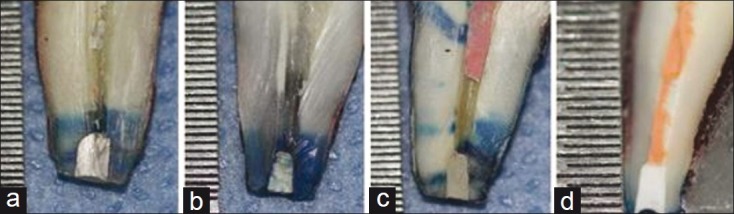
Crowns of sixty extracted human maxillary incisors were sectioned at the cemento-enamel junction (CEJ). All the roots were instrumented and obturated with gutta-percha and resin sealer. Obturated roots were divided randomly into 2 control groups and 4 experimental groups of 10 samples each. In the negative control group (group I), roots were kept without any further preparation. In the positive and experimental groups roots, were apically resected and root-end cavities were prepared and filled with: (a) gutta-percha (group 2-positive control group); (b) amalgam (group 3); (c) IRM (group 4); (d) WMTA (group 5); (e) DBA (group 6). Apical leakage was assessed using dye penetration technique. Data were submitted to statistical analysis by the one-way analysis of variance (ANOVA) and Tukey's test.
Significant difference of sealing ability was found among 4 tested groups. DBA followed by MTA showed the highest sealing ability.
DBA with its high sealing ability can be considered a possible alternative to MTA.
本体外研究评估并比较了Diadent生物聚合材料(DBA)作为一种新型根充材料与汞合金、中间修复材料(IRM)和白色三氧化矿物凝聚体(WMTA)的封闭能力。
将60颗拔除的人类上颌切牙在牙骨质-釉质界(CEJ)处截断。所有牙根均进行预备并用牙胶和树脂封闭剂充填。将充填后的牙根随机分为2个对照组和4个试验组,每组10个样本。阴性对照组(第I组)的牙根不做进一步预备。阳性对照组和试验组的牙根进行根尖切除,制备根端窝洞并分别充填:(a)牙胶(第2组-阳性对照组);(b)汞合金(第3组);(c)IRM(第4组);(d)WMTA(第5组);(e)DBA(第6组)。采用染料渗透技术评估根尖微渗漏情况。数据采用单因素方差分析(ANOVA)和Tukey检验进行统计学分析。
4个试验组的封闭能力存在显著差异。DBA其次是MTA显示出最高的封闭能力。
具有高封闭能力的DBA可被认为是MTA的一种可能替代材料。