Department of Obstetrics and Gynecology, Soroka University Medical Center, School of Medicine, Faculty of Health Sciences, Ben Gurion University of the Negev, P O Box 151, Beer Sheva, 84101, Israel.
BMC Pregnancy Childbirth. 2012 Aug 10;12:82. doi: 10.1186/1471-2393-12-82.
To determine whether patients with placenta previa who delivered preterm have an increased risk for recurrent spontaneous preterm birth.
This retrospective population based cohort study included patients who delivered after a primary cesarean section (n = 9983). The rate of placenta previa, its recurrence, and the risk for recurrent preterm birth were determined.
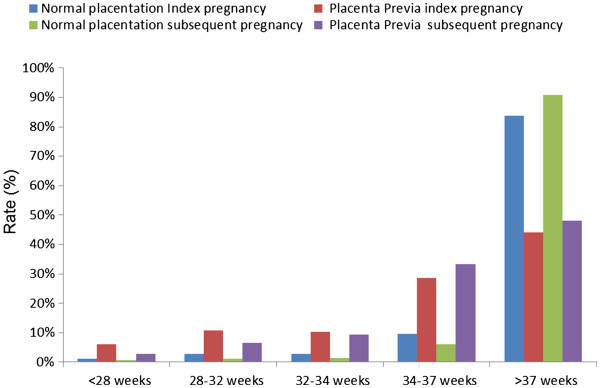
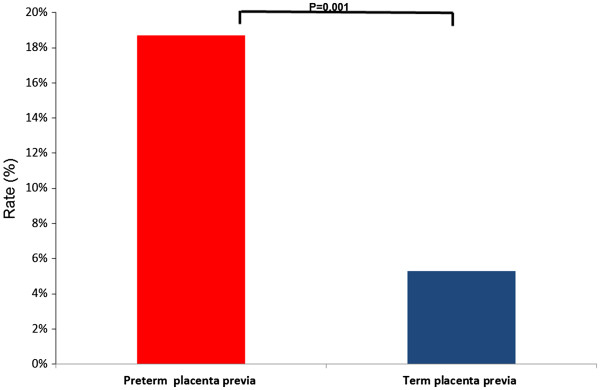
Patients who had a placenta previa at the primary CS pregnancy had an increased risk for its recurrence [crude OR of 2.65 (95% CI 1.3-5.5)]. The rate of preterm birth in patients with placenta previa in the primary CS pregnancy was 55.9%; and these patients had a higher rate of recurrent preterm delivery than the rest of the study population (p < .001). Among patients with placenta previa in the primary CS pregnancy, those who delivered preterm had a higher rate of recurrent spontaneous preterm birth regardless of the location of their placenta in the subsequent delivery [OR 3.09 (95% CI 2.1-4.6)]. In comparison to all patients with who had a primary cesarean section, patients who had placenta previa and delivered preterm had an independent increased risk for recurrent preterm birth [OR of 3.6 (95% CI 1.5-8.5)].
Women with placenta previa, who deliver preterm, especially before 34 weeks of gestation, are at increased risk for recurrent spontaneous preterm birth regardless to the site of placental implantation in the subsequent pregnancy. Thus, strict follow up by high risk pregnancies specialist is recommended.
为了确定是否患有前置胎盘并早产的患者再次发生自发性早产的风险增加。
本回顾性基于人群的队列研究纳入了因初次剖宫产分娩的患者(n=9983)。确定了前置胎盘的发生率、其复发率以及再次早产的风险。
初次剖宫产时患有前置胎盘的患者其复发风险增加[粗 OR 2.65(95%CI 1.3-5.5)]。初次剖宫产时患有前置胎盘的患者早产率为 55.9%;与研究人群的其余部分相比,这些患者再次早产的发生率更高(p<0.001)。在初次剖宫产时患有前置胎盘的患者中,无论其胎盘在随后分娩中的位置如何,早产患者再次发生自发性早产的风险更高[OR 3.09(95%CI 2.1-4.6)]。与所有初次剖宫产的患者相比,前置胎盘且早产的患者再次早产的风险独立增加[OR 3.6(95%CI 1.5-8.5)]。
前置胎盘且早产的患者,尤其是在妊娠 34 周之前早产的患者,再次发生自发性早产的风险增加,无论其胎盘在随后妊娠中的植入部位如何。因此,建议高危妊娠专科医生对其进行严格随访。