
利用尿沉渣蛋白质组谱检测膀胱癌。
Detection of bladder cancer using proteomic profiling of urine sediments.
机构信息
Department of Pathology, The University of Texas MD Anderson Cancer Center, Houston, Texas, United States of America.
出版信息
PLoS One. 2012;7(8):e42452. doi: 10.1371/journal.pone.0042452. Epub 2012 Aug 3.
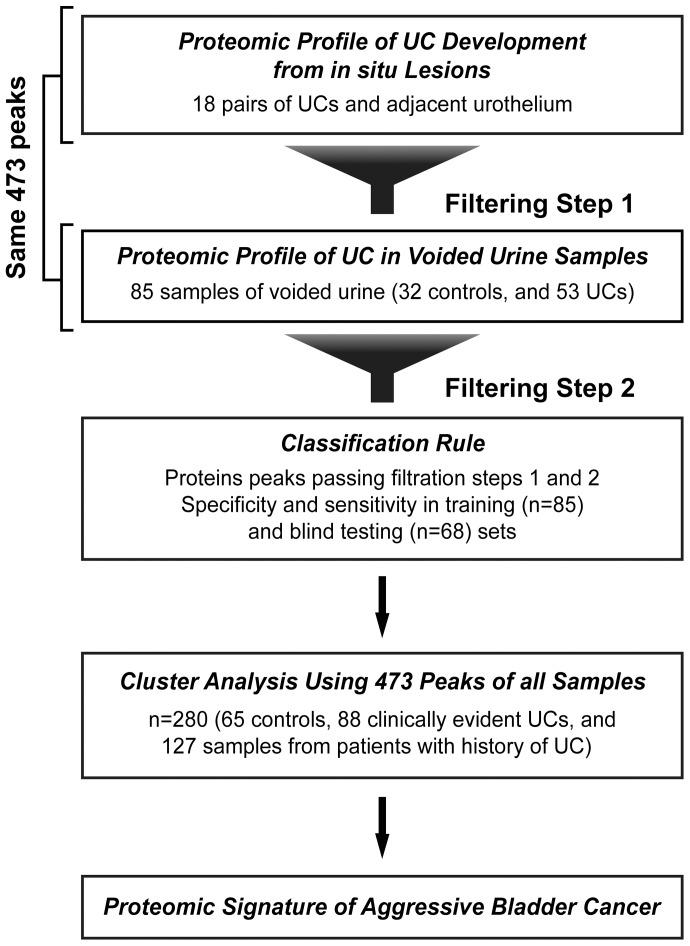
We used protein expression profiles to develop a classification rule for the detection and prognostic assessment of bladder cancer in voided urine samples. Using the Ciphergen PBS II ProteinChip Reader, we analyzed the protein profiles of 18 pairs of samples of bladder tumor and adjacent urothelium tissue, a training set of 85 voided urine samples (32 controls and 53 bladder cancer), and a blinded testing set of 68 voided urine samples (33 controls and 35 bladder cancer). Using t-tests, we identified 473 peaks showing significant differential expression across different categories of paired bladder tumor and adjacent urothelial samples compared to normal urothelium. Then the intensities of those 473 peaks were examined in a training set of voided urine samples. Using this approach, we identified 41 protein peaks that were differentially expressed in both sets of samples. The expression pattern of the 41 protein peaks was used to classify the voided urine samples as malignant or benign. This approach yielded a sensitivity and specificity of 59% and 90%, respectively, on the training set and 80% and 100%, respectively, on the testing set. The proteomic classification rule performed with similar accuracy in low- and high-grade bladder carcinomas. In addition, we used hierarchical clustering with all 473 protein peaks on 65 benign voided urine samples, 88 samples from patients with clinically evident bladder cancer, and 127 samples from patients with a history of bladder cancer to classify the samples into Cluster A or B. The tumors in Cluster B were characterized by clinically aggressive behavior with significantly shorter metastasis-free and disease-specific survival.
我们利用蛋白质表达谱开发了一种分类规则,用于检测和预测膀胱癌患者尿液样本中的膀胱癌。使用Ciphergen PBS II ProteinChip 读取器,我们分析了 18 对膀胱肿瘤和相邻尿路上皮组织样本、85 份尿液样本(32 份对照和 53 份膀胱癌)的训练集以及 68 份尿液样本(33 份对照和 35 份膀胱癌)的盲测试集的蛋白质图谱。通过 t 检验,我们发现了 473 个峰,这些峰在不同类别的配对膀胱肿瘤和相邻尿路上皮样本与正常尿路上皮样本相比显示出明显的差异表达。然后,我们在尿液样本的训练集中检查了这 473 个峰的强度。通过这种方法,我们在两组样本中都鉴定出了 41 个差异表达的蛋白质峰。这 41 个蛋白质峰的表达模式用于将尿液样本分类为恶性或良性。这种方法在训练集上的灵敏度和特异性分别为 59%和 90%,在测试集上的灵敏度和特异性分别为 80%和 100%。蛋白质组学分类规则在低级别和高级别膀胱癌中具有相似的准确性。此外,我们使用所有 473 个蛋白质峰对 65 份良性尿液样本、88 份有临床明显膀胱癌的样本和 127 份有膀胱癌病史的样本进行了层次聚类,将样本分为 A 组或 B 组。B 组的肿瘤具有侵袭性的临床行为,无转移和疾病特异性生存率明显缩短。



 Zotero 插件