Mosaiques Diagnostics GmbH, Mellendorfer Strasse 7-9, D-30625 Hannover, Germany.
Clin Transl Med. 2014 Mar 29;3(1):7. doi: 10.1186/2001-1326-3-7.
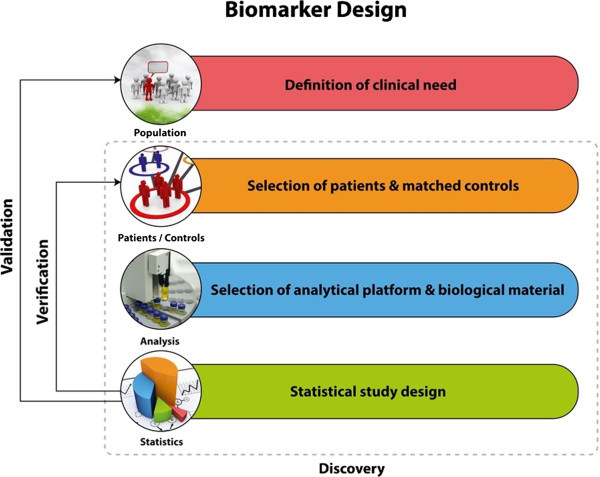
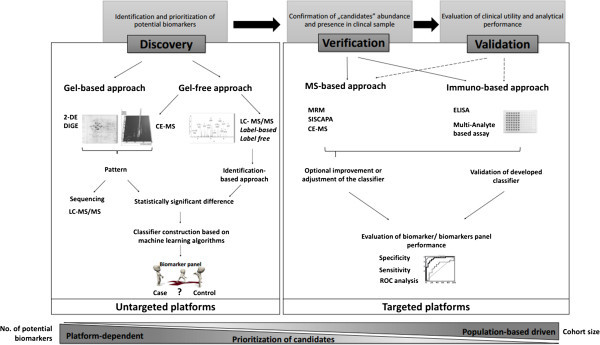
Biomarker research is continuously expanding in the field of clinical proteomics. A combination of different proteomic-based methodologies can be applied depending on the specific clinical context of use. Moreover, current advancements in proteomic analytical platforms are leading to an expansion of biomarker candidates that can be identified. Specifically, mass spectrometric techniques could provide highly valuable tools for biomarker research. Ideally, these advances could provide with biomarkers that are clinically applicable for disease diagnosis and/ or prognosis. Unfortunately, in general the biomarker candidates fail to be implemented in clinical decision making. To improve on this current situation, a well-defined study design has to be established driven by a clear clinical need, while several checkpoints between the different phases of discovery, verification and validation have to be passed in order to increase the probability of establishing valid biomarkers. In this review, we summarize the technical proteomic platforms that are available along the different stages in the biomarker discovery pipeline, exemplified by clinical applications in the field of bladder cancer biomarker research.
生物标志物研究在临床蛋白质组学领域不断扩展。可以根据特定的临床应用背景,结合不同的基于蛋白质组学的方法。此外,蛋白质组学分析平台的当前进展正在导致可识别的生物标志物候选物的扩展。具体来说,质谱技术可以为生物标志物研究提供非常有价值的工具。理想情况下,这些进展可以提供用于疾病诊断和/或预后的临床适用的生物标志物。不幸的是,一般来说,生物标志物候选物未能在临床决策中得到实施。为了改善这种现状,必须根据明确的临床需求制定明确的研究设计,同时在发现、验证和验证的不同阶段之间要通过几个检查点,以提高建立有效生物标志物的可能性。在这篇综述中,我们总结了在生物标志物发现管道的不同阶段可用的技术蛋白质组学平台,通过膀胱癌生物标志物研究领域的临床应用为例进行了说明。